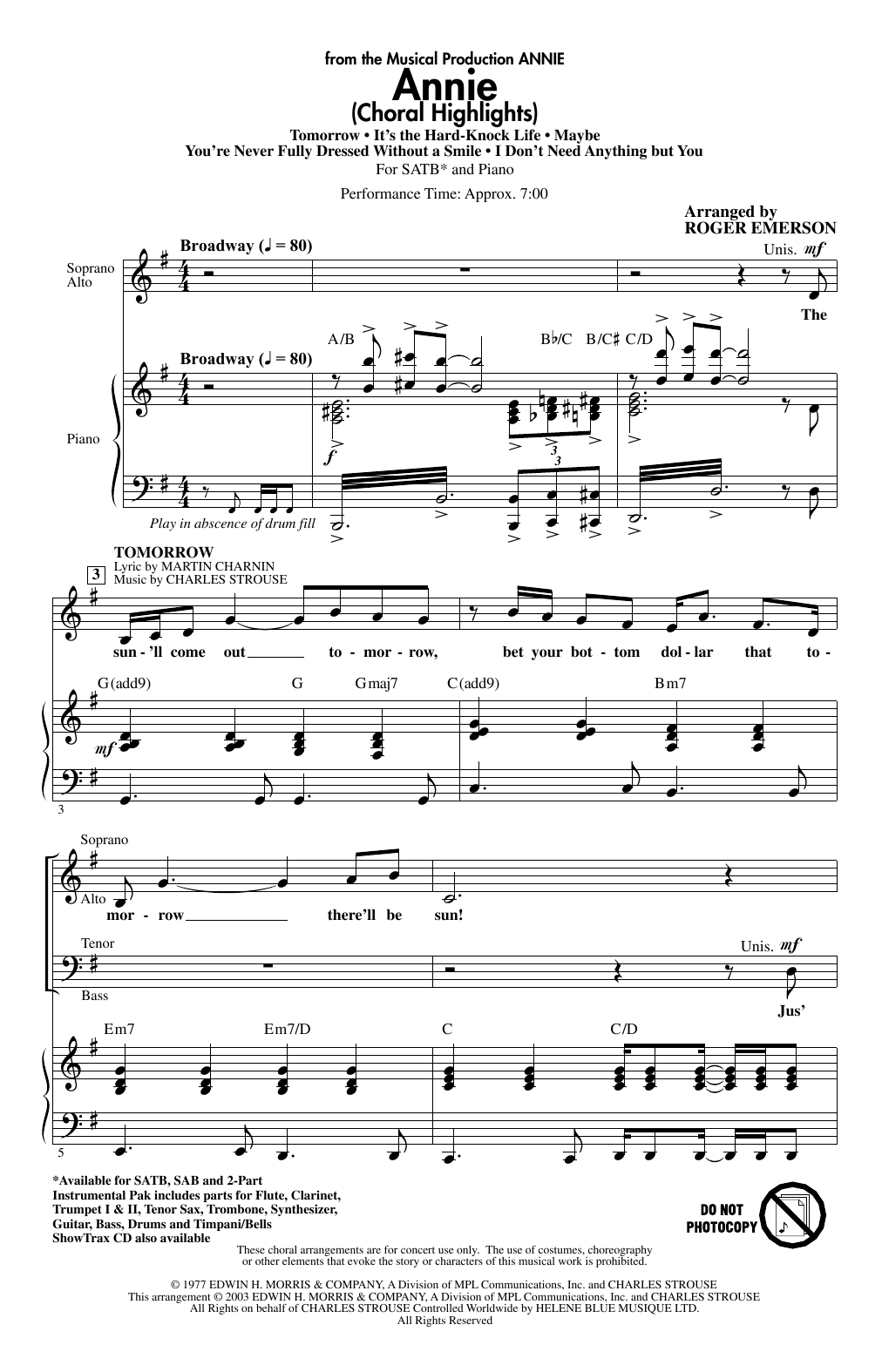
Charles Strouse composed the score for Annie in 1977, creating one of Broadway's most enduring and accessible musicals. His gift for writing memorable melodies that work across vocal ranges and ability levels made Annie a staple of school choirs, community theaters, and professional productions alike. Strouse's background in musical theater composition gave him an instinct for songs that serve both entertainment and emotional storytelling.
Why we love this
Roger Emerson's choral arrangement distills the heart of Annie into a singable, energizing package that works for intermediate choirs without requiring a full orchestra or soloists. The highlights approach lets you program recognizable moments from the show without committing to the entire musical, making it ideal for concert variety or as a gateway into longer Broadway projects. Audiences recognize these melodies instantly, which means your singers get the satisfaction of performing music people actually know and love.
What to expect
Bright, spirited, and genuinely hopeful. These highlights capture the scrappy optimism that defines Annie, with melodies that sit comfortably in the middle of the staff and harmonies that support rather than complicate the lines. There's a directness and warmth here that makes singers feel like they're telling a story rather than navigating technical challenges.
Who it's for
Intermediate to advanced high school and community choirs looking for Broadway repertoire that's both musically satisfying and programmatically flexible. Directors who want material that engages singers without requiring complex staging or elaborate production elements will find this arrangement particularly useful.
How to get the most out of it
Balance the melodic material carefully between sections so the main themes stay prominent even when multiple voice parts are active; this is especially important in unison passages where clarity matters more than blend.
Trust the rhythmic drive of the accompaniment to carry momentum through longer phrases; resist the urge to over-phrase or add extra breath marks where the arranger hasn't indicated them.
Lean into the optimism and directness of these songs rather than trying to add sophistication that isn't there; the musical language is deliberately bright and uncomplicated.
How to use it
This works beautifully as the centerpiece of a pops or Broadway concert, or as a shorter alternative when you want the charm of Annie without the time commitment of a full musical production. It also pairs well with other Strouse material or period Broadway selections if you're building a Golden Age of Musical Theater program. Consider programming it mid-concert where the energy and familiarity can lift audience engagement.
Skills your students will build
Singing through longer melodic phrases without unnecessary breath breaks
Balancing ensemble texture when multiple voice parts carry thematic material
Musical theater diction and stylistic consistency across repeated musical sections
Responding to accompaniment-driven cues and maintaining tempo independence from the band
You May Also Like
Scan to Complete Your Purchase
Use your phone's camera to scan the code below
You'll log in on your phone and the order will be added to your account