
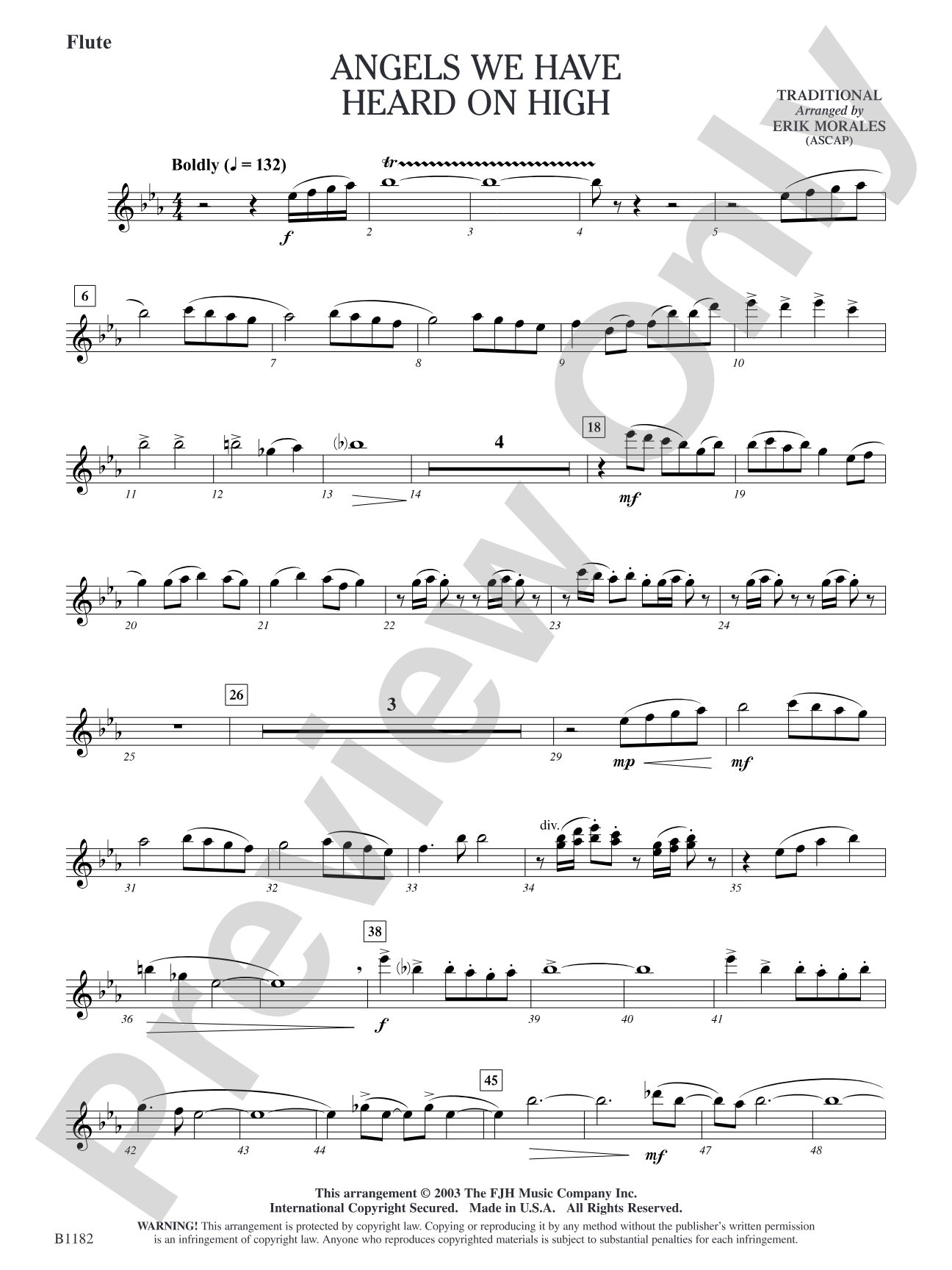

Angels We Have Heard on High: Flute
Arranged by Erik Morales
Grade: 2.5
Item: 98-PC-DB1182_F1
$7.00
Pickup currently not available
Description
Many directors express the need for more involved literature that is appropriate for holiday concerts. This excellent arrangement provides a wealth of teaching potential while staying well within the technical abilities of young musicians. A heroic fanfare subsides into a beautiful treatment of the melody that continues to evolve through several settings. A powerful conclusion makes this a must for your next program. Be sure to listen to this one!


Discover MakeMusic Cloud: thousands of interactive titles your students can play along with today.
Sample Audio
1
Audio File
--:--
0:00
0:00
Sample Video
No sample videos found.
Additional Details
Series:
FJH Young Band
Publisher:
The FJH Music Company, Inc.
SKU:
98-PC-DB1182_F1
More about this title
About the Composer: Erik Morales

Erik Morales has spent his career building a bridge between artistic integrity and classroom viability. Since his high school band director first hired him to arrange marching music in 1985, he has published over 150 works across wind, orchestral, jazz, and chamber settings, with his music performed internationally. His formal training at Florida International University and the University of Louisiana, Lafayette (completed 1989) gave him the tools, but his years working directly in educational contexts shaped his compositional voice.
A trumpeter himself, Morales has earned particular recognition for his contributions to the trumpet repertoire. His chamber works won first place at the National Trumpet Competitions in 2006 and 2008, and his Concerto for Two Trumpets premiered at the 2013 International Trumpet Guild conference. Beyond concert works, he receives regular commissions from schools and organizations nationwide, consistently seeking that balance between music that challenges students intellectually and remains achievable within a rehearsal season.
Why we love this
Morales understands exactly what young ensembles can accomplish when given material with real musical substance. The opening fanfare immediately signals that this arrangement carries weight, yet the voice leading and technical demands stay grounded in Grade 2.5 reality. What keeps directors coming back to his holiday work is the sense of purposeful evolution, the melody doesn't just repeat; it actually becomes something different each time.
What to expect
The piece opens with ceremonial brightness that immediately commands attention, then invites the ensemble into something more intimate and reflective. As the familiar melody passes between voices and undergoes subtle transformations, it feels less like a simple arrangement and more like a fresh discovery of the carol itself. The journey concludes with real power, leaving both musicians and audience with a sense of accomplishment.
Who it's for
Directors programming holiday concerts who want their Grade 2 and 2.5 bands to play something with genuine architecture and musical purpose. This works equally well for groups that thrive on melodic clarity and those with stronger harmonic sophistication.
How to get the most out of it
- Shape the opening fanfare with clear dynamic intention rather than playing it as a single gesture; the subsiding quality asks for precise control of the decrescendo.
- Let the ensemble settle into the lyrical section with patience, the beauty here lives in sustained tone and vertical alignment, not in rushing the phrasing.
- Balance the melodic evolution carefully as the piece unfolds; if the texture thickens, resist the urge to cover the original melody with harmonic weight.
- Prepare the powerful conclusion by building momentum gradually through the preceding measures rather than treating it as a sudden shift.
How to use it
Open a holiday concert with this if you want to establish that your young ensemble plays with both technical control and musical maturity. Alternatively, program it mid-concert as a thoughtful interlude between more energetic seasonal pops; the contrast will sharpen both pieces. It also pairs well with other carols at different grade levels, creating a cohesive holiday segment without feeling redundant.
Skills your students will build
- Dynamic control across sustained passages and subsiding gestures
- Balancing melody and harmony in multi-voice settings
- Recognizing and executing melodic variation across different orchestrations
- Maintaining phrase integrity while managing textural changes
- Ensemble precision in articulation shifts between fanfare and lyrical sections