
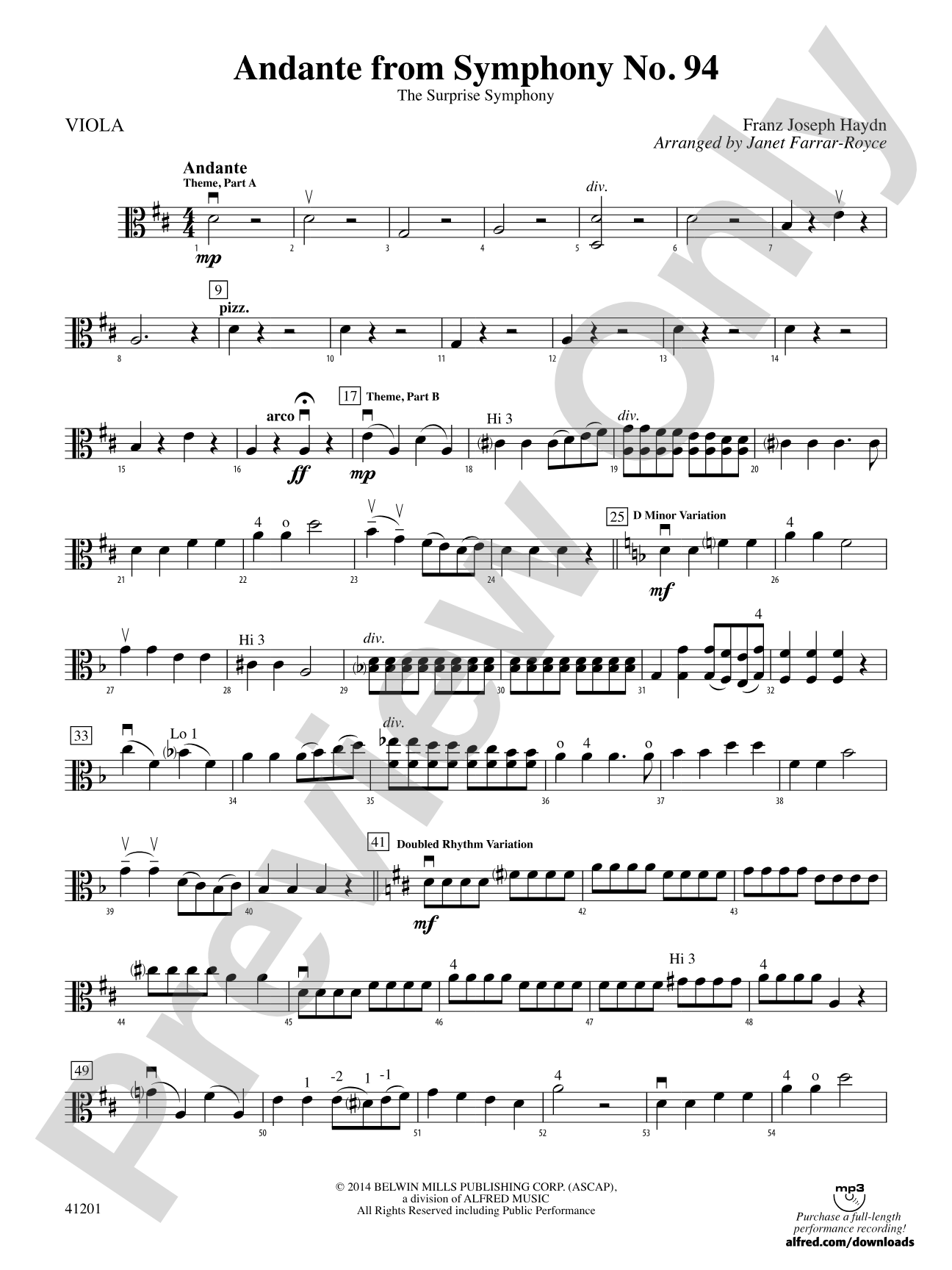

Andante from Symphony No. 94: Viola
The Surprise Symphony
By Franz Joseph Haydn / arr. Janet Farrar-Royce
Grade: 3
Item: 00-PC-0016328_VA1
$5.99
Pickup currently not available
Description
Perfect for festival, and ever a favorite, this lovely transcription shares the surprise with a new generation of students! (4:30) This title is available in MakeMusic Cloud.


Don't just read it, hear it, play along with it, and watch your students grow with it. In MakeMusic Cloud, Andante from Symphony No. 94: Viola comes alive with professional accompaniment, adjustable tempo, and built-in practice tools that turn solo practice into real progress.
Open in the Player
Jump straight in and assign it today.
Start Your Free Trial
Open this title and explore the full library in minutes.
Sample Audio
1
Audio File
--:--
0:00
0:00
Sample Video
No sample videos found.
Additional Details
Series:
Belwin Intermediate String Orchestra
Publisher:
Alfred Music
Page Count:
144
SKU:
00-PC-0016328_VA1
More about this title
About the Composer: Franz Joseph Haydn
Franz Joseph Haydn (1732-1809) shaped the symphony into one of music's most enduring forms. Working across nearly seven decades as a composer, kapellmeister, and innovator, Haydn moved between Vienna and the Esterházy court, building a catalog of over 100 symphonies that defined the Classical era's structural clarity and harmonic adventure.
For music educators, Haydn represents the intersection of craft and accessibility. His melodies sing naturally, his forms teach themselves through repetition and contrast, and his orchestrations reward both precision and expression from student musicians. The famous "Surprise" Symphony (No. 94) exemplifies why teachers turn to Haydn: it engages audiences, challenges young players proportionally to their abilities, and demonstrates that serious music can also be joyful.
Why we love this
This arrangement captures what makes the Surprise Symphony so effective in the classroom: instant melodic appeal, clear sectional structure, and a moment of genuine theatrical surprise that audiences recognize immediately. Grade 3 orchestration means every section stays engaged without overwrought divisi parts, and the piece finishes under 5 minutes, making it ideal for festivals where both pacing and impact matter.
What to expect
The opening unfolds with gentle grace, built on a simple melody that invites singers to move into instrumental color. The surprise erupts suddenly, a moment of delightful mischief that reminds us why Haydn's music has entertained and taught for centuries. Throughout, there's a sense of inevitability and proportion that comes from Classical form at its most elegant.
Who it's for
This transcription serves intermediate string orchestras preparing for festival performances or concert programming. String directors seeking repertoire that combines recognizable masterwork status with manageable technical demands will find this arrangement fits Grade 3 ensembles that have solid intonation and basic vibrato control.
How to get the most out of it
- Balance the opening melody between first and second violins so the familiar theme emerges clearly; the accompanying voices should support without drowning out the primary line.
- Prepare the sudden forte that introduces the surprise by rehearsing the dynamic contrast in isolation; young players often anticipate or diminish the shock if not locked into the exact cutoff.
- Shape the longer melodic phrases with subtle vibrato and air, particularly in the cello and viola lines, to avoid a static, detached sound in slower passages.
- Coordinate bowings across all sections during the running passages in the development; consistent articulation choices create forward momentum and ensemble cohesion.
How to use it
Program this as a standalone work on a concert where you want immediate audience recognition and engagement, or pair it with a contrasting contemporary piece to frame how far orchestration and harmonic language have evolved. It also serves beautifully as a festival warm-up piece that settles an orchestra into focused ensemble playing before tackling more demanding works.
Skills your students will build
- Executing dynamic contrast, particularly sudden shifts from piano to forte
- Sustaining tone quality across longer melodic phrases
- Maintaining ensemble balance across multiple voice parts in a homophonic texture
- Reading and playing standard Classical-era orchestral form
- Coordinating bowings and articulation across full string sections