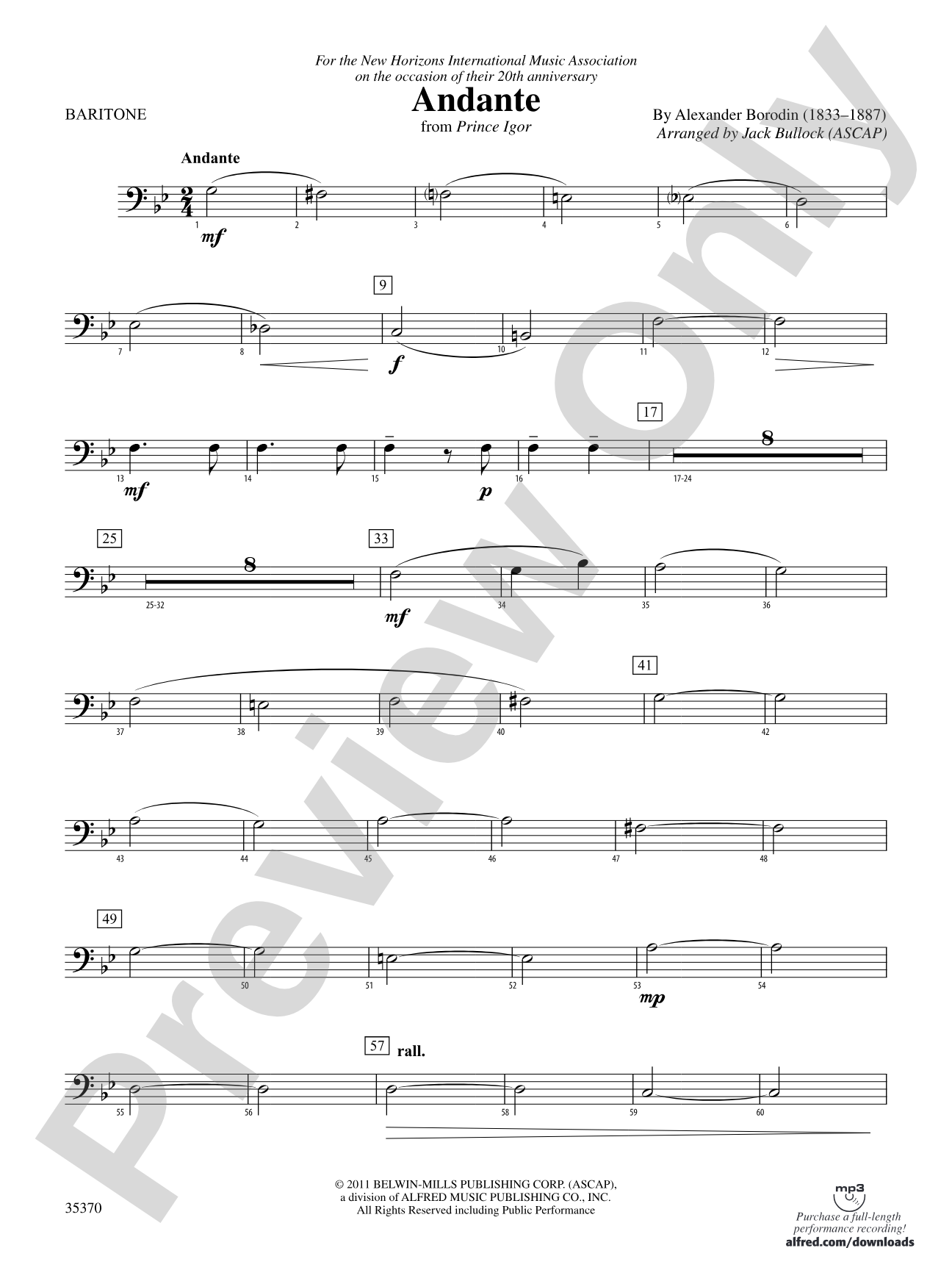
Andante (from Prince Igor): Baritone B.C. Sheet Music Preview

Andante (from Prince Igor): Baritone B.C.

By Alexander Borodin / arr. Jack Bullock

Grade: 2 (Easy)

Item: 00-PC-0014921_BBC1

Digital Download
$3.00
Description
Alexander Borodin (1833--1887) was a well-known Russian composer, particularly for his opera, Prince Igor. Borodin was in the middle of composing the piece when he suddenly died. Rimsky-Korsakov and another Russian composer, Alexander Glazanov, completed the unfinished score and the opera had its debut in November of 1890. During the overture prelude, a beautiful flowing melody from Act III, entitled "Andante," is an emotional addition to the young band literature. Most musical! This title is available in MakeMusic Cloud.

Don't just read it, hear it, play along with it, and watch your students grow with it. In MakeMusic Cloud, Andante (from Prince Igor): Baritone B.C. comes alive with professional accompaniment, adjustable tempo, and built-in practice tools that turn solo practice into real progress.

Sample Audio
0:00
0:00
Sample Video
Additional Details
Series: Belwin Young Band
Publisher: Alfred Music
Page Count: 210
SKU: 00-PC-0014921_BBC1

More about this title

About the Composer: Alexander Borodin

Alexander Borodin (1833-1887) was a Russian composer and chemist whose dual career made him one of the most distinctive voices of the Romantic era. Though he composed relatively little due to his scientific work, his operatic masterpiece Prince Igor stands as a monument to Russian musical nationalism, filled with sweeping melodies and rich orchestration that captured the spirit of his country.

Borodin died before completing Prince Igor, leaving the score unfinished. His colleagues Nikolai Rimsky-Korsakov and Alexander Glazanov took up the task of completion, and the opera premiered in 1890 to immediate acclaim. The "Andante" melody from Act III endures as one of the opera's most memorable moments, a lyrical gem that translates beautifully to the concert band medium.

Why we love this

This arrangement distills one of opera's great melodies into a piece that young bands can actually succeed with. The Grade 2 scoring lets every section carry the tune without drowning in orchestration, and the emotional weight of Borodin's writing gives students something genuinely expressive to sink their teeth into rather than endless technical patterns.

What to expect

The "Andante" unfolds with the unhurried beauty of a Russian winter landscape: lyrical, slightly melancholic, and deeply expressive. The melody flows like a folk song transformed by art music, a quality that makes it instantly singable and emotionally accessible to young musicians.

Who it's for

Young concert bands at the Grade 2 level, including middle school groups and beginning high school ensembles, will find this piece rewarding. Students encounter a genuine operatic masterwork arranged at an appropriate technical level, giving them access to the Romantic repertoire without frustration.

How to get the most out of it

  • Shape the phrases with a consistent, unhurried tempo; resist the urge to rush through the melody even as younger players build confidence.
  • Balance the melodic line between your first and second players so the tune speaks clearly without one voice overshadowing the other.
  • Use the conductor score to mark exactly where your principal voices are at any moment; this clarity helps section leaders know when they're accompanying versus carrying the phrase.

How to use it

Program this alongside other accessible Romantic-era selections to give your band exposure to orchestral literature beyond contemporary band compositions. It works beautifully as a slower contrasting piece in a concert that features faster, more energetic works, and it's substantial enough for a festival program without overextending your group.

Skills your students will build

  • Singing sustained melodic lines with expressive phrasing rather than mechanical counting
  • Balance between principal and supporting parts in a homorhythmic texture
  • Following subtle dynamic and tempo changes marked in the conductor score
  • Responding to legato articulation and long-breath musical thinking

You May Also Like