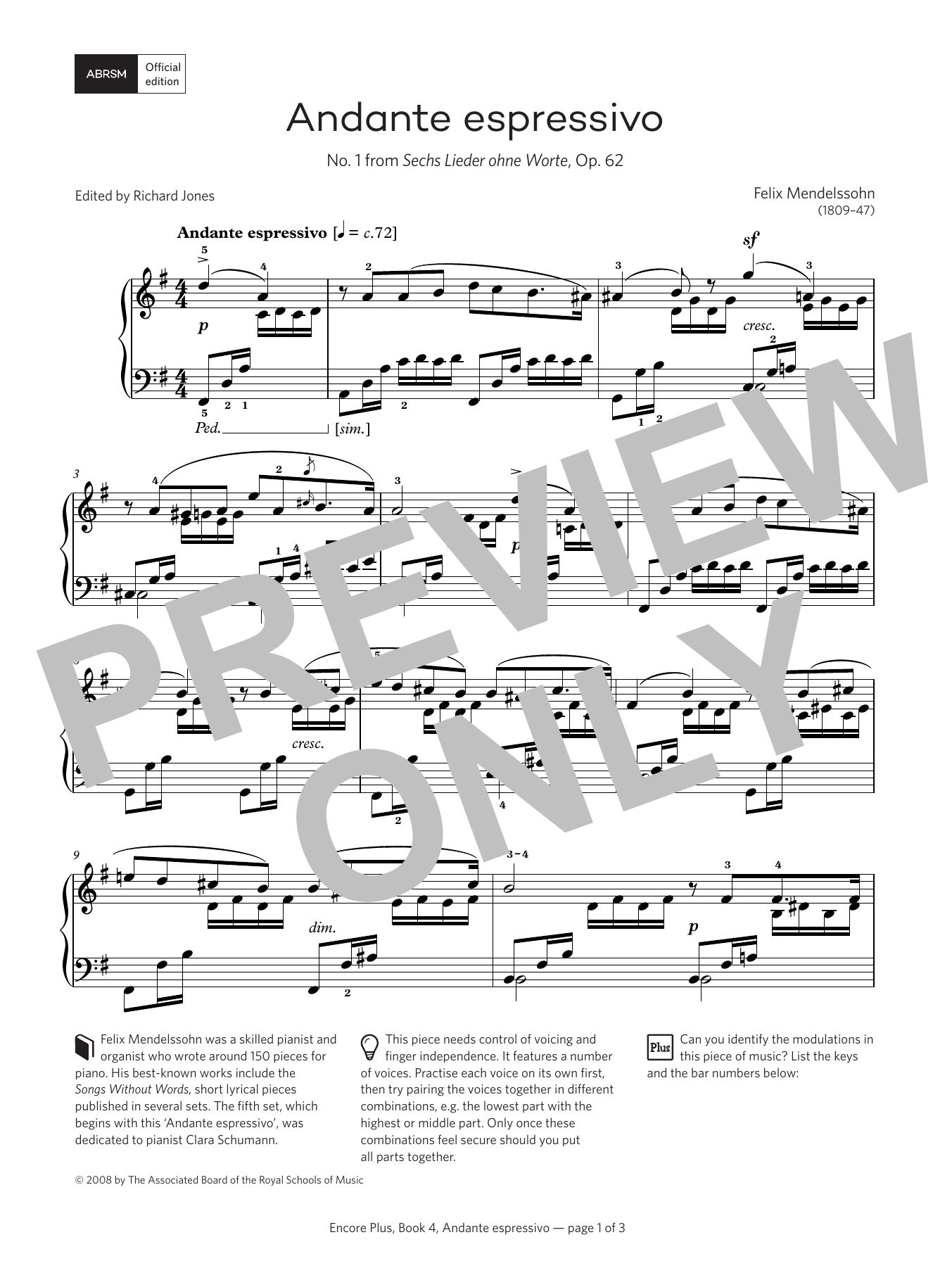
Andante espressivo (Encore Plus, Book 4) Sheet Music Preview

Andante espressivo (Encore Plus, Book 4): Piano Solo

By Felix Mendelssohn

Grade: 7

Item: 35-DS01989543

Digital Download
$4.99
Description

Discover MakeMusic Cloud: thousands of interactive titles your students can play along with today.

Sample Audio
No sample audio found.
Sample Video
Additional Details
Publisher: Hal Leonard
Page Count: 3
SKU: 35-DS01989543

More about this title

About the Composer: Felix Mendelssohn

Felix Mendelssohn (1809–1847) was a German composer whose command of form and orchestration shaped Romantic music across all genres. His piano works reveal an intimate, lyrical voice distinct from his symphonies and concertos; they were written for genuine domestic music-making and reflect his deep engagement with Bach and Baroque counterpoint alongside contemporary Romantic sensibility.

Mendelssohn's approach to the piano emphasized singing tone and architectural clarity. His pieces reward students who understand that Romantic expression doesn't require abandoning structural integrity; his melodies breathe, but they belong within larger musical designs.

Why we love this

Andante espressivo presents the genuine article: a piece that sounds difficult but rewards grade 7 pianists with immediate musical satisfaction. The writing balances expressive freedom with clear harmonic language, so students feel the shape of their phrase work rather than fight against muddled textures.

What to expect

Introspective and graceful, with a melody that sings above gently rolling accompaniment. The piece unfolds with quiet urgency, inviting performers to shape lyrical gestures within a compact, well-balanced form.

Who it's for

Grade 7 pianists working on Romantic repertoire who have solid technique and are ready to develop phrasing sophistication. Teachers seeking a genuine compositional voice for intermediate students will find this both accessible and artistically substantial.

How to get the most out of it

  • Shape the melody in three-bar phrases rather than treating each bar as a separate unit; this prevents rhythmic stiffness and lets the line breathe naturally.
  • Separate the harmonic accompaniment slightly from the lyrical line in touch and voicing; clarity here prevents the piece from sounding muddy at slower tempos.
  • Return to tempo after any ritardando with confidence; Mendelssohn's form depends on secure pacing to balance the expressive moments.
  • Listen through to the final cadence; resist the urge to slow down until the music explicitly asks for it.

How to use it

Program this as a recital interlude or as the opening to a Romantic piano suite. Its compact length and emotional directness also make it valuable for chamber contexts or as the centerpiece of a student showcase focused on 19th century solo literature.

Skills your students will build

  • Sustaining lyrical phrasing across harmonic changes
  • Balancing melodic line against Romantic-era accompaniment figures
  • Interpreting tempo and dynamic markings as structural elements rather than arbitrary ornaments
  • Voice leading awareness in a contrapuntal texture

You May Also Like