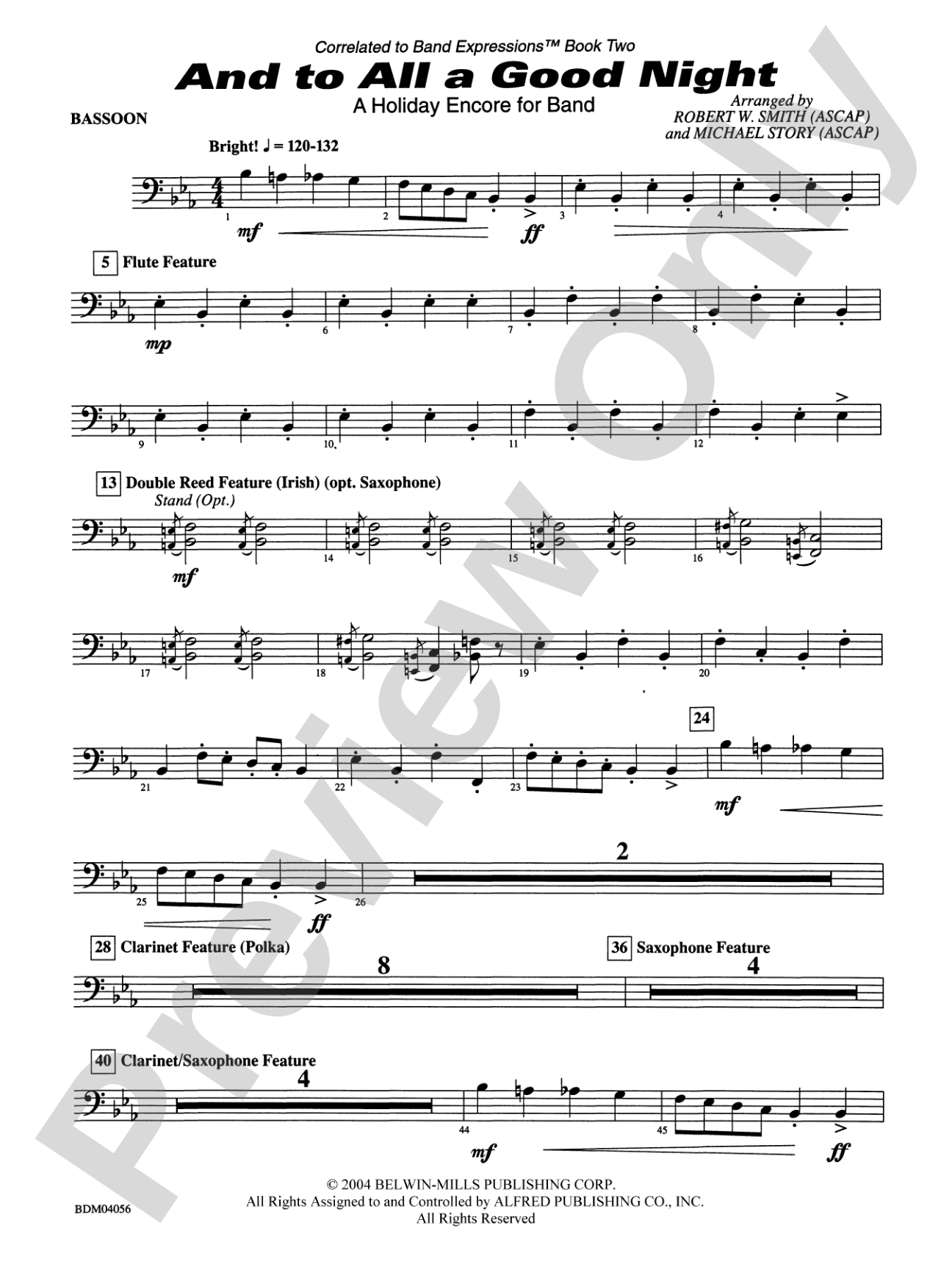
And to All a Good Night (A Holiday Encore for Band): Bassoon Sheet Music Preview

And to All a Good Night (A Holiday Encore for Band): Bassoon

A Holiday Encore for Band

Arr. Robert W. Smith and Michael Story

Grade: 1.5 (Very Easy to Easy)

Item: 00-PC-0002199_B1

Digital Download
$3.00
Description
Subtitled "A Holiday Encore for Band," this cheery arrangement of "Up on the Housetop" features virtually every section of the band with its own characteristic rendition. Ample cross cuing makes this attainable by every ensemble. Happy Holidays! (2:45)

Don't just read it, hear it, play along with it, and watch your students grow with it. In MakeMusic Cloud, And to All a Good Night (A Holiday Encore for Band): Bassoon comes alive with professional accompaniment, adjustable tempo, and built-in practice tools that turn solo practice into real progress.

Sample Audio
0:00
0:00
Sample Video
Additional Details
Series: Band Expressions
Publisher: Alfred Music
Page Count: 230
SKU: 00-PC-0002199_B1

More about this title

About the Arranger: Robert W. Smith

Robert W. Smith

Robert W. Smith stands among the most frequently performed composers and arrangers of concert band music in America, with over 400 published works to his credit. He holds degrees from Troy State University and the University of Miami, and his compositions have been performed by ensembles across North America, Europe, Australia, and Asia. His symphonies The Divine Comedy and The Odyssey, along with works like The Tempest, have become staples in the developing band repertoire.

Beyond the concert hall, Smith's arrangements have appeared on major television broadcasts, from the Macy's Thanksgiving Day Parade to Olympic opening ceremonies. He has served as a conductor and clinician internationally, bringing his deep understanding of band sonority and accessibility to ensembles at every level.

Why we love this

Smith and Story have taken a familiar melody and turned it into a genuine section feature showcase. Rather than a straightforward arrangement, this piece gives clarinet, trumpet, saxophone, and trombone their own distinctive musical moments, keeping every player engaged and invested. At Grade 1.5, the writing is genuinely accessible without feeling thin or oversimplified.

What to expect

Cheerful and spirited, with a sense of friendly competition as different sections take the spotlight. The arrangement bounces along with the lightheartedness of the original melody while maintaining genuine musicality and orchestration that respects the concert band sound.

Who it's for

Any concert band working at the Grade 1 to early Grade 2 level can successfully perform this arrangement. It suits holiday programs, festival closers, or any concert where you need an uplifting finale that keeps every player actively contributing.

How to get the most out of it

  • Let each section claim ownership of their rendition. The clarinet, trumpet, saxophone, and trombone passages each have distinct character; encourage players to listen to the arrangements written for other sections so they understand the full landscape.
  • The extensive cross cuing means you can perform this with confidence even if a chair is temporarily empty. Mark the primary part clearly in rehearsal so students know which line they're following.
  • Balance the festive energy without losing clarity. At 2:45, this encore thrives on buoyant articulation and clean attacks; resist the urge to drag the tempo despite the holiday context.
  • Use the concert band recording available separately as a reference for style and pacing, but trust your own ensemble's personality to shine through.

How to use it

Program this as a second-half encore or as the closing selection on a winter concert. Its brevity and accessible difficulty make it an ideal choice when you want to build confidence in younger ensembles or when you need a piece that brings genuine joy without overshadowing more substantial works earlier in the program.

Skills your students will build

  • Responding to section-specific scoring and balance adjustments
  • Reading and executing musical character changes across multiple arrangements of a single melody
  • Listening to ensemble sonority and blending within section-featured passages
  • Maintaining steady tempo and rhythmic confidence in an accessible yet musically substantive arrangement

You May Also Like