
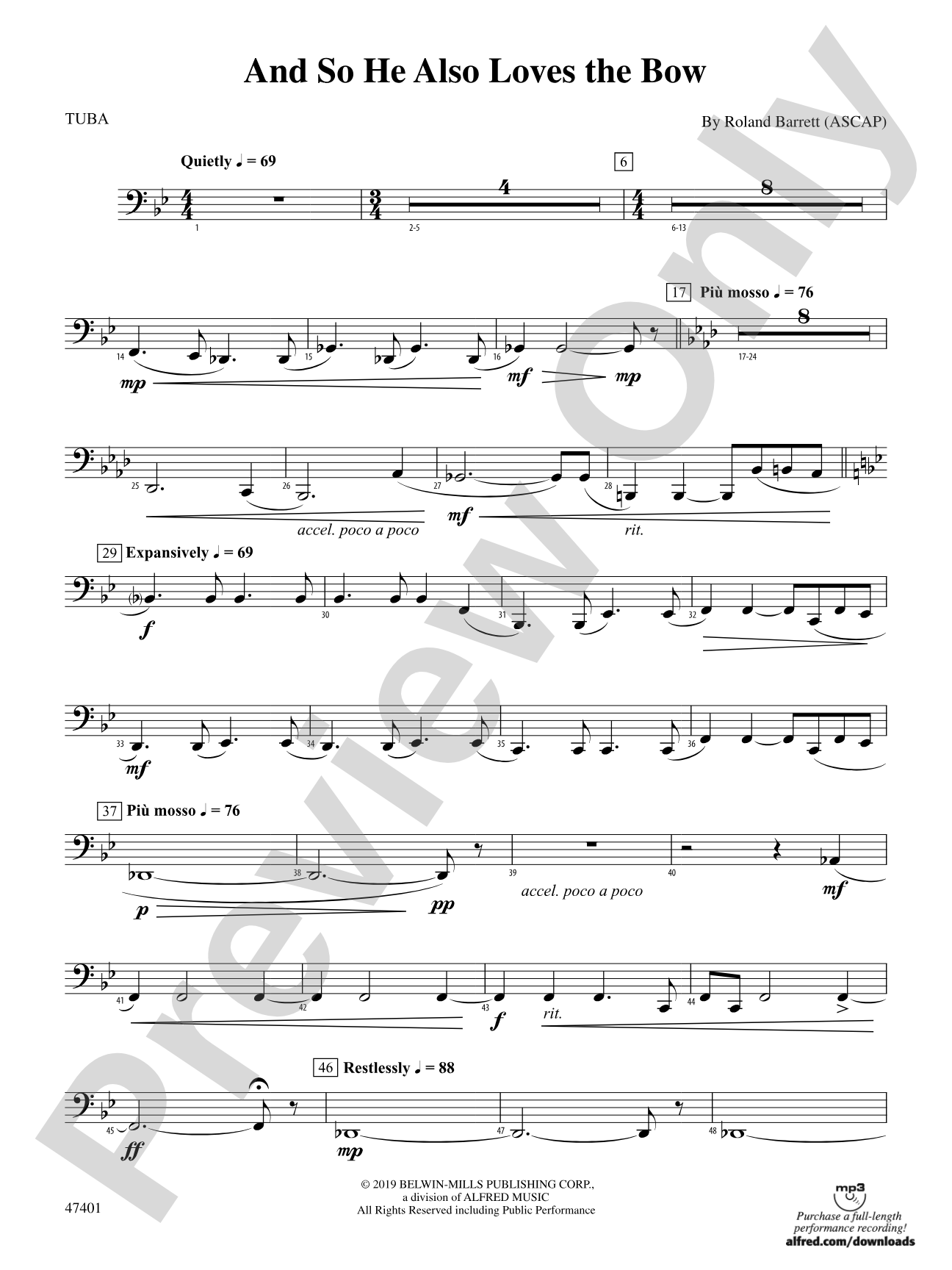

And So He Also Loves the Bow: Tuba
By Roland Barrett
Grade: 2.5 (Easy to Medium Easy)
Item: 00-PC-0017934_TB1
$3.00
Pickup currently not available
Description
Honoring four students who lost their lives, this powerful original work draws its title and its inspiration from poet Kahlil Gibran's "On Children." Like the poem, the composition musically invokes emptiness, restlessness and longing but provides reassurance to those grieving with peace, hope and optimism. (4:45)


Don't just read it, hear it, play along with it, and watch your students grow with it. In MakeMusic Cloud, And So He Also Loves the Bow: Tuba comes alive with professional accompaniment, adjustable tempo, and built-in practice tools that turn solo practice into real progress.
Open in the Player
Jump straight in and assign it today.
Start Your Free Trial
Open this title and explore the full library in minutes.
Sample Audio
1
Audio File
--:--
0:00
0:00
Sample Video
Additional Details
Series:
Belwin Young Band
Publisher:
Alfred Music
Page Count:
216
SKU:
00-PC-0017934_TB1
More about this title
About the Composer: Roland Barrett

Roland Barrett has shaped multiple generations of musicians through his work as both composer and educator. Since joining the University of Oklahoma's composition and theory faculty in 2001, he has mentored students across undergraduate and graduate levels while maintaining an active presence as arranger for the Pride of Oklahoma marching band.
Barrett's catalog includes over two hundred published works for symphonic band, chamber ensembles, and marching band. His compositions have earned performances by the Dallas Wind Symphony, countless All-State and All-Region Honor Bands, and broadcasts on NPR and the USA network. He is a multiple recipient of the ASCAPlus award and has been recognized at major conventions including the Midwest Band & Orchestra Conference and the International Trumpet Guild.
Why we love this
Barrett has written a work that tackles genuine emotional weight without requiring advanced technical demands from your ensemble. The Grade 2.5 instrumentation and straightforward harmonic language make this accessible to many programs, yet the musical architecture and sensitivity to Gibran's message create a piece that genuinely moves audiences and performers alike. This is thoughtful programming that respects both your students' developing skills and the occasion it serves.
What to expect
The music inhabits a liminal space between sorrow and solace. Moments of sparse, open voicings create the emptiness and longing referenced in its inspiration, while gentler harmonic movement offers quiet reassurance. There is no bombast here; instead, Barrett's orchestration allows silence and space to carry weight alongside the sustained lines and gentle textures of the band.
Who it's for
Concert bands at the Grade 2.5 level seeking meaningful repertoire that serves both musical development and community needs. This work is especially valuable for programs looking to address themes of loss and resilience through music, whether in memorial contexts, educational settings focused on emotional literacy, or festivals that welcome works with deeper purpose.
How to get the most out of it
- Balance the ensemble to allow the lyrical lines to emerge naturally; avoid the temptation to push volume in climactic sections at the expense of clarity and phrasing.
- Pay close attention to the harmonic progression during passages that suggest restlessness and longing; slight dynamic shaping through individual sections will help listeners follow the emotional arc.
- Give your students context about the work's memorial purpose during rehearsal. Understanding what the music honors will inform their interpretation and investment in achieving the subtle emotional shifts Barrett asks for.
- Use the recorded accompaniment as a rehearsal reference to hear how the parts interact, but encourage your band to find their own interpretive voice rather than mimicking the recording exactly.
How to use it
This piece functions powerfully as a concert centerpiece or as part of a program exploring themes of remembrance and hope. Its moderate length (4:45) makes it suitable for festival performance or as a reflective moment within a longer concert. Consider pairing it with contrasting works to frame a complete program, or program it as a standalone feature with brief contextual remarks from your conductor.
Skills your students will build
- Shaping lyrical melodic lines with sensitivity and restraint
- Balancing ensemble voice independence within a homophonic texture
- Responding to subtle dynamic and articulation changes that convey emotional meaning
- Sustaining tone quality and intonation during extended soft passages
- Understanding how harmonic color and orchestration contribute to musical storytelling