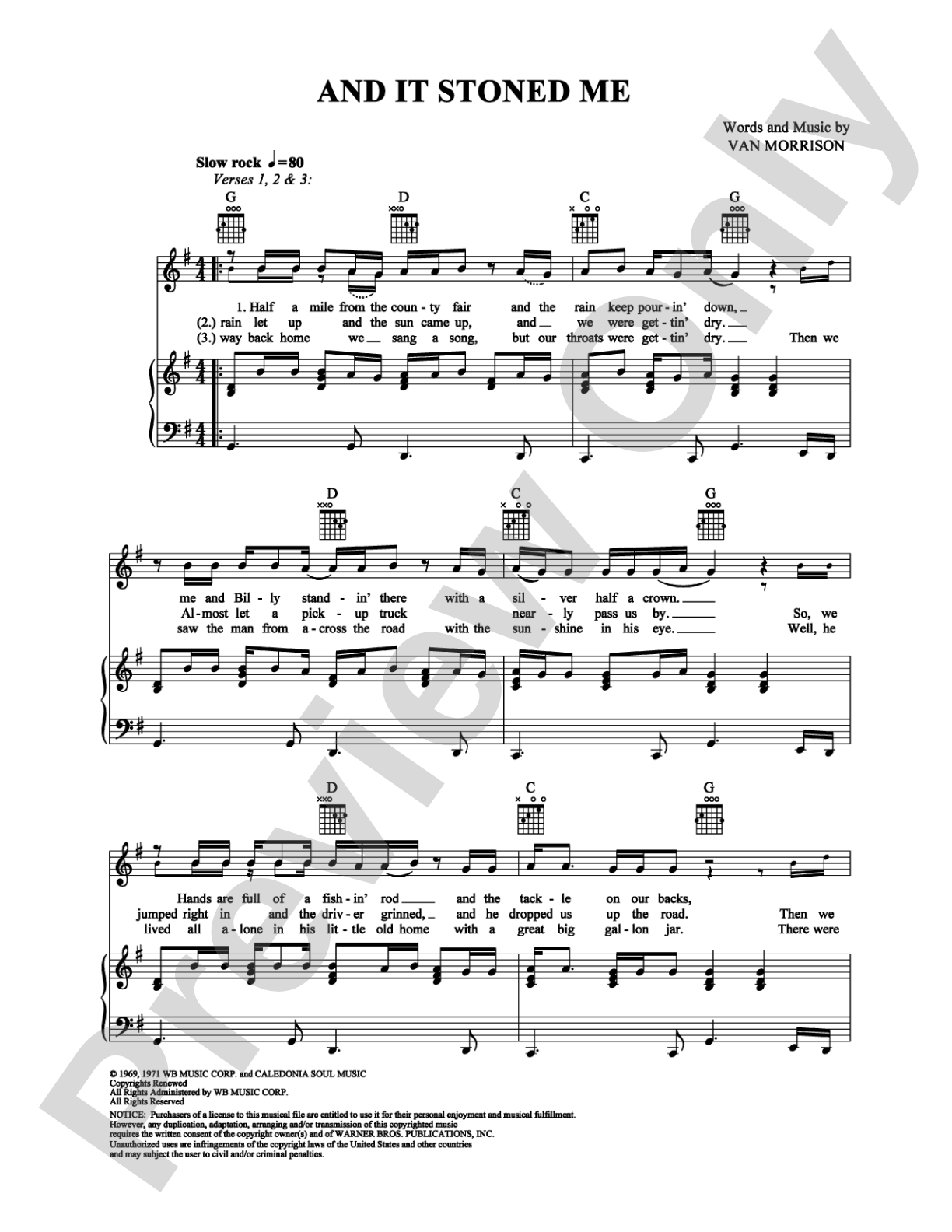
And It Stoned Me: Piano/Vocal/Chords Digital Sheet Music

And It Stoned Me: Piano/Vocal/Chords Digital Sheet Music

Van Morrison

Item: 00-PS-0005405

Digital Download
$3.99
Description

And It Stoned Me: Piano/Vocal/Chords Digital Sheet Music isn't in MakeMusic Cloud just yet...but it could be. Let us know you'd like to see it, and you'll help shape what comes next. In the meantime, start a free trial and dive into thousands of interactive titles your students can play along with today.

Sample Audio
No sample audio found.
Sample Video
Additional Details
SKU: 00-PS-0005405

More about this title

About the Artist: Van Morrison

Van Morrison is a Northern Irish singer-songwriter whose career spans from the 1960s to the present day. His distinctive vocal style and genre-blending approach to rock, soul, and folk have made him one of the most influential artists in popular music. Morrison's songwriting draws heavily from American blues and R&B traditions while incorporating Celtic and spiritual themes, earning him induction into the Rock and Roll Hall of Fame and recognition as a major figure in the development of rock and soul music.

His work remains central to contemporary music education contexts because of its harmonic sophistication, emotional directness, and accessibility for singers and pianists of intermediate to advanced ability. Songs like "And It Stoned Me" showcase his gift for narrative storytelling paired with memorable melodies, making them valuable repertoire for singers exploring adult contemporary and roots-influenced material.

Why we love this

This song captures Morrison's gift for capturing small, vivid moments of human experience in music that feels both immediate and timeless. The melody sits naturally for singers across ranges, and the harmonic movement gives pianists something genuinely interesting to work with, not overly complex, but rich with color and movement that rewards thoughtful playing.

What to expect

The song has a reflective, meandering quality that feels like an intimate conversation rather than a performance. Harmonically warm and rootsy, it balances rock elements with a folk-like simplicity that makes each lyric land clearly. The overall effect is one of unhurried storytelling, inviting both singer and pianist to inhabit the narrative space rather than rush through it.

Who it's for

This arrangement serves singers working at intermediate to advanced levels who are exploring contemporary adult and pop-rock repertoire. It works equally well for private voice students building interpretive skills, singers preparing audition material, and ensembles programming acoustic or stripped-down arrangements alongside classical art song. Pianists accompanying vocalists will find it a natural fit for collaborative repertoire study.

How to get the most out of it

  • Treat the melody as speech-inflected rather than metrically rigid; Morrison's phrasing often sits slightly ahead of or behind the beat, so listen carefully to a reference recording and shape your phrases to match that conversational quality.
  • Build the dynamic arc gradually across verses rather than front-loading intensity; let the storytelling carry the first verse, then deepen the emotional commitment in later sections.
  • Balance the piano part so it supports rather than leads; the voice should feel like the primary voice in the room, with accompaniment providing harmonic and rhythmic context.
  • Pay attention to chord voicings and inversions in the sheet music; they often suggest specific emotional colors that change subtly from verse to verse, so honor those details rather than playing generic block chords.

How to use it

Program this as a bridge piece between classical song literature and contemporary singer-songwriter material, especially if you're building a recital or showcase that spans genres. It works beautifully in a set with other Van Morrison songs or in a thematic program exploring narrative and storytelling in popular song. It's also an excellent choice for a collaborative recital emphasizing piano and voice partnership.

Skills your students will build

  • Interpreting conversational phrasing and rhythmic flexibility in melody
  • Reading lead-sheet chord symbols and translating them into pianistic voicings
  • Balancing accompaniment texture so it supports rather than competes with the vocal line
  • Understanding harmonic progression in contemporary popular song
  • Developing interpretive choices that honor the style while allowing for personal expression

You May Also Like