
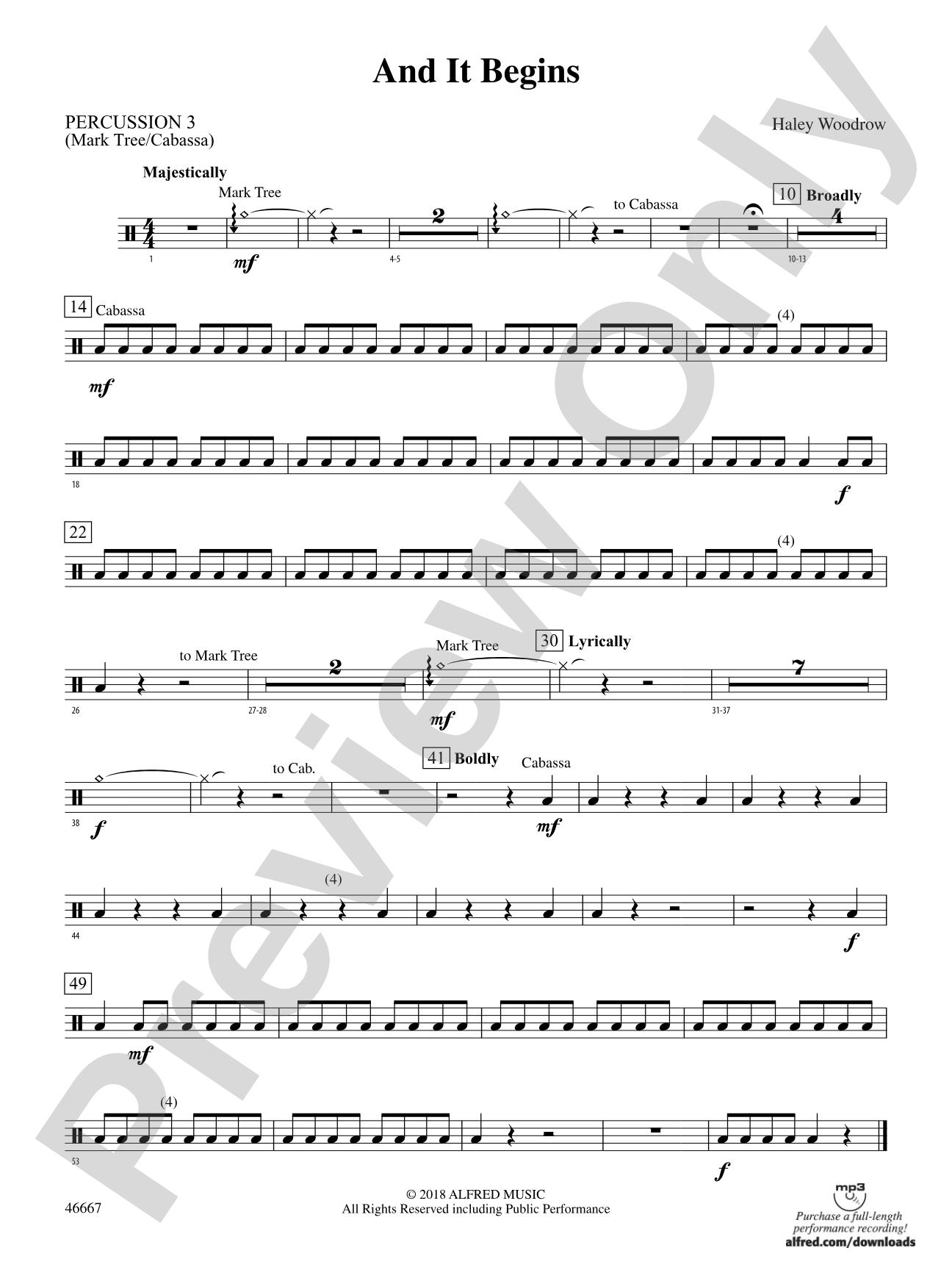

And It Begins: 3rd Percussion
By Haley Woodrow
Grade: 2 (Medium Easy)
Item: 00-PC-0017806_PC3
$5.99
Pickup currently not available
Description
"And It Begins" is winner of the National Band Association 2016 Young Band Composition Contest. The works includes both lyrical and march sections, including a snare solo and a low-winds feature on the main melody, with generous cueing. Harmonies in the lyrical section of the piece provide an educational opportunity to expose young musicians to chord extensions. The title is derived from the composer's fond memory of beginning the journey of becoming a forever "band-kid."


Don't just read it, hear it, play along with it, and watch your students grow with it. In MakeMusic Cloud, And It Begins: 3rd Percussion comes alive with professional accompaniment, adjustable tempo, and built-in practice tools that turn solo practice into real progress.
Open in the Player
Jump straight in and assign it today.
Start Your Free Trial
Open this title and explore the full library in minutes.
Sample Audio
1
Audio File
--:--
0:00
0:00
Sample Video
Additional Details
Series:
Young Symphonic
Publisher:
Alfred Music
Page Count:
134
SKU:
00-PC-0017806_PC3
More about this title
About the Composer: Haley Woodrow

Haley Woodrow is a composer, educator, and trumpeter from Bedford, Texas, whose work spans multiple genres and instrumental settings. She earned her Bachelor of Music in jazz studies from the University of Texas at Arlington in 2008, then completed her Master of Music in composition at Texas Christian University in 2016, studying under Dan Cavanagh, George Chave, Blaise Ferrandino, and Neil Anderson-Himmelspach. Between 2006 and 2013, she served as Orchestra Director and Arranger for Cornerstone Baptist Church, where she created approximately 500 arrangements.
Woodrow's approach to composition emphasizes genre fusion and stylistic versatility. Her winning entry in the 2016 National Band Association Young Band Composition Contest, "And It Begins," reflects her gift for writing accessible yet musically sophisticated pieces that speak directly to the student experience. The piece draws on her own memory of receiving her first instrument as a beginning band student, transforming a personal milestone into repertoire that resonates with young musicians at the threshold of their ensemble journeys.
Why we love this
This is a piece that understands what young band students actually care about. Rather than generic Grade 2 writing, Woodrow builds genuine musical interest through a snare solo that puts a spotlight on section leadership, introduces chord extensions that expand harmonic vocabulary without overwhelming the ensemble, and balances lyrical beauty with rhythmic energy. Directors choose this because it earns respect from players while remaining genuinely playable.
What to expect
The piece captures both the excitement and the reverence of a young musician's first real experience. It opens with quiet, personal introspection before building into the confident march sections that frame it. The middle brings unexpected harmonic richness, drawing listeners into a moment of genuine beauty before the final march section brings everything home with earned satisfaction.
Who it's for
Grade 2 concert bands ready to move beyond basic rhythmic and harmonic concepts. This works especially well for young ensembles that have developed steady ensemble control and can handle balance across all sections, and for programs seeking Contest/Festival programming that reflects genuine musical values rather than empty technical display.
How to get the most out of it
- Give the snare player time to own their featured passages in rehearsal. The solo should feel like a natural moment of leadership, not a rushed technical display. Work the entrance and the figure that follows with clarity so the soloist feels supported by the ensemble.
- Shape the low-winds feature with deliberate care on the main melody. This is a chance for bass clarinet, tenor saxophone, and lower brass to carry the song; balance them so the line sings without drowning out the inner voices.
- In the lydian dominant middle section, emphasize the harmonic color that Woodrow is building. Have students listen to how the chord extensions create tension and release. This section is the musical heart of the piece.
- Bring out the march character in the outer sections with confident articulation and rhythmic precision. The contrast between the march sections and the lyrical middle will feel more purposeful if both are fully committed.
How to use it
Program "And It Begins" as a centerpiece in a concert celebrating your program's foundations or as an opening piece that sets a thoughtful, ambitious tone for the rest of the program. It pairs well with contrasting styles in a concert program and translates effectively to festival settings where judges respond to both craft and musical maturity. Consider performing it early in the concert season to build ensemble confidence and unity around a piece that explicitly honors what it means to be a band student.
Skills your students will build
- Balance and blend across mixed registers in the low-winds melody feature
- Recognition and execution of chord extensions (extended harmonies beyond triads)
- Lydian dominant harmonic sound and color
- Supporting and accompanying featured solo passages (snare and melodic sections)
- Contrast between march style and lyrical style within a single piece
- Dynamic shaping and phrasing in the context of ensemble texture