
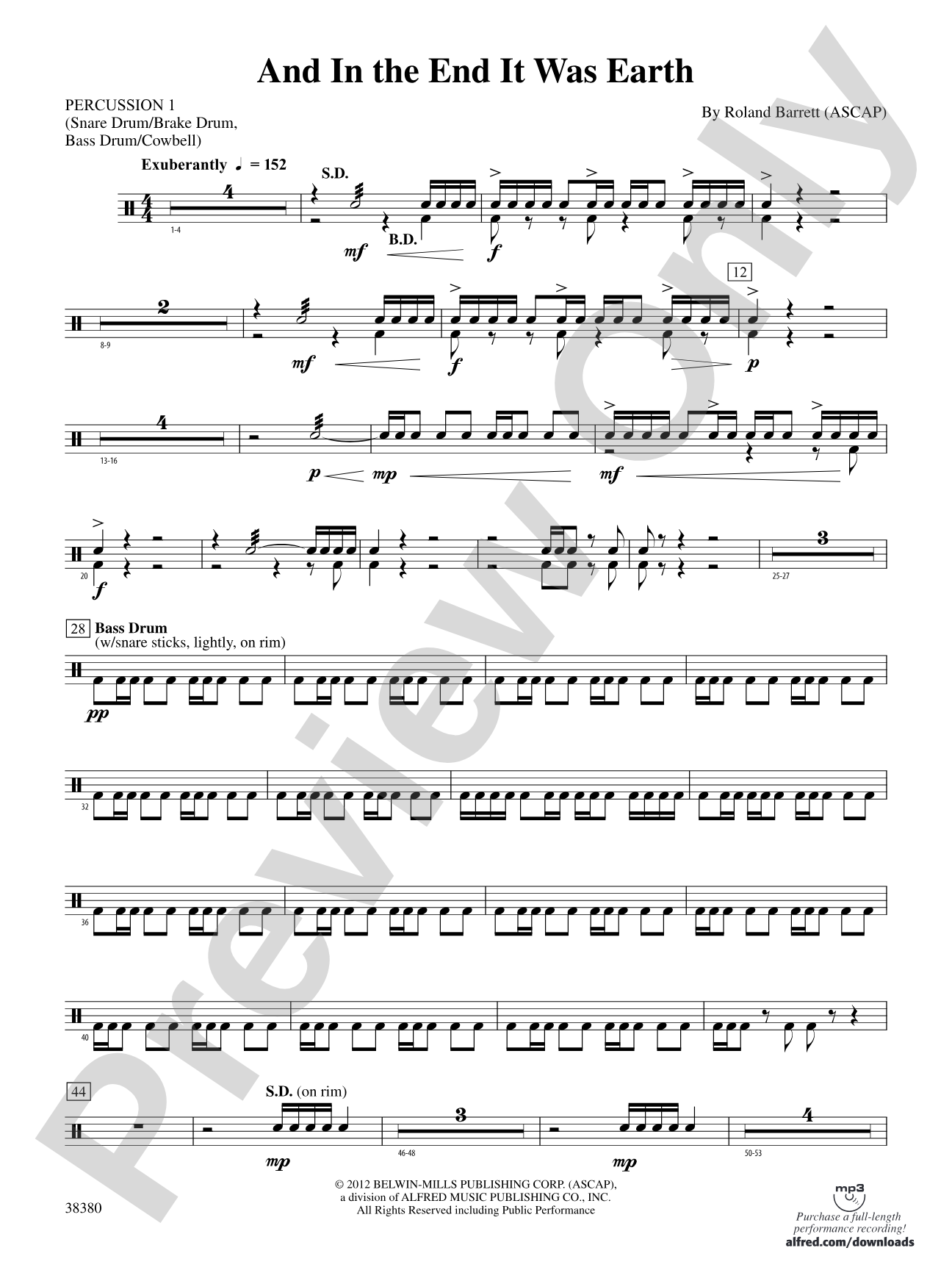

And in the End It Was Earth: 1st Percussion
By Roland Barrett
Grade: 4 (Medium)
Item: 00-PC-0015457_PC1
$3.00
Pickup currently not available
Description
Inspired by the Native American proverb, "We do not inherit the earth from our ancestors, we borrow it from our children." Roland Barrett has scored this original composition to musically reflect that sentiment conveying the inherent beauty, majesty, and grandeur of planet Earth. Combining fluid moving melodic components with energetic and driving rhythmic pulse, the work will capture the imagination of all. (5:30) This title is available in MakeMusic Cloud.


Don't just read it, hear it, play along with it, and watch your students grow with it. In MakeMusic Cloud, And in the End It Was Earth: 1st Percussion comes alive with professional accompaniment, adjustable tempo, and built-in practice tools that turn solo practice into real progress.
Open in the Player
Jump straight in and assign it today.
Start Your Free Trial
Open this title and explore the full library in minutes.
Sample Audio
1
Audio File
--:--
0:00
0:00
Sample Video
Additional Details
Series:
Belwin Symphonic Band
Publisher:
Alfred Music
Page Count:
276
SKU:
00-PC-0015457_PC1
More about this title
About the Composer: Roland Barrett

Roland Barrett has held a composition and music theory faculty position at the University of Oklahoma since 2001, following fifteen years in a band directing role. His scholarly work centers on twentieth-century topics across both undergraduate and graduate curricula, while his creative output remains prolific: over two hundred published works for symphonic band, chamber ensembles, and marching band.
Barrett's compositions have earned national recognition through performances by the Dallas Wind Symphony, numerous All-State and All-Region honor bands, and broadcasts on National Public Radio and USA cable television. His work has been featured at the Midwest Band and Orchestra Convention, the National Trumpet Competition, and the International Trumpet Guild convention. He is a multiple recipient of the ASCAP Plus award and continues to arrange for the Pride of Oklahoma marching band.
Why we love this
Barrett's environmental message arrives through genuinely engaging orchestration rather than didactic heaviness. The balance between lyric, flowing melodic material and propulsive rhythmic energy keeps the piece moving without sacrificing the contemplative moments that make the proverb's wisdom land with students. At Grade 4, it's sophisticated enough to challenge a solid ensemble while remaining accessible enough to let the thematic content breathe.
What to expect
The music unfolds as a journey across the planet's grandeur: sweeping, majestic passages contrast with driving rhythmic sections that pulse with energy and life. There is reverence woven throughout, moments of stillness that honor the earth's beauty, punctuated by passages that feel urgent and alive, capturing the tension between what we inherit and what we owe.
Who it's for
Conductors leading Grade 4 concert bands who want repertoire with genuine artistic substance and environmental themes that resonate beyond the classroom. Programs looking for a major work that opens conversations about stewardship and the natural world while maintaining musical rigor will find this piece essential.
How to get the most out of it
- Shape the fluid melodic lines through long-line phrasing and dynamic contours rather than marking every structural boundary; the piece's beauty depends on singers and players understanding their part as part of a larger vocal gesture.
- Balance the energetic rhythmic pulses in the middle sections so they drive forward without overshadowing countermelodies; this is where the duality of the proverb's sentiment (urgency and reverence) plays out instrumentally.
- Use the five-and-a-half-minute runtime to establish sustainable tempos that allow the band to maintain articulation clarity and intonation under the piece's harmonic shifts.
- Consider the conductor score's full instrumentation context when shaping sectional cues; transparency matters when thematic material passes between woodwinds, brass, and percussion.
How to use it
Program this as the anchor of a concert exploring environmental themes or human responsibility, or build a set around the collision of introspection and momentum that Barrett creates here. The five-and-a-half-minute length sits comfortably in a mixed program, works well as a contrasting piece mid-concert, or stands powerfully as a finale statement about something beyond music itself.
Skills your students will build
- Sustaining long lyric lines across phrase changes
- Balancing melodic independence within dense orchestration
- Interpreting thematic material passed between instrumental sections
- Navigating harmonic shifts and tonal color changes
- Ensemble entrances and cutoffs with rhythmic precision across Grade 4 complexity