
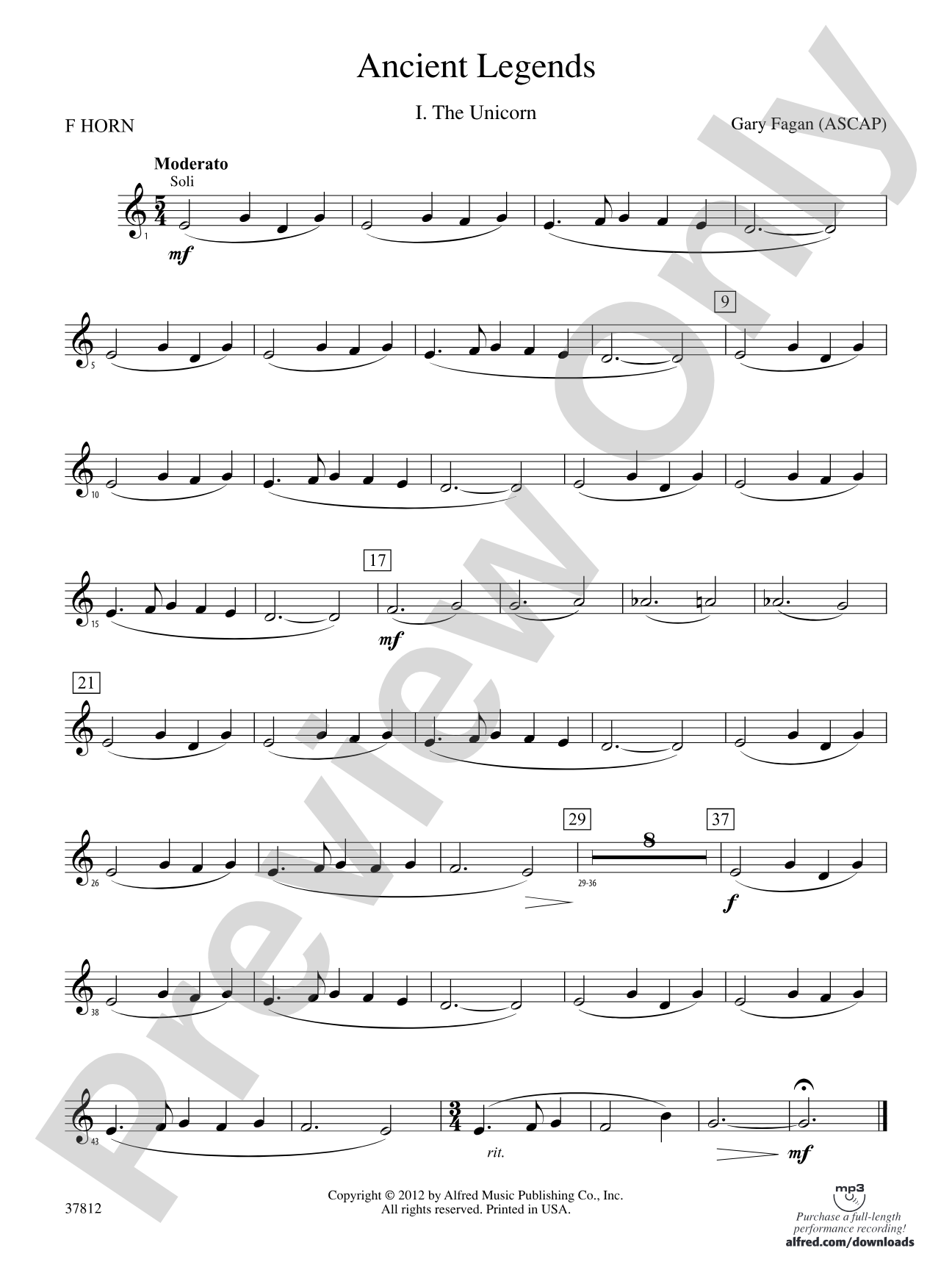

Ancient Legends: 1st F Horn
By Gary Fagan
Grade: 2.5 (Medium Easy)
Item: 00-PC-0015342_H1
$3.00
Pickup currently not available
Description
Ancient Legends is a two-movement suite that musically depicts two legendary creatures from ancient times---the quiet and serene character of the unicorn, and the hideous and terrifying Minotaur. (3:40)


Don't just read it, hear it, play along with it, and watch your students grow with it. In MakeMusic Cloud, Ancient Legends: 1st F Horn comes alive with professional accompaniment, adjustable tempo, and built-in practice tools that turn solo practice into real progress.
Open in the Player
Jump straight in and assign it today.
Start Your Free Trial
Open this title and explore the full library in minutes.
Sample Audio
1
Audio File
--:--
0:00
0:00
Sample Video
No sample videos found.
Additional Details
Series:
Young Symphonic
Publisher:
Alfred Music
Page Count:
268
SKU:
00-PC-0015342_H1
More about this title
About the Composer: Gary Fagan

Gary Fagan brings four decades of band direction experience to his compositions, having shaped music programs in Albemarle County before transitioning to university teaching. His work has reached audiences from the White House to the Midwest Band and Orchestra Clinic, earning recognition as Central Virginia's Outstanding Middle School Teacher and multiple educator honors from Virginia institutions.
Beyond composing, Fagan remains deeply engaged in music education as a University Supervisor at James Madison University, where he teaches arranging and mentors future directors. He holds degrees from Bridgewater College and JMU, serves as Assistant Director of the Charlottesville Band, and works actively as a clinician and adjudicator throughout the region. His involvement with ASCAP, the National Band Association, and Phi Beta Mu reflects his commitment to the profession's ongoing development.
Why we love this
Ancient Legends succeeds because it tells a clear, visceral story through musical contrast without demanding virtuosic technique. The Grade 2.5 difficulty level means your band can focus entirely on character and expression rather than wrestling with technical complexity, making this ideal for building interpretive skills and ensemble balance. Programming two distinct movements back-to-back gives students a masterclass in stylistic control.
What to expect
The unicorn emerges as quiet elegance, with a serene melodic line floating over gentle harmonic support that evokes calm and mythic beauty. The Minotaur shifts the mood entirely, building tension through darker colors and unsettling rhythms that convey menace and ancient terror.
Who it's for
Directors programming Grade 2 and 2.5 bands who want meaningful concert or festival repertoire that challenges interpretation rather than technique. This work suits bands ready to explore character-driven writing and gives students practice with both lyrical phrasing and rhythmic precision in accessible arrangements.
How to get the most out of it
- Shape the unicorn movement with transparent voicing and sustained phrasing; resist the urge to overdrive the dynamics, as the serenity depends on restraint and careful balance between the melody and harmonic foundation.
- Build the Minotaur's menace gradually through rhythmic precision and deliberate crescendos rather than immediate aggression; lock the percussion section early so attacks land as one unified gesture.
- Use the concert context to guide your sectional rehearsals; work the unicorn and Minotaur separately until each movement has a clear emotional identity, then rehearse the transition between them to ensure the contrast reads unmistakably.
- Conduct the quiet sections with clear, economical gestures to maintain ensemble focus without over-indicating; save your interpretive energy for the second movement's dramatic peaks.
How to use it
Open a concert with the unicorn movement as a calming overture before shifting to faster repertoire, or frame both movements as the centerpiece of a mythology-themed concert. The contrasting moods and moderate difficulty make this a strong choice for festival competitions where judges value musicality and ensemble control.
Skills your students will build
- Sustaining long melodic phrases with consistent tone quality and dynamic control
- Balancing transparent harmonic textures in soft passages
- Creating dramatic contrast between complementary musical characters
- Responding to expressive conducting gestures and sectional cues
- Executing precise rhythmic attacks in articulate passages