
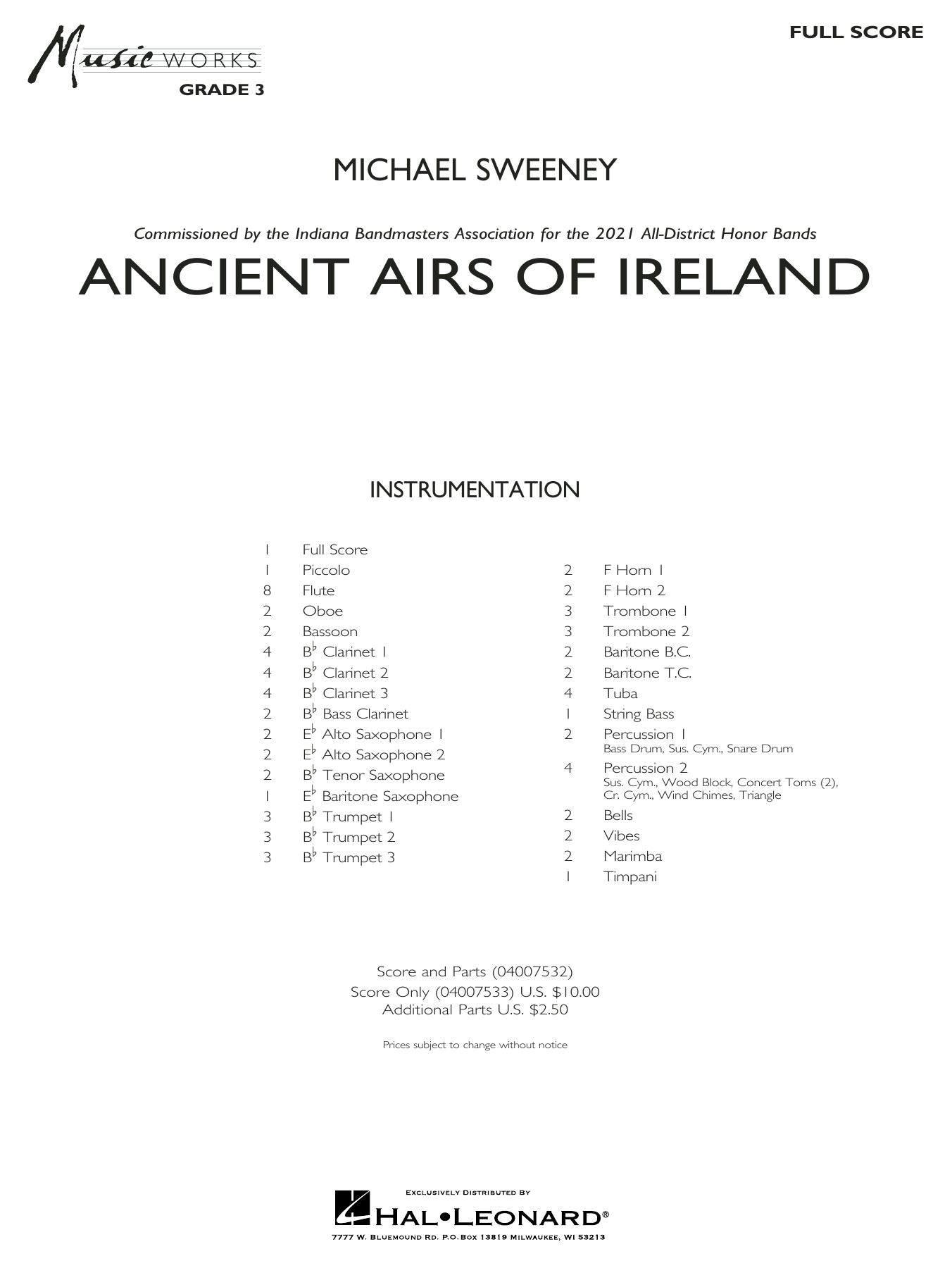

Ancient Airs of Ireland: Concert Band Conductor Score & Parts
By Michael Sweeney
Grade: 3
Item: 35-PK01039118
$75.00
Pickup currently not available
Buy Extra Parts (Digital PDF Download)
Parts Added to Cart!
Description
Based on traditional tunes dating back hundreds of years, Michael's masterful rhapsodic setting utilizes a wide variety of styles and moods. Taking the listener on a dramatic and emotional journey, the featured melodies include: "Return from Fingal", "Lord Mayo", "The Yellow Bittern", "Captain O'Kane", "Song of the Chanter", and "Behind the Bush in the Garden". Dur: 6:35


Discover MakeMusic Cloud: thousands of interactive titles your students can play along with today.
Sample Audio
No sample audio found.
Sample Video
Additional Details
Publisher:
Hal Leonard
SKU:
35-PK01039118
More about this title
About the Composer: Michael Sweeney
Michael Sweeney has built a distinguished career composing and arranging for wind bands, with a particular gift for breathing new life into traditional melodies. His settings consistently honor the character of source material while showcasing sophisticated harmonic and textural choices that engage both players and audiences.
Why we love this
Sweeney's approach to these Irish airs treats each tune as a portal into emotional storytelling rather than a simple folk melody adaptation. The rhapsodic structure gives your band interpretive freedom within a through-composed arc, and the Grade 3 scoring balances accessibility with genuine musical substance.
What to expect
A guided tour through centuries of Irish musical expression. The piece alternates between moments of introspection and passages of driving energy, creating an arc that feels both intimate and expansive within its six and a half minute span.
Who it's for
Bands seeking repertoire that offers cultural depth without excessive technical demands. This works equally well for groups developing their concert program or those wanting to explore a musical tradition beyond their usual repertoire.
How to get the most out of it
- Shape each air as a distinct character within the larger journey. The transition between melodies is your opportunity to refresh the ensemble's focus and reset the emotional temperature.
- Listen carefully to how Sweeney distributes the melodic material across sections. Soloistic passages demand careful balance so secondary voices don't obscure the featured line.
- Pay attention to dynamic shifts as primary storytelling devices. The contrast between intimate passages and fuller textures carries as much weight as the melodies themselves.
- Allow time in rehearsal to discuss the traditional origins of these tunes. Students who understand the cultural context bring deeper intention to their playing.
How to use it
Position this as a centerpiece for a concert that explores world music or traditional repertoire. Its length and emotional intensity make it valuable as a second or third selection, where it can anchor the program without overshadowing lighter opening pieces or major closing works.
Skills your students will build
- Phrasing and shaping across longer melodic lines
- Balancing featured soloists with supporting voices
- Responding to subtle dynamic and textural shifts
- Stylistic interpretation of traditional material
- Ensemble cohesion across multiple mood changes