
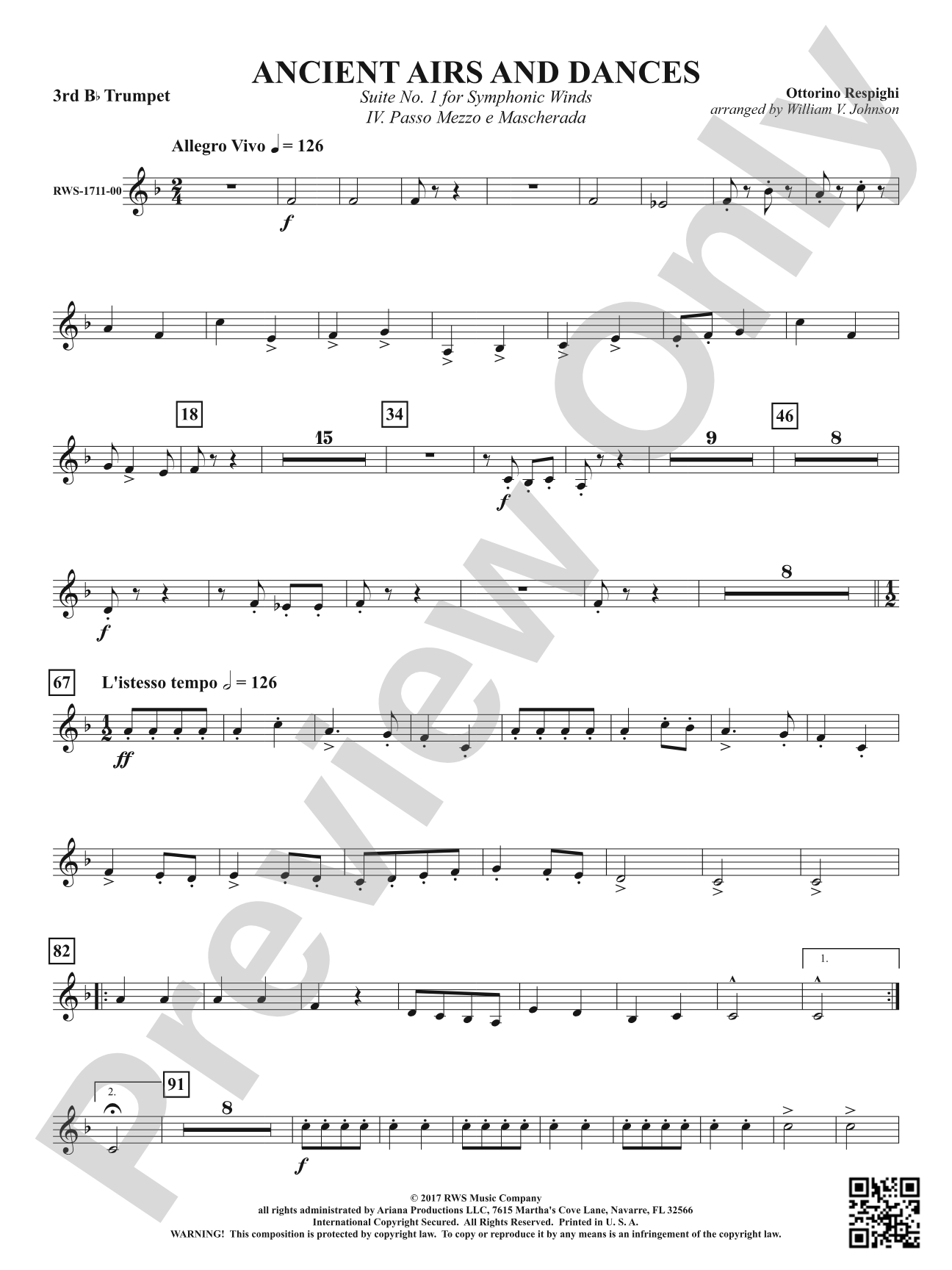

Ancient Airs and Dances - Suite No. 1 for Symphonic Winds - IV. Passo Mezzo e Mascherada: 3rd B-flat Trumpet
Suite No. 1 for Symphonic Winds - IV. Passo Mezzo e Mascherada
Arranged by William V. Johnson
Grade: 5
Item: 98-PC-RWS1711_T3
$3.99
Pickup currently not available
Description
William Johnson's wind band transcription of this Renaissance masterwork by Respighi will be the headline of your next concert. Appropriate for your festival program, "Ancient Airs And Dances" provides a powerful musical and educational experience for your ensemble. With parts included for optional color instruments, this exceptional edition brings classic Renaissance repertoire into the modern era.
Original Item#: RWS-1711-00


Original Item#: RWS-1711-00
Ancient Airs and Dances - Suite No. 1 for Symphonic Winds - IV. Passo Mezzo e Mascherada: 3rd B-flat Trumpet isn't in MakeMusic Cloud just yet...but it could be. Let us know you'd like to see it, and you'll help shape what comes next. In the meantime, start a free trial and dive into thousands of interactive titles your students can play along with today.
Request This Title
Tell us you want it.
Start Your Free Trial
Explore everything that's ready to play right now.
Sample Audio
1
Audio File
--:--
0:00
0:00
Sample Video
No sample videos found.
Additional Details
Series:
RWS - Symphony Band
Publisher:
RWS Music Company
SKU:
98-PC-RWS1711_T3
More about this title
About the Arranger: William V. Johnson
William V. Johnson is a respected arranger and composer whose work for concert band brings familiar classical and Renaissance repertoire within reach of modern ensembles. His transcriptions prioritize musical integrity while adapting scores for the instrumental combinations and pedagogical needs of school and community bands.
Johnson's arrangements are known for preserving the character and sophistication of their sources while offering flexible instrumentation options. His editions have become standards in festival and concert programming across North America.
Why we love this
This arrangement opens Respighi's Renaissance masterpiece to concert bands that rarely encounter it in standard repertoire. Johnson's scoring maintains the intricate polyphonic beauty of the original while distributing the musical material across typical wind band instrumentation, making it a genuinely musically rewarding experience rather than a simplified version. The optional color instruments add flexibility for ensembles with different instrumentation strengths.
What to expect
A sophisticated journey through Renaissance dance forms with pageantry and elegance. The Mascherada movement carries the playful grandeur of a masked celebration, with shifting instrumental colors and intricate rhythmic patterns that feel both ancient and immediately engaging. The writing is articulate and energetic, never drowsy or merely academic.
Who it's for
Concert bands in Grades 5 and above seeking programming that combines musical substance with ensemble development. This works equally well for high school concert bands building a serious repertoire and adult community ensembles looking to explore classical masterworks beyond standard wind band literature.
How to get the most out of it
- Balance the layered melodic lines across sections; Renaissance counterpoint demands clarity of voice independence rather than blended sonority.
- Shape phrases with Renaissance sensibility: avoid the sustained vibrato of Romantic-era interpretation. Use light articulation and shaped breathing to suggest the dancing quality implied in the movement title.
- Lock the rhythmic precision between woodwinds and low brass; the Passo Mezzo structure relies on steady pulse and crisp ensemble attacks.
- Use the optional color parts strategically for rehearsal texture and color variation, but ensure the core arrangement is solid before adding instrumental variety.
How to use it
Feature this as a centerpiece of a classical or historic music concert, or pair it with other Respighi works to create a thematic program. It works beautifully as a contrast to contemporary pieces and serves as a gateway for ensembles moving into more complex European classical repertoire. Consider programming it in spring festivals or formal concert settings where programming sophistication makes an impression.
Skills your students will build
- Reading and executing Renaissance polyphonic textures in modern instrumentation
- Balancing independent melodic lines while maintaining ensemble cohesion
- Light articulation and phrasing in non-Romantic styles
- Rhythmic precision within dance-form structures
- Dynamic control across sectional doublings and optional coloristic parts