
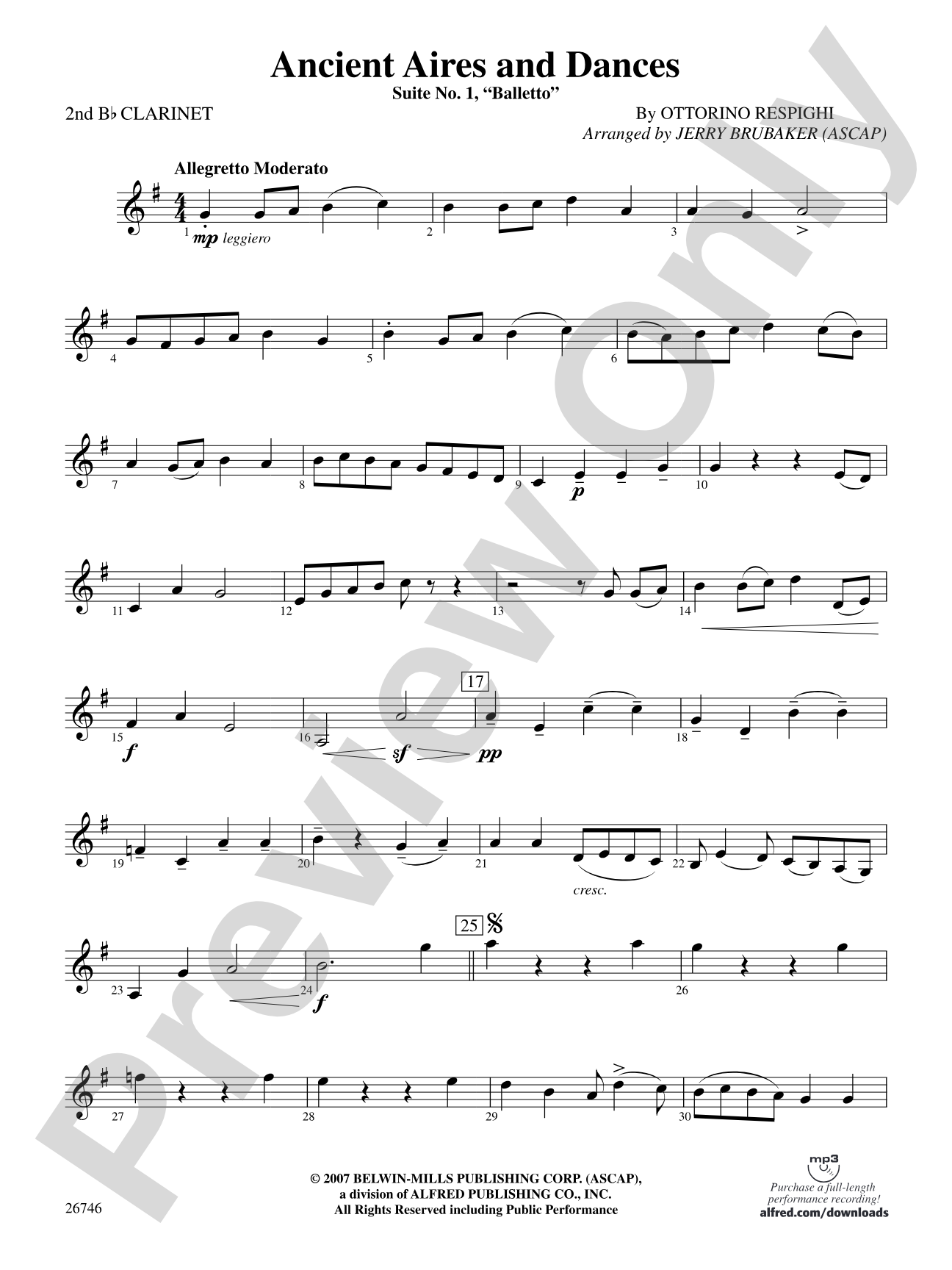

Ancient Aires and Dances: 2nd B-flat Clarinet
By Ottorino Respighi / arr. Jerry Brubaker
Grade: 3 (Medium Easy)
Item: 00-PC-0001208_C2
$5.99
Pickup currently not available
Description
Respighi musically embraced what he termed early music. Capturing the noble elegance from the Balleto movement in his Ancient Aires and Dances, Jerry Brubaker has scored this admired work for concert band. This transcription is true to the original yet scored to accommodate the contemporary concert band. A distinctive choice! This title is available in MakeMusic Cloud.


Don't just read it, hear it, play along with it, and watch your students grow with it. In MakeMusic Cloud, Ancient Aires and Dances: 2nd B-flat Clarinet comes alive with professional accompaniment, adjustable tempo, and built-in practice tools that turn solo practice into real progress.
Open in the Player
Jump straight in and assign it today.
Start Your Free Trial
Open this title and explore the full library in minutes.
Sample Audio
1
Audio File
--:--
0:00
0:00
Sample Video
No sample videos found.
Additional Details
Series:
Belwin Concert Band
Publisher:
Alfred Music
Page Count:
78
SKU:
00-PC-0001208_C2
More about this title
About the Composer: Ottorino Respighi
Ottorino Respighi (1879-1936) was an Italian composer who made his mark as a master orchestrator and champion of early music revival. His deep study of Renaissance and Baroque works informed his own compositions, which seamlessly blend historical elements with rich Romantic harmony and color. Respighi's gift was his ability to honor the past while writing music that sounded entirely his own, making him a bridge between centuries.
As a conductor, composer, and teacher at the St. Cecilia Conservatory in Rome, Respighi shaped Italian musical life for decades. His orchestral suites remain cornerstones of the concert repertoire, celebrated for their melodic generosity, harmonic sophistication, and brilliant instrumental writing. Band arrangers and conductors continue to find in his work a model for how to honor a composer's intent while adapting music for new ensembles.
Why we love this
Jerry Brubaker's transcription brings one of the most elegant movements from Respighi's orchestral suite to a Grade 3 concert band with remarkable fidelity. The arrangement preserves the harmonic sophistication and melodic sweep of the original while distributing the parts idiomatically across contemporary band instrumentation. This is the kind of masterwork transcription that gives students meaningful access to repertoire they'd otherwise only hear in recordings.
What to expect
Ancient Aires and Dances evokes the dignity and restraint of Renaissance court music while speaking in a voice entirely Respighi's own. The Balleto movement moves with unhurried grace, its noble melody unfolding over gently shifting harmonies that feel both intimate and grand. There's a quiet confidence in the writing, as if stepping into a stately procession from centuries past.
Who it's for
Concert band directors programming Grade 2-4 repertoire who want to introduce students to a genuine masterwork without overextending their technical range. This arrangement works for ensembles looking to build musicianship through exposure to sophisticated harmony and orchestration at an accessible level. It's equally suited to festival programmers seeking distinctive concert material or instructors planning repertoire that showcases both technical growth and musical maturity.
How to get the most out of it
- Balance the inner voices carefully; the beauty of this arrangement lives in the harmonic fullness, not just the outer melodies. Resist the urge to push the lyrical lines at the expense of supporting voicings.
- Shape phrases with a long musical line in mind rather than counting bar by bar. Respighi's melodic architecture rewards conductors who think in terms of arcs and breathing.
- Let the noble character emerge through clarity and restraint. The elegance of early music lies in articulation and intonation, not in pushing tempo or volume.
- Attend to exposed divisi passages in the woodwind and brass sections. Respighi's orchestration often places important supporting voices in unexpected places.
How to use it
Program this as a concert opener to establish an elegant tone, or pair it with contrasting modern works to highlight Respighi's bridge between eras. It's an excellent choice for festival concerts where you want to represent serious repertoire study without requiring the technical demands of Grade 4-5 transcriptions. The 78-page score and parts make it a substantial undertaking that rewards careful preparation across the full ensemble.
Skills your students will build
- Identifying and balancing harmonic voice leading across the ensemble
- Sustaining long melodic phrases with consistent tone and phrasing
- Reading and performing divisi passages with accuracy
- Responding to subtle dynamic shadings that define early music style
- Understanding orchestration principles through recognition of color changes across instruments