
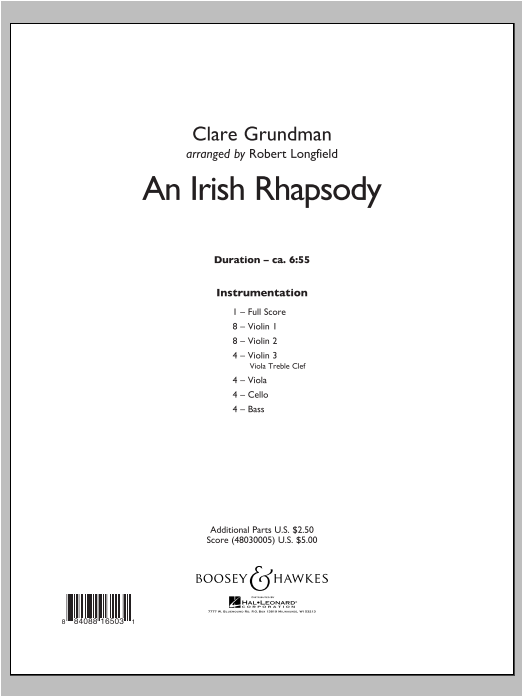

An Irish Rhapsody: String Orchestra Conductor Score & Parts
By Clare Grundman / Arranged by Robert Longfield
Grade: 3-4
Item: 35-PK00251405
$50.00
Pickup currently not available
Buy Extra Parts (Digital PDF Download)
| Product | Price | Quantity |
|---|---|---|
| An Irish Rhapsody - Conductor Score (Full Score) | $7.50 | |
| An Irish Rhapsody - Violin 1 | $7.00 | |
| An Irish Rhapsody - Violin 2 | $7.00 | |
| An Irish Rhapsody - Violin 3 Viola Treble Clef | $7.00 | |
| An Irish Rhapsody - Viola | $7.00 | |
| An Irish Rhapsody - Cello | $7.00 | |
| An Irish Rhapsody - Bass | $7.00 |
Parts Added to Cart!
Description
Master arranger Robert Longfield has transformed a Grundman symphonic classic into a superb edition for string ensembles. Includes the folk melodies: The Morren (Minstrel Boy), I Know Where I'm Going, Shepherd's Lamb Reel, Cockles and Mussels, The Rakes of Mallow and Kathleen O'More. (Boosey Hawkes) Dur: 6:55


An Irish Rhapsody: String Orchestra Conductor Score & Parts isn't in MakeMusic Cloud just yet...but it could be. Let us know you'd like to see it, and you'll help shape what comes next. In the meantime, start a free trial and dive into thousands of interactive titles your students can play along with today.
Request This Title
Tell us you want it.
Start Your Free Trial
Explore everything that's ready to play right now.
Sample Audio
No sample audio found.
Sample Video
No sample videos found.
Additional Details
Publisher:
Hal Leonard
SKU:
35-PK00251405
More about this title
About the Composer: Clare Grundman
Clare Grundman was a prolific composer and arranger whose vast catalog shaped the sound of American concert bands and orchestras for decades. His gift lay in transforming folk materials and popular melodies into sophisticated, accessible works that never condescended to their audiences or players.
Grundman's symphonic arrangements became standard repertoire in school and community settings because they balanced musical substance with reasonable technical demands. His ear for orchestration and his respect for source material set a high bar for arrangement craft that continues to influence how we think about folk music adaptation.
Why we love this
Longfield's string orchestration captures the spirit of Grundman's original without requiring the full winds and percussion. The six folk melodies are sequenced to build momentum, and Longfield's writing gives violins genuinely musical roles rather than just doubling the melodic line. Your students will recognize and connect with these tunes instantly, while the arrangement sustains their interest through clever voice leading and texture shifts.
What to expect
Warmth and movement. These melodies carry the weight of folk tradition, but Longfield's arrangement keeps them buoyant and conversational. You hear violin color shift between bright and lyrical passages, creating a sense of landscape and storytelling rather than a static showcase of tunes.
Who it's for
String orchestras in grades 3 and 4 who want repertoire with immediate appeal and genuine musical substance. Directors seeking Irish or folk-inspired programming will find this covers both concert requirements and audience engagement without compromise.
How to get the most out of it
- Shape each folk tune to its own character: The Minstrel Boy moves with gentle nobility, while Cockles and Mussels has a rollicking market-day energy. Let the melody's origin inform your approach to phrasing and vibrato.
- Balance the second violins carefully when they carry inner voices or countermelodies. These are essential to the arrangement's texture, not filler, so they need to be heard without overwhelming the first violin line.
- Pay attention to the transitions between tunes. Longfield uses brief ritardandos and tempo shifts to mark the boundaries. These moments give you space to reset and gather the ensemble before launching into the next melody.
- Use the recorded accompaniment to lock in rhythmic relationships, especially in the faster reels where syncopation matters. Then remove it before performance so your players develop independence.
How to use it
Place this in a concert celebrating cultural music or heritage programming where you want something substantial alongside lighter fare. It also works beautifully as a spring concert centerpiece, where the accumulated energy of six linked melodies gives you a satisfying close without the demands of a full symphony. At six minutes, it's long enough to feel like a real achievement but short enough to balance an evening of mixed repertoire.
Skills your students will build
- Sustaining lyrical phrasing across longer melodic lines
- Balancing interior voices against the primary melody
- Responding to tempo and character changes within a unified work
- Playing with stylistic awareness of folk music conventions
- Coordinating smooth transitions between connected musical sections