
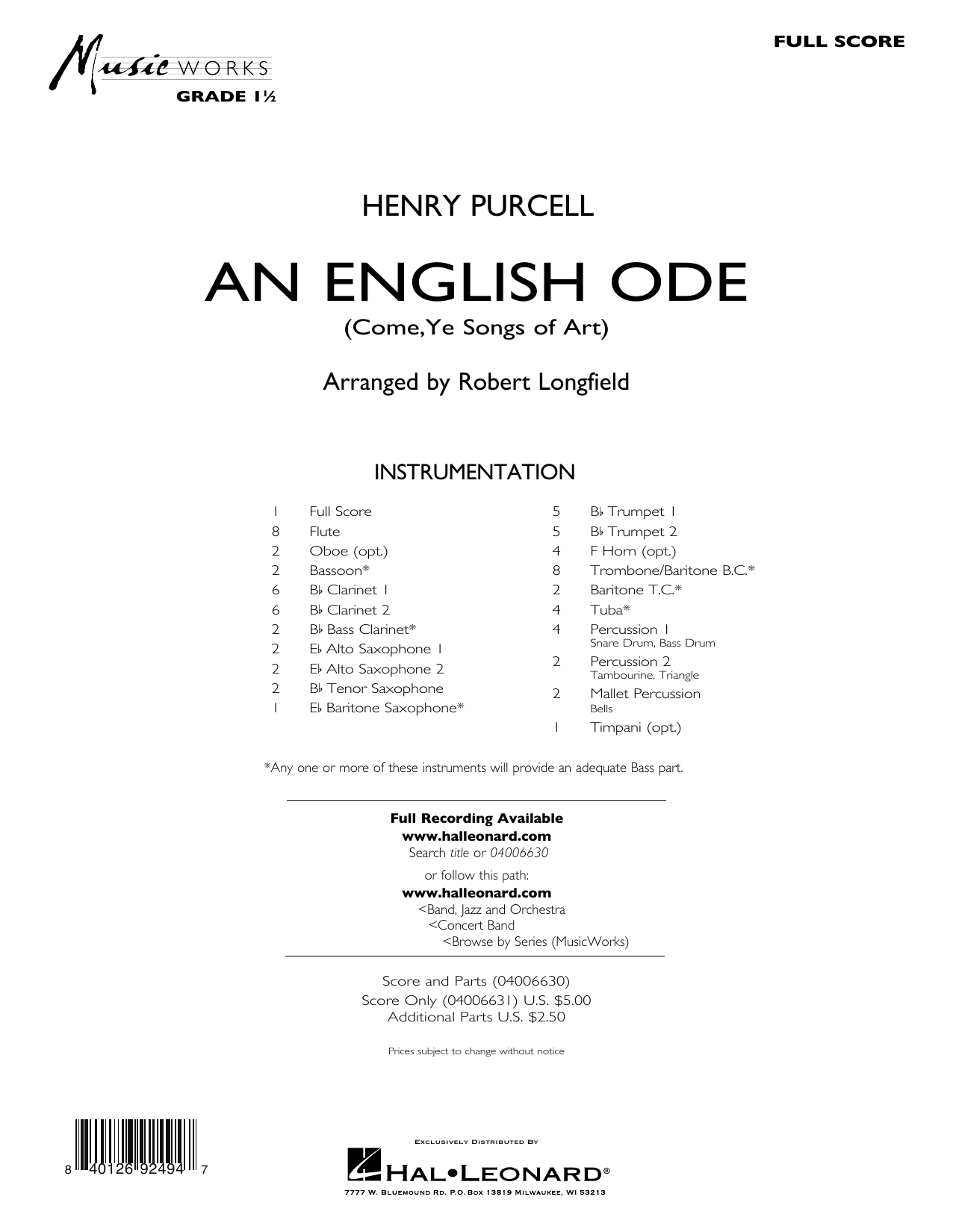

An English Ode (Come, Ye Sons of Art) (arr. Robert Longfield): Concert Band Conductor Score & Parts
By Henry Purcell / Arranged by Robert Longfield
Grade: 1.5
Item: 35-PK00469713
$45.00
Pickup currently not available
Buy Extra Parts (Digital PDF Download)
Parts Added to Cart!
Description
Based on Purcell's "Come, Ye Sons of Art," this carefully crafted arrangement for second year players features a nice variety in scoring and dynamic contrasts. Phrases are traded between the woodwind and brass sections (cues included), then the full band comes together for the final segment.


An English Ode (Come, Ye Sons of Art) (arr. Robert Longfield): Concert Band Conductor Score & Parts isn't in MakeMusic Cloud just yet...but it could be. Let us know you'd like to see it, and you'll help shape what comes next. In the meantime, start a free trial and dive into thousands of interactive titles your students can play along with today.
Request This Title
Tell us you want it.
Start Your Free Trial
Explore everything that's ready to play right now.
Sample Audio
No sample audio found.
Sample Video
No sample videos found.
Additional Details
Publisher:
Hal Leonard
SKU:
35-PK00469713
More about this title
About the Composer: Henry Purcell
Henry Purcell (1659-1695) stands as England's greatest Baroque composer, creating music of unmatched emotional depth and harmonic ingenuity across operas, chamber works, and sacred compositions. His influence on the concert band repertoire persists through arrangements like this one, which capture the grandeur and lyrical elegance that define his compositional voice.
Why we love this
Longfield's arrangement unpacks the architecture of Purcell's original without oversimplifying it. The trading of phrases between sections keeps young ensembles engaged intellectually while building ensemble listening skills, and the cues make it genuinely playable for second year bands without sacrificing the work's musical integrity.
What to expect
Stately and ceremonial, with the warmth of Purcell's harmonic language glowing beneath the surface. The interplay between sections creates a sense of courtly pageantry, while moments of lyrical repose invite reflection before the ensemble gathers strength for its final statement.
Who it's for
Second year concert bands seeking repertoire that sits comfortably in their wheelhouse while introducing genuine musical complexity. It works equally well for festival performances and classroom study of Baroque compositional technique.
How to get the most out of it
- Balance the sectional dialogue carefully so that when phrases pass from woodwinds to brass, the transition feels inevitable rather than abrupt. Neither section should overwhelm; think of it as a musical conversation where each voice has equal weight.
- Shape the final tutti segment with deliberate dynamic control. Resist the impulse to jump immediately to full volume. Build the climax gradually so the full band moment lands with real impact.
- Honor the Baroque phrasing underlying Purcell's original. Use breath points and articulation to clarify the harmonic structure rather than treating sections as seamless blocks of sound.
How to use it
Pair this with other Baroque arrangements or use it as a single centerpiece in a concert dedicated to British musical heritage. It also serves as an effective teaching tool for studying how historical music translates to contemporary ensemble formats without losing its character.
Skills your students will build
- Listening and responding to sectional cues in real time
- Balancing dynamic contrast between woodwind and brass scoring
- Phrasing in the Baroque idiom with appropriate articulation and breath placement
- Ensemble blend when transitioning between reduced and full instrumentation
- Reading cue lines to anticipate entrances