
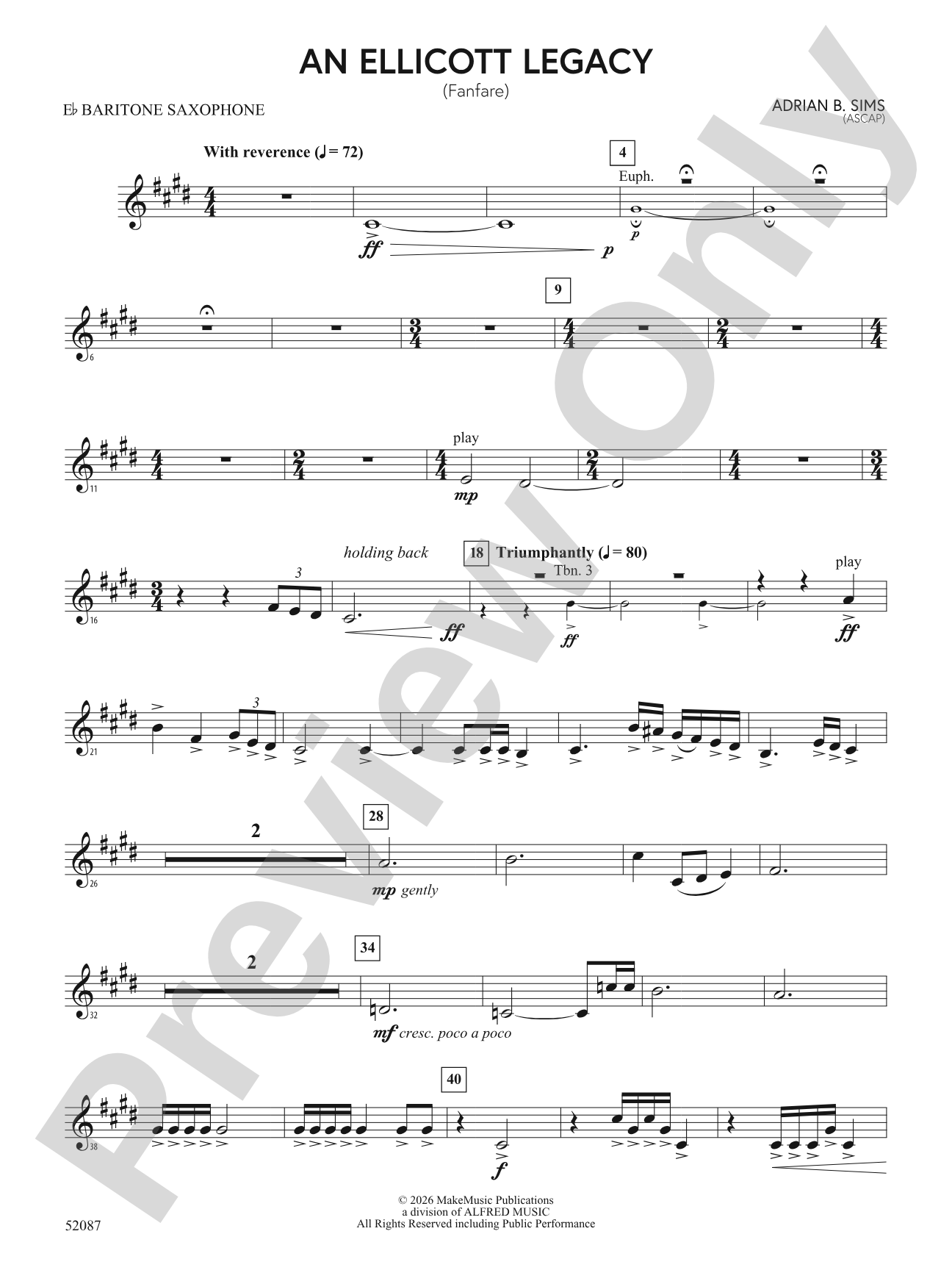

An Ellicott Legacy: E-flat Baritone Saxophone
(Fanfare)
Adrian B. Sims
Grade: 4.5
Item: 00-PC-0019687_BTX
$3.00
Pickup currently not available
Description
Celebrate community and the enduring spirit of music with An Ellicott Legacy, an exhilarating fanfare by Adrian B. Sims. Written as a tribute to visionary music educators, the music constantly builds and grows much like the trajectory of a blossoming music program. What begins humbly soon explodes into a breathtaking juxtaposition of heroic lines and rhythmic intensity. (3:20)


An Ellicott Legacy: E-flat Baritone Saxophone isn't in MakeMusic Cloud just yet...but it could be. Let us know you'd like to see it, and you'll help shape what comes next. In the meantime, start a free trial and dive into thousands of interactive titles your students can play along with today.
Request This Title
Tell us you want it.
Start Your Free Trial
Explore everything that's ready to play right now.
Sample Audio
1
Audio File
--:--
0:00
0:00
Sample Video
Additional Details
Series:
MakeMusic Symphonic Band
Publisher:
MakeMusic Publications
SKU:
00-PC-0019687_BTX
More about this title
About the Composer: Adrian B. Sims

Adrian B. Sims was born in Seattle in 2000 and earned his early musical training in Maryland, where he developed as both a composer and trombonist. His work has appeared at The Midwest Band and Orchestra Clinic, earned recognition on the Bandworld Top 100 List, and won awards through the Maryland Music Educators Association Young Composers Project and the Make Music Young Composers Contest. He has conducted his own compositions in performances across Maryland schools and performed as a trombonist in orchestral, jazz, and band settings, including appearances with the Baltimore Symphony Orchestra.
Currently pursuing a dual degree in Music Education and Composition at The University of Maryland, Sims studies composition with Dr. Robert Gibson and has received mentorship from composer Brian Balmages. His bass trombone training comes from Matthew Guilford, principal soloist with the National Symphony Orchestra. He credits his band directors Christopher Gnagey and Cindy Stevenson for shaping his musical foundation.
Why we love this
Sims crafts a fanfare that genuinely earns its climaxes rather than simply announcing them. The architecture mirrors real program growth—modest opening gestures that gather momentum through layered orchestration and rhythmic propulsion—making it feel earned rather than imposed. Directors looking for a contest or festival opener that energizes both ensemble and audience will find the trajectory here particularly satisfying.
What to expect
An Ellicott Legacy moves with infectious forward momentum, beginning as an understated gesture before swelling into full-throated declaration. The piece pulses with youthful energy and ambition, mirroring the growth narrative that inspired its creation. Expect a sound that feels both celebratory and genuinely heroic by its conclusion.
Who it's for
This work serves bands at the Grade 4 to 4.5 level with solid fundamentals and the stamina for sustained ensemble focus. It works equally well for competitive festival programs and concert settings where you want a memorable opener that showcases what your band can achieve. Directors seeking music that balances technical challenge with musical satisfaction will find it appropriate.
How to get the most out of it
- Build the dynamic shape deliberately from the opening. Resist the urge to start loud; let the piece grow organically so the heroic sections hit with maximum impact.
- Balance the rhythmic intensity across the ensemble. The constant forward motion requires tight internal synchronization, especially in the full band passages.
- Shape the juxtaposed sections with clear articulation contrasts. Allow the heroic lines to breathe melodically while maintaining precision in the rhythmic figures.
- Use the recorded accompaniment to lock ensemble pulse during rehearsal, particularly through transitions where the momentum shifts most dramatically.
How to use it
Open a festival program or concert with this fanfare to establish energy and confidence from the first moments. Its three-minute-twenty duration makes it an ideal companion to longer works, allowing you to lead with impact while preserving time for substantive repertoire. Consider programming it early in the year when your ensemble is still developing cohesion; the building trajectory rewards focused rehearsal attention.
Skills your students will build
- Dynamic control across extended crescendos
- Ensemble synchronization in complex rhythmic passages
- Articulation clarity under sustained tempo
- Listening for harmonic balance in layered textures
- Phrasing heroic melodic lines without rhythmic drift