
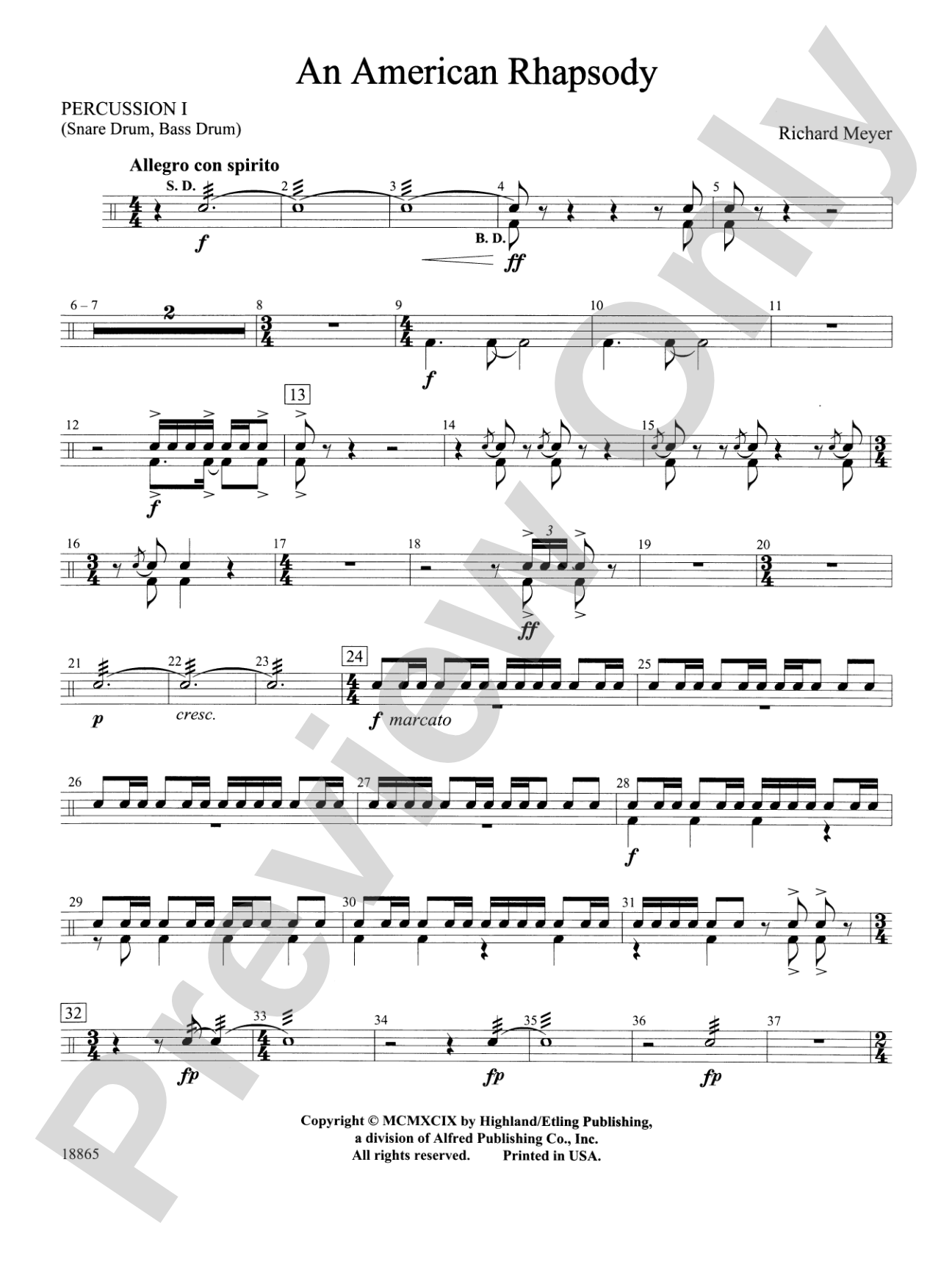

An American Rhapsody: 1st Percussion
By Richard Meyer
Grade: 4
Item: 00-PC-0000303_PC1
$3.00
Pickup currently not available
Description
Exciting, lyrical and highly dramatic, this bold new showcase for the mature school orchestra has it all. Richard Meyer has fashioned an overture that explores the various sounds of American music (including a virtuosic nod to the "fiddle-style"). Featuring challenging parts for every section, this one is sure to raise your students' level of playing and bring your audience to its feet. A perfect concert opener or closer!


Don't just read it, hear it, play along with it, and watch your students grow with it. In MakeMusic Cloud, An American Rhapsody: 1st Percussion comes alive with professional accompaniment, adjustable tempo, and built-in practice tools that turn solo practice into real progress.
Open in the Player
Jump straight in and assign it today.
Start Your Free Trial
Open this title and explore the full library in minutes.
Sample Audio
1
Audio File
--:--
0:00
0:00
Sample Video
No sample videos found.
Additional Details
Series:
Highland/Etling Full Orchestra
Publisher:
Alfred Music
Page Count:
160
SKU:
00-PC-0000303_PC1
More about this title
About the Composer: Richard Meyer

Richard Meyer's three decades of string pedagogy shaped orchestras across Southern California, most notably at Oak Avenue Intermediate School where he built the program from 29 students to 200. His tenure as music director of the Pasadena Youth Symphony Orchestra for 16 years took student musicians to performance stages in Vienna, Australia, and multiple U.S. cities, establishing him as a conductor who raises the artistic bar wherever he works.
Beyond the podium, Meyer's impact reaches through composition and education innovation. With over 190 published works to his name and a 16-year tenure as string editor for Alfred Publishing, he understands what school orchestras can accomplish. His "Giving Bach" program brought interactive concerts to special needs and underserved students throughout the region, earning national recognition for its creative approach to access and inclusion. He has mentored countless music educators through clinician roles at major conferences including the A.S.T.A. National Conference and All-State honors.
Why we love this
Meyer writes for the orchestras that actually exist in schools, which means every section gets genuinely rewarding material without synthetic busywork. The fiddle-style passages give your students a chance to explore American musical vernacular that lives outside the classical canon, and that kind of cultural breadth matters. Best of all, it reads as one unified concert moment, not a patchwork of standalone effects, so your ensemble experiences what it means to sustain a major dramatic arc.
What to expect
Bold and unapologetically theatrical, with the confidence of a seasoned overture that knows how to make an entrance. The work mines American musical traditions with genuine affection, swinging from lyrical passages that settle into the heart to virtuosic fiddle-style writing that crackles with energy and regional flavor.
Who it's for
Mature school orchestras at the Grade 4 level with balanced sections across all families and players secure enough to handle individual responsibility. This is the concert piece for ensembles ready to step beyond safe repertoire and perform something with real dramatic stakes and stylistic range.
How to get the most out of it
- Balance the ensemble across the dramatic peaks. Meyer's orchestration spans a wide dynamic range, so mark your critical balancing points at rehearsal and return to them regularly; the fiddle-style sections especially need the strings bright and the winds transparent.
- Shape the lyrical passages with long, connected phrasing. This is not a fast-moving, effects-driven piece; it breathes and develops, so conductor gesture and instrumental line must communicate that continuity to the audience.
- Clarify the rhythmic energy in transition passages. When American music styles shift or build, precision in subdivision and clean attacks will carry the momentum without sounding rushed.
How to use it
Open your concert with this and set an ambitious tone for the rest of the program, or close with it and send audiences out energized and satisfied. At 160 pages of score and parts, it's substantial enough to anchor a full program or balance a mixed repertoire set. The stylistic breadth and showstopper moments make it equally compelling in either spot.
Skills your students will build
- Sustaining lyrical phrasing across longer musical phrases
- Executing double-stop and fiddle-style articulations with clarity
- Responding to nuanced conductor gesture and dramatic timing
- Balancing ensemble sound across multiple style shifts and dynamic levels
- Reading and performing non-classical American musical idioms