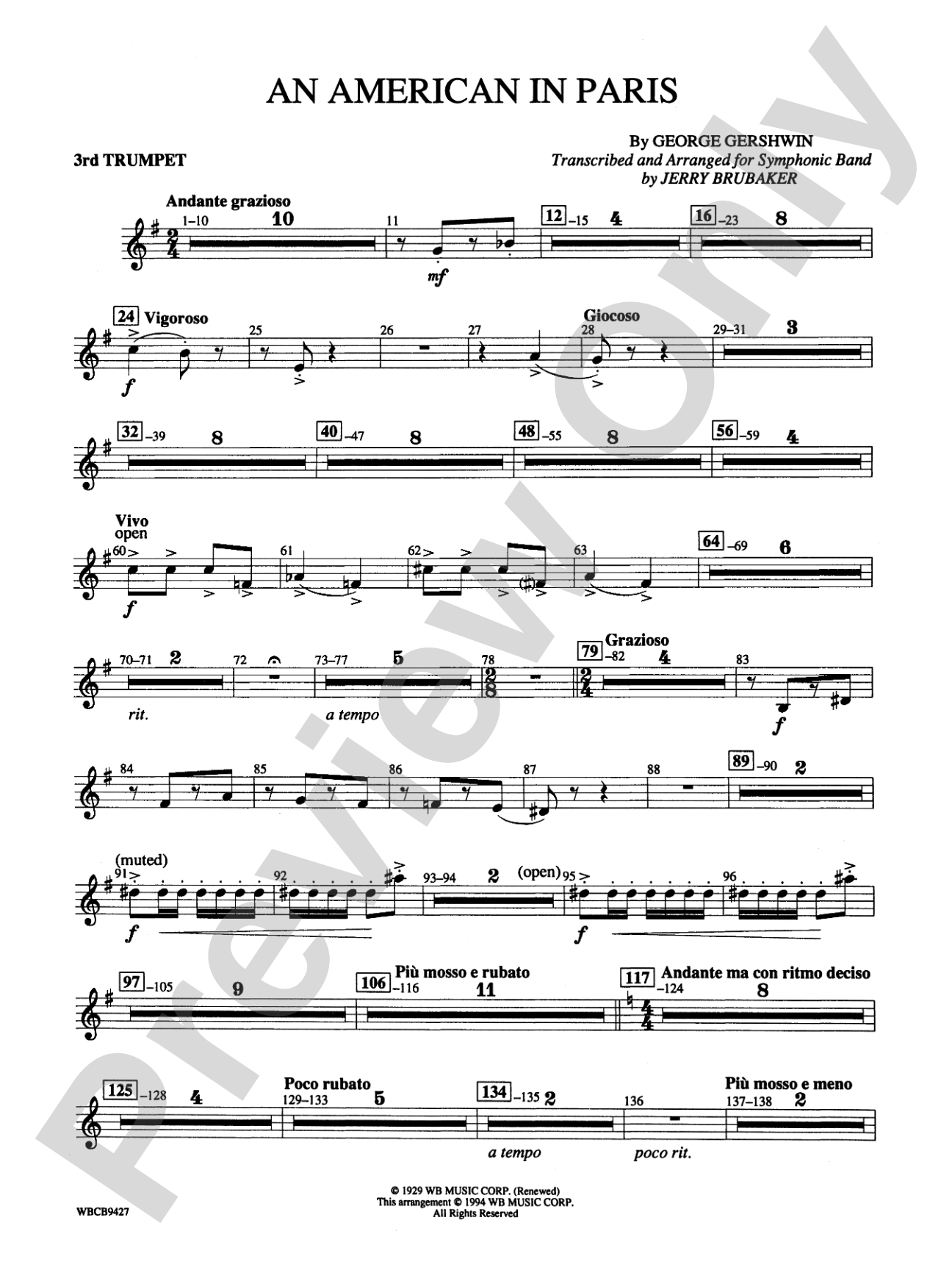
An American in Paris: 3rd B-flat Trumpet Sheet Music Preview

An American in Paris: 3rd B-flat Trumpet

By George Gershwin / arr. Jerry Brubaker

Grade: 4 (Medium)

Item: 00-PC-0002597_T3

Digital Download
$3.00
Description
The honking of auto horns conjures up a vision of Parisian drivers careening and lurching around the streets of this fabulous city. We're off on a madcap whirl from the genius of George Gershwin. Close your eyes and listen to the colors---you'll know exactly where you are. A stunning setting!

An American in Paris: 3rd B-flat Trumpet isn't in MakeMusic Cloud just yet...but it could be. Let us know you'd like to see it, and you'll help shape what comes next. In the meantime, start a free trial and dive into thousands of interactive titles your students can play along with today.

Sample Audio
No sample audio found.
Sample Video
Additional Details
Series: Belwin Symphonic Band
Publisher: Alfred Music
Page Count: 378
SKU: 00-PC-0002597_T3

More about this title

About the Composer: George Gershwin

George Gershwin (1898-1937) stands as one of the most innovative American composers of the twentieth century. He bridged classical forms and jazz idioms in ways that remain influential; his works for concert band and orchestra shaped how generations of listeners understand American musical identity.

Gershwin's gift lay in orchestration and melodic invention. He wrote directly for ensembles rather than adapting existing works, and his scores reward both performers and audiences with colorful harmonies, accessible themes, and genuine compositional sophistication. An American in Paris exemplifies his ability to evoke place and emotion through music.

Why we love this

Jerry Brubaker's arrangement captures Gershwin's orchestral magic without requiring a full symphony orchestra. The auto horn effects and harmonic complexity remain intact, making this a serious artistic statement that your band can execute at a high level. Audiences recognize the piece instantly, and your students will feel the electricity of playing genuine twentieth-century American masterwork composition.

What to expect

An American in Paris unfolds as a musical postcard: you hear the hustle and bustle of Parisian street life in those famous auto horn calls, then drift into moments of romantic reverie. The piece swings between energy and lyricism, conjuring the experience of a American visitor wandering through the city, enchanted and occasionally bemused by what surrounds them.

Who it's for

Concert bands at the middle-to-advanced level who want to program substantial twentieth-century American literature. Grade 4 difficulty makes this accessible to strong high school bands and confident middle school ensembles with adequate rehearsal time. Directors seeking repertoire that audiences know and respect while offering genuine musical substance will find this essential.

How to get the most out of it

  • Balance the solo voices that carry thematic material against the ensemble texture. This isn't a piece where parts blend into a wall of sound; Gershwin's orchestration deserves transparency and individual instrumental color.
  • Shape the transitions between the Paris street scene and the more lyrical passages with clear tempo and dynamic control. These shifts are compositional markers, not accidents of style.
  • Coordinate the auto horn effects (typically in brasses or percussion) with precision so they land as intentional sonic color rather than noise. They should make people smile, not wince.
  • Lock the rhythmic foundation in place early, especially the jazz-inflected syncopations. Once your rhythm section is secure, the chromatic voice-leading and shifting harmonies above will land with clarity.

How to use it

Program this as the centerpiece of a concert celebrating American composers or twentieth-century orchestral innovation. Its broad appeal makes it ideal for family concerts or as a standalone feature that can anchor a diverse program. The roughly twenty-minute duration fits naturally alongside lighter pops selections or serious contemporary works.

Skills your students will build

  • Reading and executing jazz-inflected rhythms and syncopations
  • Balancing individual solo lines within ensemble textures
  • Managing rapid harmonic changes and chromatic voice-leading
  • Coordinating ensemble coordination across multiple tempo shifts and dynamic landscapes
  • Interpreting twentieth-century American compositional style

You May Also Like