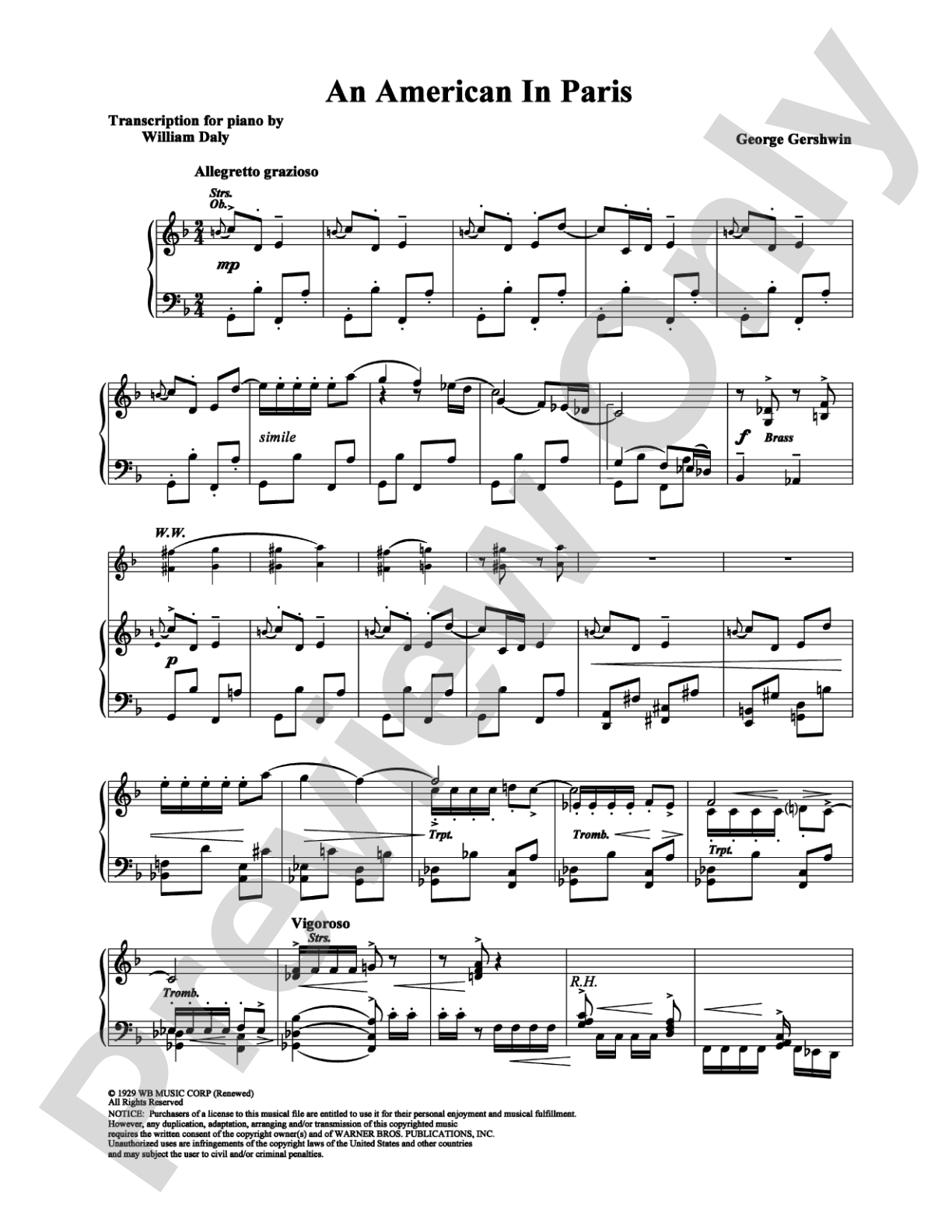
An American in Paris: Piano Digital Sheet Music

An American in Paris: Piano Digital Sheet Music

George Gershwin

Item: 00-PS-0002092

Digital Download
$3.99
Description

An American in Paris: Piano Digital Sheet Music isn't in MakeMusic Cloud just yet...but it could be. Let us know you'd like to see it, and you'll help shape what comes next. In the meantime, start a free trial and dive into thousands of interactive titles your students can play along with today.

Sample Audio
No sample audio found.
Sample Video
Additional Details
SKU: 00-PS-0002092

More about this title

About the Composer: George Gershwin

George Gershwin (1898, 1937) became one of America's most distinctive voices by refusing to choose between classical ambition and popular appeal. His gift was synthesis: he took jazz idioms, blues inflections, and modernist harmonies and wove them into concert works that felt both sophisticated and immediately alive. An American in Paris, composed in 1928, stands as his most direct expression of that philosophy, a work born from his own time in Paris and shaped by everything he heard there, from street musicians to Parisian concert halls.

Why we love this

An American in Paris captures everything that makes Gershwin essential: jazzy rhythms, memorable themes, and orchestral color translated brilliantly for solo piano. The piece sits at the exact intersection of accessibility and sophistication, giving pianists room to explore both technical brilliance and genuine musicality.

What to expect

An American in Paris unfolds like a walk through Manhattan: energetic street scenes give way to reflective moments, then surge back with infectious swagger. The writing sparkles with syncopation and jazz harmonies while maintaining a thoroughly composed, structural logic that feels both spontaneous and inevitable.

Who it's for

Pianists at the intermediate to advanced level will find a piece that rewards technical growth without sacrificing musicality. This is ideal for students ready to explore twentieth-century American idiom and performers building a recital that spans classical, jazz, and popular traditions.

How to get the most out of it

  • Balance the jazz idioms with clarity. Gershwin's syncopations need a light touch; let the offbeat rhythms breathe rather than overstating them.
  • Shape the famous walking bass lines with direction. They anchor the harmonies but should never sound mechanical.
  • Use tempo flexibility to highlight the character shifts between sections. Gershwin marks changes deliberately; honor them as structural signposts.
  • Color the blues chords and chromatic passages distinctly. These moments define the piece's personality and deserve tonal variety.

How to use it

Program this as a centerpiece for a recital exploring American twentieth-century music, or pair it with other Gershwin works to create a focused showcase. It also works as a bridge piece between classical and contemporary contexts, engaging audiences who might not otherwise connect with concert music.

Skills your students will build

  • Interpreting jazz idioms and syncopation in a concert context
  • Managing harmonic complexity across multiple registers
  • Executing fast scalar passages and hand crossings with clarity
  • Balancing melody and accompaniment in blues-inflected writing
  • Responding to compositional architectural changes without losing stylistic coherence

You May Also Like