
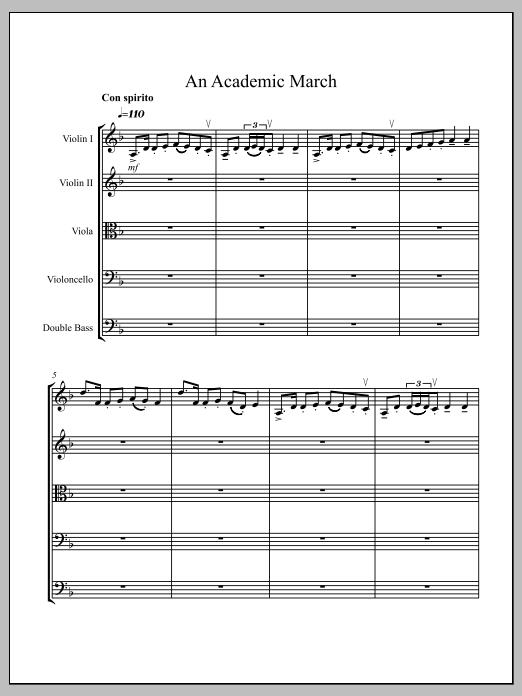

An Academic March: String Orchestra Conductor Score & Parts
Arranged by Richard Chiarappa
Item: 35-PK00270501
$6.95
Pickup currently not available
Buy Extra Parts (Digital PDF Download)
| Product | Price | Quantity |
|---|---|---|
| An Academic March - Full Score | $1.05 | |
| An Academic March - Violin | $0.30 | |
| An Academic March - Violin | $1.50 | |
| An Academic March - Viola | $0.30 | |
| An Academic March - Violoncello | $0.30 | |
| An Academic March - Contrabass | $1.50 |
Parts Added to Cart!
Description
Written and dedicated to my 2011 high school string orchestra, this piece was reviewed in American String Teacher magazine in the May, 2013, Vol. 63 edition. It was given a playing level of Grade 2. Duration: 04:00


An Academic March: String Orchestra Conductor Score & Parts isn't in MakeMusic Cloud just yet...but it could be. Let us know you'd like to see it, and you'll help shape what comes next. In the meantime, start a free trial and dive into thousands of interactive titles your students can play along with today.
Request This Title
Tell us you want it.
Start Your Free Trial
Explore everything that's ready to play right now.
Sample Audio
No sample audio found.
Sample Video
No sample videos found.
Additional Details
Publisher:
Hal Leonard
SKU:
35-PK00270501
More about this title
Why we love this
Chiarappa composed this march specifically for a high school string orchestra, which means every phrase speaks directly to what young players can handle and want to play. The Grade 2 designation from American String Teacher reflects a piece that's genuinely rewarding without punishing rehearsal time; students leave each sectional feeling competent rather than frustrated.
What to expect
Purposeful and measured, with the dignity of a genuine march rather than a simplified imitation. The piece carries a sense of occasion and tradition while remaining accessible, creating moments where young musicians feel the weight of what they're playing.
Who it's for
High school string orchestra directors seeking substantial yet manageable repertoire that students actually enjoy performing. The four-minute duration and Grade 2 difficulty make it ideal for groups building technical confidence without needing extensive preparation time.
How to get the most out of it
- Establish a steady, confident tempo early in rehearsals. The march form depends on rhythmic precision, so lock the pulse before layering articulation refinements.
- Balance the melody across your first violins and violas. Chiarappa likely distributes thematic material intentionally, so follow the score to avoid burying important lines.
- Shape the dynamic contours in four-bar phrases rather than stopping at longer crescendos. Young players respond well to this architectural approach and it builds phrasing awareness.
- Record a section rehearsal on your phone and play it back. Hearing themselves as an ensemble clarifies intonation issues that are invisible in real time.
How to use it
This works beautifully as a standalone concert opener or as part of a themed program pairing classical forms with contemporary student compositions. Its four-minute length makes it valuable filler that elevates rather than dilutes a concert when you need something substantial between longer works.
Skills your students will build
- Sustaining consistent tempo through march form structures
- Balancing melodic and harmonic roles across string sections
- Executing clean ensemble articulations
- Reading and responding to phrase-based dynamic shaping