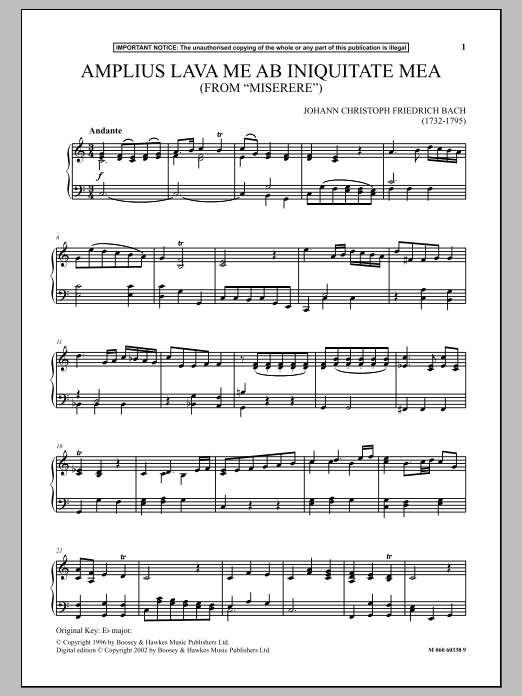
Amplius Lava Me Ab Iniquitate Mea (from Miserere) Sheet Music Preview

Amplius Lava Me Ab Iniquitate Mea (from Miserere): Piano Vocal

As performed by Johann Christoph Friedrich Bach

Item: 35-DS00238124

Digital Download
$5.99
Description

Amplius Lava Me Ab Iniquitate Mea (from Miserere): Piano Vocal isn't in MakeMusic Cloud just yet...but it could be. Let us know you'd like to see it, and you'll help shape what comes next. In the meantime, start a free trial and dive into thousands of interactive titles your students can play along with today.

Sample Audio
No sample audio found.
Sample Video
Additional Details
Publisher: Hal Leonard
Page Count: 7
SKU: 35-DS00238124

More about this title

About the Artist: Johann Christoph Friedrich Bach

Johann Christoph Friedrich Bach (1732–1795) was the youngest and perhaps most progressive son of J.S. Bach. While his father remained rooted in the Baroque, the younger Bach absorbed emerging galant and early Classical styles, creating a musical bridge between two eras. He served as Kapellmeister in Bückeburg and later in London, where he composed prolifically across genres including sacred vocal music, symphonies, and keyboard works.

As a vocal composer, Bach the Younger brought melodic elegance and expressive warmth to sacred texts. His church music balances the contrapuntal discipline inherited from his father with the clearer harmonic language of the Classical period. This particular setting of Psalm 51 demonstrates his gift for combining spiritual depth with singable, accessible writing.

Why we love this

This movement from the Miserere cycle offers soloists a prayer that feels contemporary in its emotional honesty. Bach's vocal line sits naturally in the voice while the piano part provides intelligent harmonic support without overshadowing the text, making it effective in both concert and liturgical settings.

What to expect

Introspective and searching. The music moves through moments of vulnerability and quiet pleading, never demanding but always earnest. You feel held by the harmonic language, supported by the piano as you articulate the deepest concerns of the text.

Who it's for

Advanced vocalists working toward a deeper command of sacred repertoire and directors building liturgical programs or concert programs centered on psalm settings. This suits singers comfortable with German or Latin diction and willing to invest in textual interpretation.

How to get the most out of it

  • Shape the vocal line with careful attention to text underlay. The Latin syllables should feel organic to your phrasing, not constraint it.
  • Balance the piano's role as accompanist rather than equal partner. The voice carries the spiritual weight here.
  • Explore the harmonic shifts as moments of introspection. Bach moves through several tonal regions that, when voiced deliberately, deepen the sense of confession and seeking.
  • Let silence breathe. The spaces between phrases matter as much as the notes themselves in a text this intimate.

How to use it

Pair this with other settings of Psalm 51 (Pergolesi, Purcell, or modern composers) to explore how different eras interpreted this text of repentance. It also fits naturally into services focused on reconciliation or seasons of penitence, and works as a recital piece for singers developing their art song repertoire.

Skills your students will build

  • Sustained legit singing with textual clarity in Latin
  • Harmonic navigation through tonal movement within Classical formal structures
  • Interpretive choices in intimate, single-voice sacred music
  • Collaboration between vocalist and pianist as equals in expressive intent

You May Also Like