
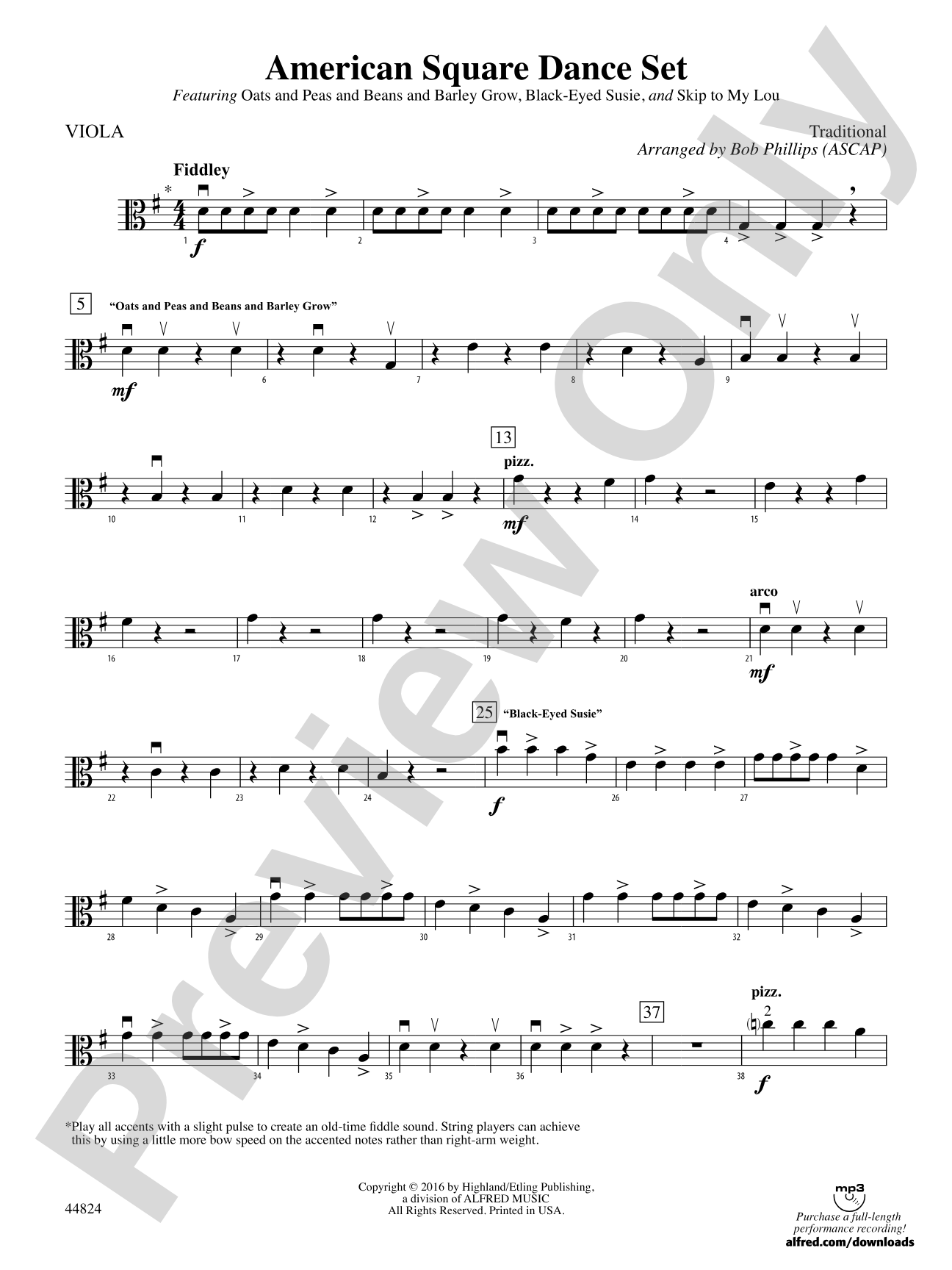

American Square Dance Set: Viola
Featuring: Oats and Peas and Beans and Barley Grow / Black-Eyed Susie / Skip to My Lou
Traditional / arr. Bob Phillips
Grade: 1
Item: 00-PC-0017341_VA1
$5.99
Pickup currently not available
Description
Using only paired eighth notes with the notes on the A, D, and G strings, this accessible piece will help any group sound more mature. This easy, fun tune will delight audiences and students. It includes dancing for a change of pace and to aid in developing a sense of rhythm. The calls to teach the Virginia Reel are in the educational packs. (2:05)


Don't just read it, hear it, play along with it, and watch your students grow with it. In MakeMusic Cloud, American Square Dance Set: Viola comes alive with professional accompaniment, adjustable tempo, and built-in practice tools that turn solo practice into real progress.
Open in the Player
Jump straight in and assign it today.
Start Your Free Trial
Open this title and explore the full library in minutes.
Sample Audio
1
Audio File
--:--
0:00
0:00
Sample Video
Additional Details
Series:
Sound Innovations for String Orchestra
Publisher:
Alfred Music
Page Count:
148
SKU:
00-PC-0017341_VA1
More about this title
About the Arranger: Bob Phillips

Bob Phillips (b. 1953) has spent decades shaping string education through composition, arrangement, and large-group pedagogy. A conductor and teacher trainer, he developed a 700-student string program in Saline, Michigan that became a national model for teaching both classical and eclectic repertoire. His pedagogical vision extends across 25+ book series, including all six levels of Sound Innovations and groundbreaking style collections like Fiddlers Philharmonic, Jazz Philharmonic, and Rock Philharmonic.
With over 200 published works for orchestras and bands, Phillips is an award-winning ASCAP composer whose pieces are performed by thousands of students annually. He founded the Saline Fiddlers Philharmonic, an ensemble that gained international recognition performing 80+ shows yearly and appearing at the White House and the Midwest Clinic. As a conductor, he has worked with youth symphonies, all-state orchestras, and prestigious summer programs including Interlochen and Blue Lake Fine Arts Camp.
Why we love this
This arrangement captures authentic square dance character while staying technically accessible, letting Grade 1 orchestras sound genuinely musical without awkward string crossings or complex fingerings. The inclusion of Virginia Reel calls and dancing transforms rehearsal into something students remember, building rhythmic confidence through movement in ways traditional playing alone cannot. Phillips writes with real knowledge of how beginners actually progress, avoiding the patronizing feel of many easy pieces.
What to expect
Bright and communal, with the warmth of American tradition and the energy of a gathering where fiddlers know the tune inside and out. The paired eighth notes on three strings create texture without density, while the square dance idiom gives the piece an unhurried, sociable character that feels both fun and genuinely musical.
Who it's for
Grade 1 string orchestras looking for repertoire that sounds polished while staying well within technical range. It works equally well for beginning and early intermediate ensembles that benefit from pieces with built-in folk authenticity and clear melodic purpose.
How to get the most out of it
- Keep the paired eighth-note figures crisp and even; they drive the piece's energy and give the square dance its characteristic bounce.
- Use the dancing itself as a rehearsal tool for rhythm section entrances and section changes, since physical coordination naturally locks everyone together.
- Balance the melody across first and second violins so the tune emerges clearly while the accompanimental voices stay supportive.
- Maintain steady tempo throughout; let the dance calls anchor the tempo rather than speeding up during excitement.
How to use it
Perfect for family or school concerts where you want to engage audiences beyond the typical recital format; the dancing provides visual interest and breaks up a program of seated performances. It also works well mid-year when students have enough security to coordinate movement and entrances, or as part of a unit on American folk traditions.
Skills your students will build
- Reading paired eighth-note rhythms in multiple voices
- Staying rhythmically secure while moving or coordinating with dancers
- Playing melody and accompaniment with balance and clarity on three strings
- Understanding drone and harmonic texture in folk music
- Transferring rehearsal skills to ensemble coordination beyond sound alone