American Song Settings, No. 1: 2nd B-flat Trumpet Sheet Music Preview

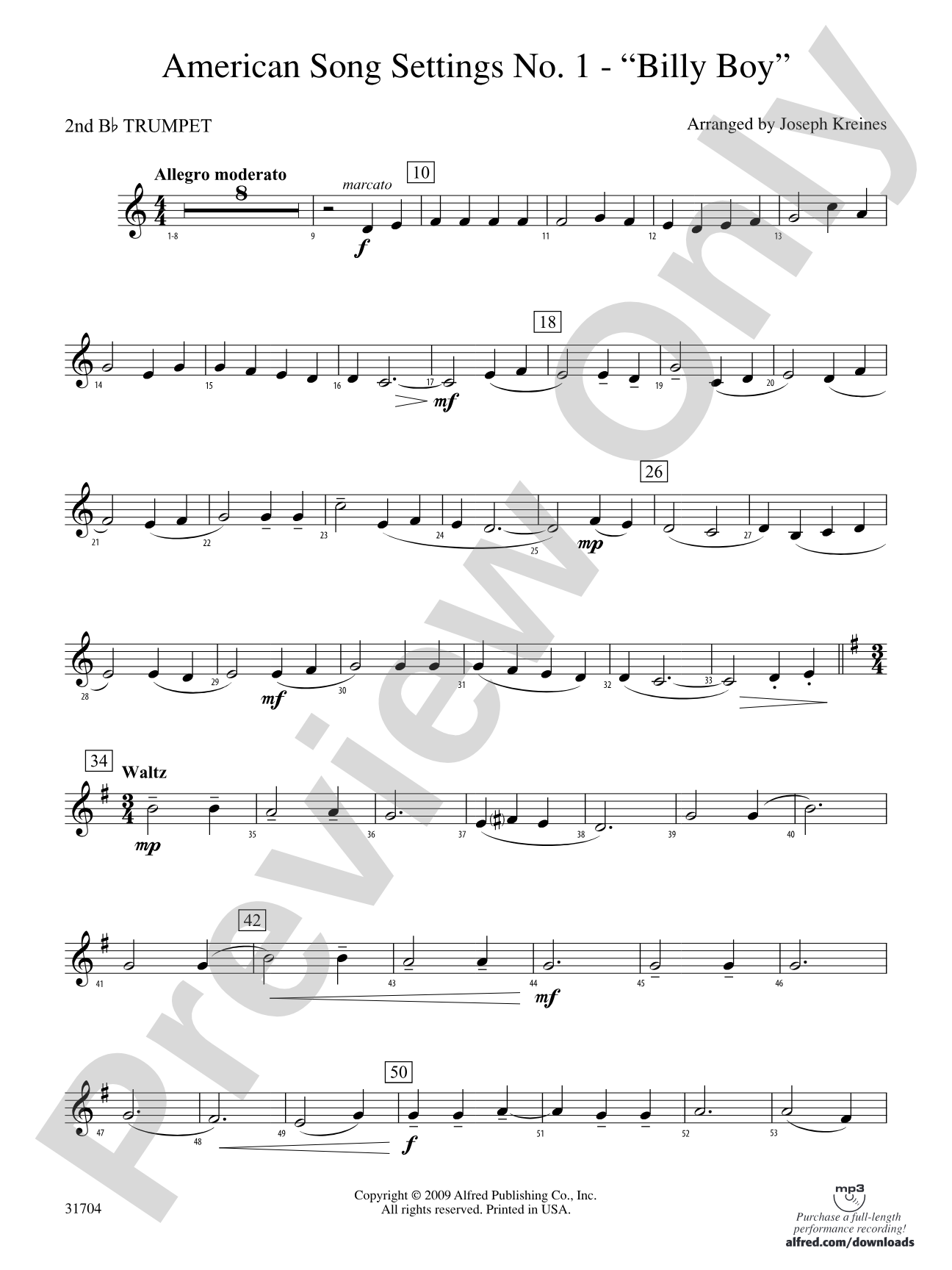
American Song Settings, No. 1: 2nd B-flat Trumpet

"Billy Boy"

Arr. Joseph Kreines

Grade: 1.5 (Easy)

Item: 00-PC-0014860_T2

Digital Download
$3.00
Description
In his American Song Settings, No. 1, Joseph Kreines has created a delightful theme and variations on the well-known traditional melody, "Billy Boy." Every instrument in the band has the melody at some point in this outstanding arrangement done in a distinctly early 20th century British style, providing opportunities for young players to play in 4/4, 3/4 and 2/4 time.

Don't just read it, hear it, play along with it, and watch your students grow with it. In MakeMusic Cloud, American Song Settings, No. 1: 2nd B-flat Trumpet comes alive with professional accompaniment, adjustable tempo, and built-in practice tools that turn solo practice into real progress.

Sample Audio
0:00
0:00
Sample Video
Additional Details
Series: Alfred Debut Series
Publisher: Alfred Music
Page Count: 234
SKU: 00-PC-0014860_T2

More about this title

About the Arranger: Joseph Kreines

Joseph Kreines

Joseph Kreines has built a career spanning conducting, composition, and transcription across Florida's orchestral and operatic landscape. Originally from Chicago, he served as associate conductor of the Florida Symphony Orchestra in Orlando before going on to lead the Brevard Symphony and hold associate conductor positions with The Florida Orchestra in Tampa, while simultaneously directing numerous opera and musical theater productions.

Kreines is equally active as a clinician, guest conductor, and piano accompanist, working with some 300 ensembles throughout the state. His transcription work, particularly his arrangements of Percy Grainger's music, has earned him recognition in the band world. He authored Music for Concert Band, a widely consulted annotated guide to band repertoire, and continues to conduct the Brevard Symphony Youth Orchestra.

Why we love this

Every band member gets time with the melody in this early 20th century British-styled treatment of "Billy Boy," ensuring no section sits out while the arrangement stays accessible at Grade 1.5. The deliberate meter shifts (4/4, 3/4, and 2/4) make this an educational tool that doesn't feel like one, offering young players natural exposure to metric variety without overwhelming them.

What to expect

Elegant and unhurried, like a theme sketched across an antique postcard. The piece drifts through variations with a distinctly early 20th century European sensibility applied to a homespun tune, creating something both familiar and pleasantly transformed.

Who it's for

Young concert bands (Grade 1.5) looking for a substantive arrangement that challenges all players without demanding virtuosity. Directors seeking approachable contest or concert fare that builds musicianship across the ensemble while celebrating an American folk melody.

How to get the most out of it

  • Bring out the theme each time it passes to a new section rather than letting it disappear into the ensemble. Young players love hearing their part emerge from the whole.
  • The meter changes demand clear conducting; don't rush the preparation beats when shifting from one time signature to another, especially for younger bands still building independence.
  • Balance the variations so the development feels fresh rather than repetitive. Subtle dynamics across sections keep the theme recognizable while highlighting the arrangement's resourcefulness.
  • Let the British character show through in the phrasing; this isn't a march or a stomp, but something more lyrical and intentional.

How to use it

Pair this with other arrangements of American folk material for a thematic concert segment, or program it mid-show to showcase your ensemble's ability to handle metric flexibility and melodic transparency. The moderate length and accessibility make it ideal for a young band's first concert or festival appearance.

Skills your students will build

  • Reading mixed meters (4/4, 3/4, and 2/4)
  • Melodic awareness and phrase shaping
  • Balancing individual sections within an ensemble texture
  • Responding to metric and textural variation without losing ensemble cohesion

You May Also Like