
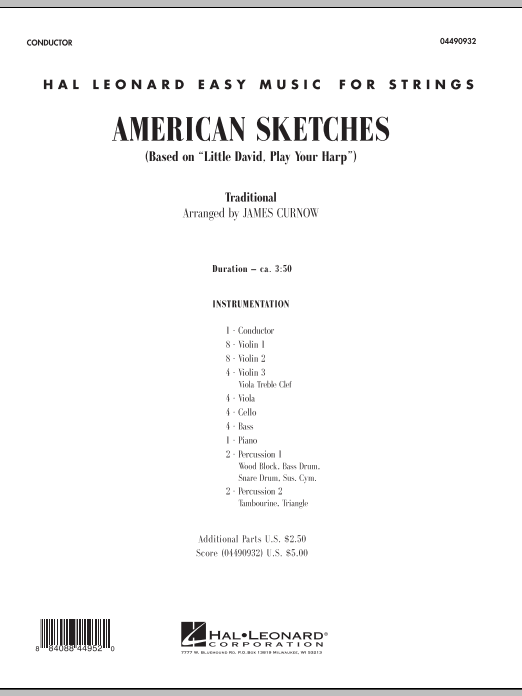

American Sketches: String Orchestra Conductor Score & Parts
By James Curnow
Grade: 2-3
Item: 35-PK00135046
$40.00
Pickup currently not available
Buy Extra Parts (Digital PDF Download)
| Product | Price | Quantity |
|---|---|---|
| American Sketches - Full Score | $6.00 | |
| American Sketches - Violin 1 | $7.00 | |
| American Sketches - Violin 2 | $7.00 | |
| American Sketches - Violin 3 (Viola Treble Clef) | $7.00 | |
| American Sketches - Viola | $7.00 | |
| American Sketches - Cello | $7.00 | |
| American Sketches - Bass | $7.00 | |
| American Sketches - Piano | $7.00 | |
| American Sketches - Percussion 1 | $7.00 | |
| American Sketches - Percussion 2 | $7.00 |
Parts Added to Cart!
Description
Based on the spiritual "Little David, Play Your Harp," James Curnow combines an American orchestral style with contemporary harmonies and orchestration to craft an impressive movement for strings. Simple tempo and style changes add interest and color to this wonderful work for student players. Dur: 3:50


American Sketches: String Orchestra Conductor Score & Parts isn't in MakeMusic Cloud just yet...but it could be. Let us know you'd like to see it, and you'll help shape what comes next. In the meantime, start a free trial and dive into thousands of interactive titles your students can play along with today.
Request This Title
Tell us you want it.
Start Your Free Trial
Explore everything that's ready to play right now.
Sample Audio
No sample audio found.
Sample Video
No sample videos found.
Additional Details
Publisher:
Hal Leonard
SKU:
35-PK00135046
More about this title
About the Composer: James Curnow
James Curnow has spent decades crafting accessible yet sophisticated works for student ensembles across all instruments. His gift lies in respecting the abilities of young players while refusing to write down to them, creating music that sounds mature and polished without demanding virtuosity.
A prolific composer for educational settings, Curnow has built a catalog that balances technical instruction with genuine musical ideas. His arrangements and compositions frequently draw on American musical traditions, filtered through contemporary harmonic language that feels fresh without alienating younger musicians.
Why we love this
Curnow grounds this arrangement in the spiritual tradition but refuses to let it sit quietly; instead, he builds color and momentum through orchestral shifts and contemporary harmonies that keep young string players engaged rather than bored. The tempo and style variations prevent this from feeling like a single idea stretched too long, and the three minute fifty second duration hits that sweet spot where the piece develops real substance without overstaying its welcome.
What to expect
Lyrical yet energized. The spiritual foundation gives the piece warmth and familiarity, while Curnow's orchestral voice pushes it into something more textured and modern. Expect moments of genuine beauty alongside passages that feel open and exploratory.
Who it's for
String orchestras working at the Grade 2 to 3 level who want a repertoire piece that sounds accomplished without requiring advanced technique. This works equally well for groups new to contemporary harmonies and for ensembles ready to explore orchestral color beyond traditional arrangements.
How to get the most out of it
- Pay attention to the style markings at each tempo shift; they're not decorative. The character between sections should feel distinct enough that audiences notice the journey, even when the harmonic language stays connected.
- Balance the melody across your sections rather than letting it live entirely in the violins. Curnow's orchestration is designed to shift emphasis; honor those choices and your sound becomes richer.
- Resist the urge to rush through the simpler passages. Young orchestras often speed up when the writing feels more relaxed, which erases the breathing room Curnow built in.
How to use it
Slot this into a mixed repertoire concert where you want something rooted in American tradition but with enough contemporary spirit to surprise audiences expecting only classics. It also serves as a gateway piece for ensembles beginning to explore how composers build on folk material rather than simply quote it.
Skills your students will build
- Responding to tempo and style changes within a single movement
- Balancing melodic responsibility across different instrumental sections
- Listening for contemporary harmonic language and how it shifts color without disrupting phrase structure
- Maintaining ensemble unity through orchestral shifts and textural changes