
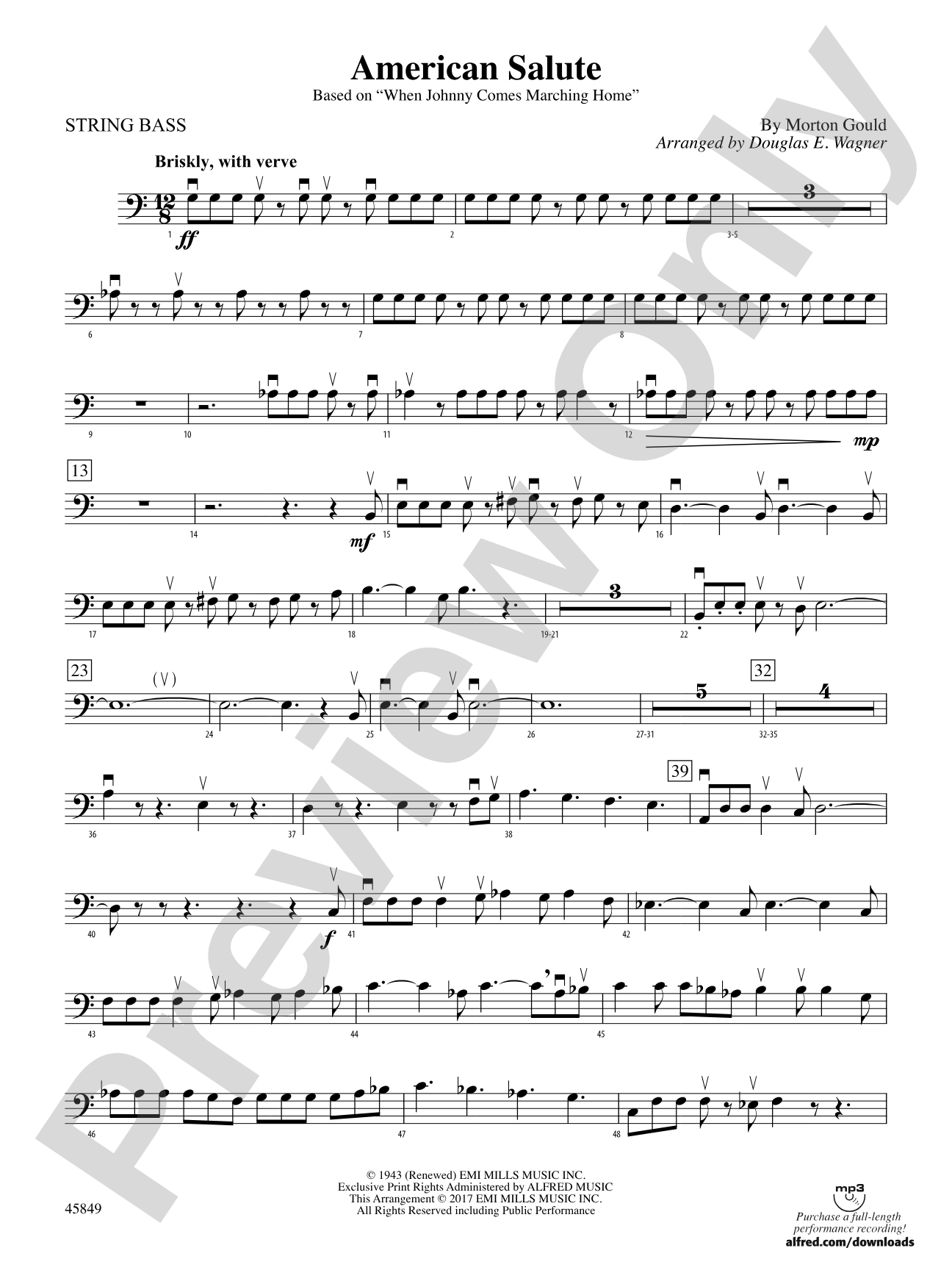

American Salute: String Bass
Based on "When Johnny Comes Marching Home"
Composed by Morton Gould / arr. Douglas E. Wagner
Grade: 3
Item: 00-PC-0017649_SB
$5.99
Pickup currently not available
Description
Morton Gould's iconic 1943 set of orchestral variations on the Civil War tune, "When Johnny Comes Marching Home," has been recorded and performed by major orchestras around the world. This truly American-sounding work, American Salute, is now available in an effective arrangement for string orchestra by Douglas E. Wagner, capturing all of the excitement of the composer's original full orchestra scoring. (4:45)


Don't just read it, hear it, play along with it, and watch your students grow with it. In MakeMusic Cloud, American Salute: String Bass comes alive with professional accompaniment, adjustable tempo, and built-in practice tools that turn solo practice into real progress.
Open in the Player
Jump straight in and assign it today.
Start Your Free Trial
Open this title and explore the full library in minutes.
Sample Audio
1
Audio File
--:--
0:00
0:00
Sample Video
Additional Details
Series:
Belwin Concert String Orchestra
Publisher:
Alfred Music
Page Count:
124
SKU:
00-PC-0017649_SB
More about this title
About the Composer: Morton Gould
Morton Gould (1913-1996) was an American composer and conductor who became one of the most performed composers of the 20th century. His gift for writing directly communicable, orchestrally sophisticated music made him equally at home in concert halls, film studios, and on Broadway. Gould's genius lay in his ability to distill American musical idioms into works of genuine artistic substance, and American Salute stands as one of his most enduring masterpieces.
Why we love this
Douglas E. Wagner's string arrangement preserves every ounce of Gould's original brilliance while making the work genuinely playable by young orchestras. The Grade 3 setting opens this concert staple to orchestras that might otherwise never tackle it, and the variations on "When Johnny Comes Marching Home" give every section moments to shine without sacrificing the punchiness of the original.
What to expect
Patriotic, energetic, and American in the most straightforward sense. Gould's variations shift between solemn and celebratory, tender and triumphant, but always with a warmth and directness that feels earned rather than saccharine. Even at this accessible level, the arrangement carries the full emotional weight of the source material.
Who it's for
String orchestra directors in Grades 6-10 who want a guaranteed-to-work concert piece with genuine orchestral sophistication and immediate audience appeal. This is ideal for orchestras ready to move beyond foundational repertoire but not yet at the advanced level; it rewards solid playing without demanding virtuosity.
How to get the most out of it
- Bring out the contrasting character of each variation clearly. The work depends on distinct emotional shifts between sections, so coach your strings toward stylistic variety even as you maintain musical cohesion.
- Balance the melody across different instrumental families as it moves. This arrangement distributes the famous tune throughout the section, and clarity of line matters more than volume.
- Lock in the rhythmic drive during the march-like passages. This is patriotic music with genuine forward momentum; a flexible tempo here reads as sloppy rather than interpretive.
- Pay attention to dynamic shaping within phrases. Gould's orchestration relies on subtle swells and releases, so encourage your strings to listen for shape rather than playing mechanically to marked dynamics.
How to use it
This belongs on any summer or 4th of July concert and works beautifully as the centerpiece of a patriotic program. You can also program it midseason as a confidence builder for an orchestra transitioning into more ambitious repertoire, or pair it with other Americana works for a thematic concert that audiences will genuinely connect with.
Skills your students will build
- Dynamic contrast and phrasing across sectional variation structures
- Balance and transparency when melody migrates between instrument groups
- Maintaining rhythmic precision during march-like passages
- Listening for orchestral architecture and texture rather than individual parts
- Sustained concentration through a multi-section work without losing stylistic consistency