
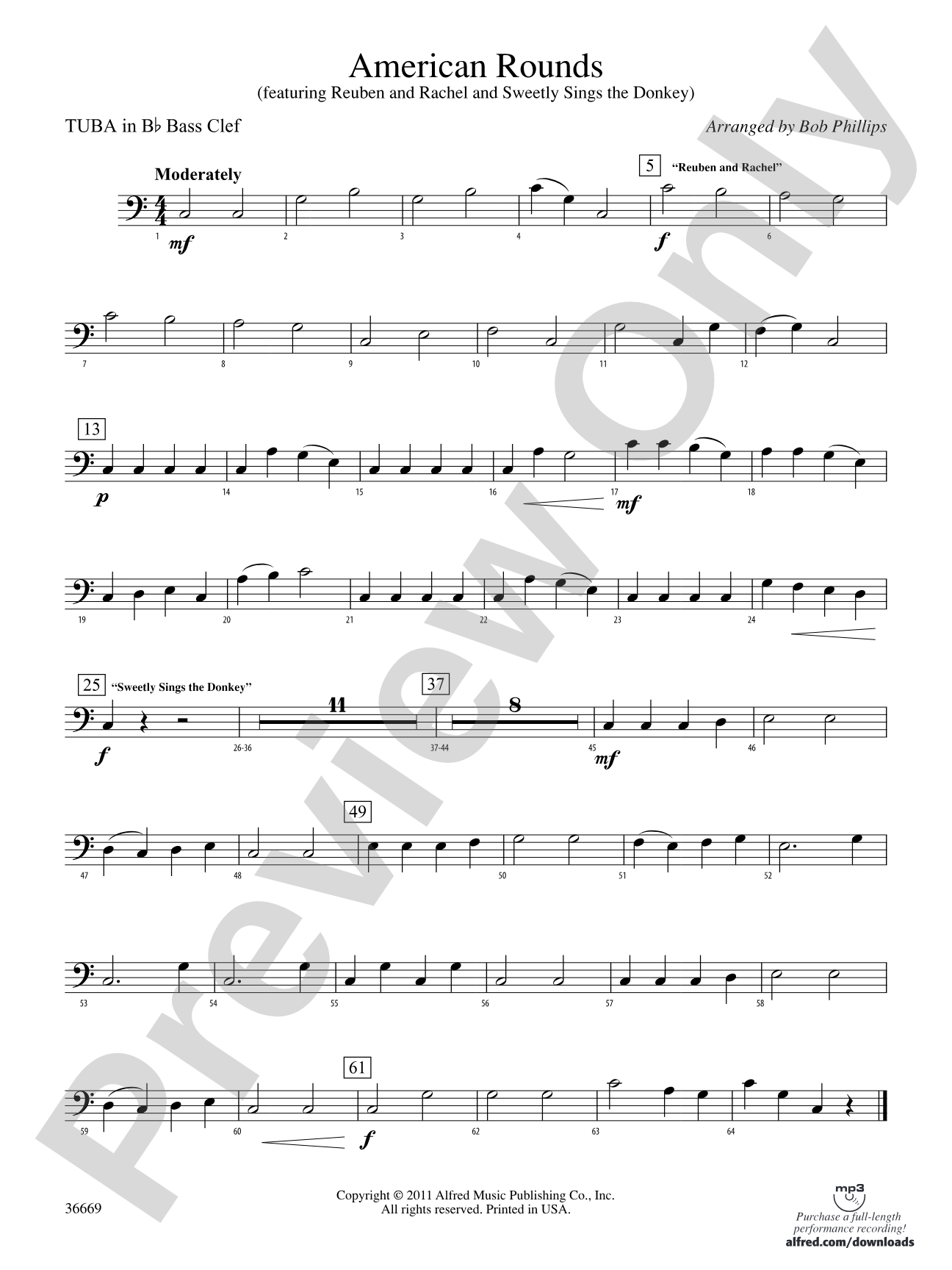

American Rounds: (wp) B-flat Tuba B.C.
Featuring: Reuben and Rachel / Sweetly Sings the Donkey
Arr. Bob Phillips
Grade: 1 (Very Easy)
Item: 00-PC-0015097_wpTBBBC
$3.00
Pickup currently not available
Description
This delightful arrangement for young band features two popular American rounds, "Reuben and Rachel" and "Sweetly Sings the Donkey." Everyone in the band takes turns with these familiar melodies while the percussion section alternates accompanying with woodblock and triangle as well as snare and bass drum. This is a terrific way to get your beginners playing full band arrangements.
American Rounds correlates to Book 1, Level 3 of Sound Innovations for Concert Band. (2:32)


American Rounds correlates to Book 1, Level 3 of Sound Innovations for Concert Band. (2:32)
Don't just read it, hear it, play along with it, and watch your students grow with it. In MakeMusic Cloud, American Rounds: (wp) B-flat Tuba B.C. comes alive with professional accompaniment, adjustable tempo, and built-in practice tools that turn solo practice into real progress.
Open in the Player
Jump straight in and assign it today.
Start Your Free Trial
Open this title and explore the full library in minutes.
Sample Audio
1
Audio File
--:--
0:00
0:00
Sample Video
No sample videos found.
Additional Details
Series:
Sound Innovations for Concert Band
Publisher:
Alfred Music
Page Count:
142
SKU:
00-PC-0015097_wpTBBBC
More about this title
About the Arranger: Bob Phillips

Bob Phillips has shaped music education through decades of innovative work in ensemble pedagogy and composition. A conductor, clinician, and prolific educational composer, he has created over 25 instructional series and more than 200 published works for orchestras and bands, with his compositions regularly performed at the Midwest Clinic. His Sound Innovations series stands as a foundational resource in thousands of classrooms.
Phillips built a nationally recognized string program in Saline, Michigan that grew to over 700 students and became a model for eclectic music education. Beyond the classroom, he founded the Saline Fiddlers Philharmonic, directed programs at major festivals and all-state orchestras across the country, and has conducted at venues ranging from the White House to international folk music festivals. He is an award-winning ASCAP composer whose work consistently reflects his commitment to making quality music accessible and engaging for young musicians.
Why we love this
This arrangement solves a real logistical challenge: giving every young band member meaningful material without overwhelming beginners with complexity. The alternating melodic roles and thoughtful percussion writing keep the entire ensemble engaged throughout, and the familiar American folk melodies make rehearsal enjoyable rather than a grinding exercise in note-reading.
What to expect
Warm and approachable, with the comfort of recognizable American folk tunes that students may already know from singing. The round structure creates a gentle conversation between instruments, and the simple percussion coloring adds character without demanding virtuosity, making the whole piece feel like a celebration rather than a challenge.
Who it's for
Beginning band students in their first or second year who benefit from full ensemble experiences that don't demand advanced technical skills. This works beautifully for students transitioning from method book exercises into short concert pieces, especially those who respond well to familiar melodies and collective success.
How to get the most out of it
- Assign the melodic sections intentionally so that quieter players or newer readers get secure passages while more confident musicians handle the busier moments.
- Work the percussion parts separately first, especially the alternation between pitched and unpitched instruments, so they understand exactly when they're accompanying versus resting.
- Keep the tempo conversational and relaxed; these rounds benefit from a gentle, almost folk-like quality rather than a marching-band precision.
- Use this piece to reinforce proper hand position and embouchure without fighting against awkward fingering patterns, since the straightforward arrangements let students focus on fundamentals.
How to use it
Feature this early in the concert season to build confidence and establish good section balance before tackling more ambitious repertoire. It works equally well as a seasonal program opener, a demonstration of young band capabilities at family nights, or a bridge piece between method book recitals and full concert programs.
Skills your students will build
- Reading simplified concert band voicings while maintaining ensemble balance
- Executing rhythmic alternation between instrumental sections (melody passing and accompaniment switching)
- Responding to conductor cues for section entries and transitions
- Ensemble intonation in unison and simple harmonic contexts
- Basic percussion alternation between different instruments and dynamic roles