
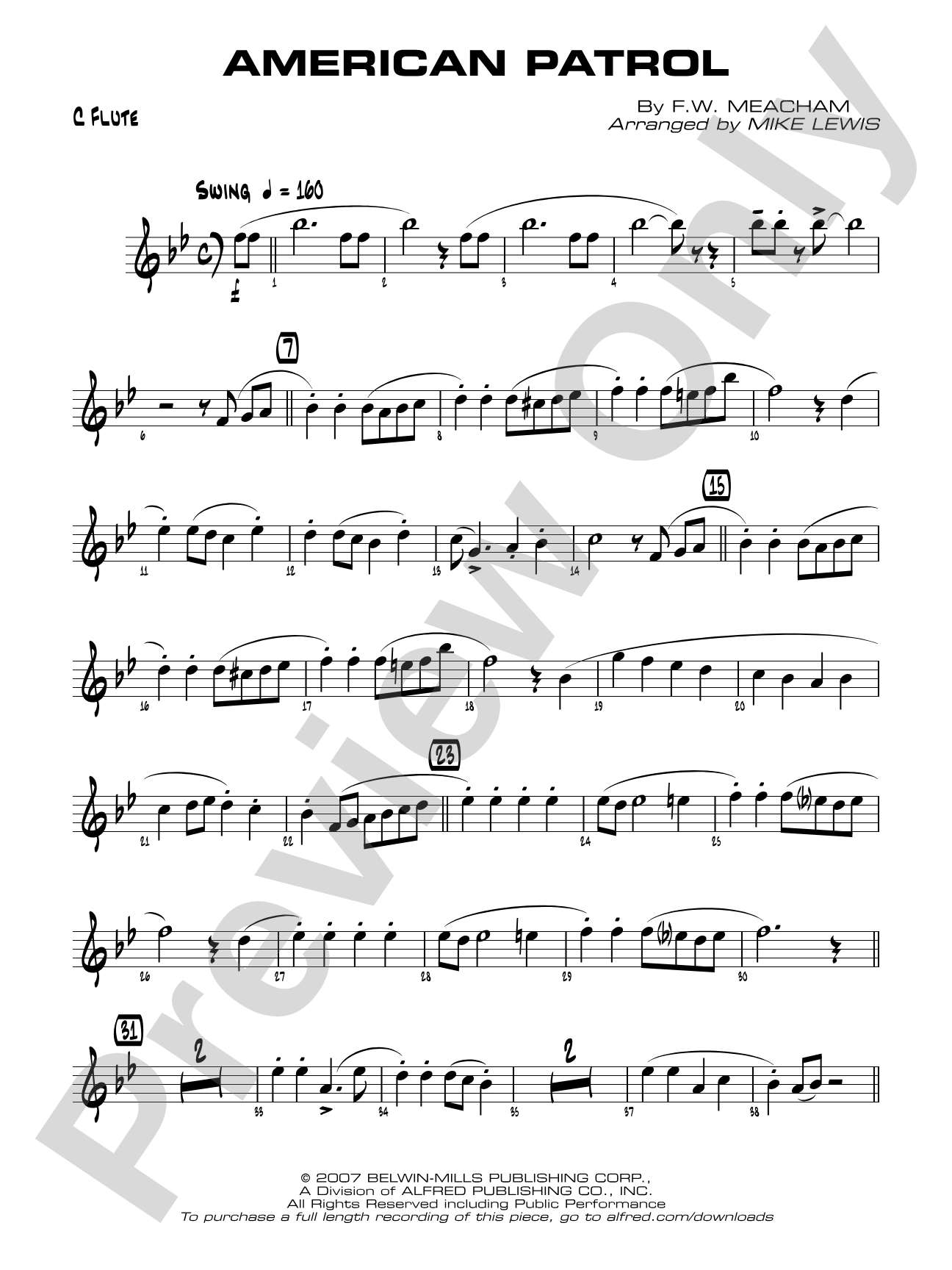

American Patrol: Flute
By Frank W. Meacham / arr. Mike Lewis
Item: 00-PC-0014277_F1
$5.99
Pickup currently not available
Description
Glenn Miller's band made this a huge World War II hit song and it is scored here for the young player. Mike Lewis arranged this chart with no individual solos, very modest brass ranges and plenty of ensemble sound. 1st trumpet range is to written E-flat on the top space. Easy to rehearse and perform. This title is available in MakeMusic Cloud.


Don't just read it, hear it, play along with it, and watch your students grow with it. In MakeMusic Cloud, American Patrol: Flute comes alive with professional accompaniment, adjustable tempo, and built-in practice tools that turn solo practice into real progress.
Open in the Player
Jump straight in and assign it today.
Start Your Free Trial
Open this title and explore the full library in minutes.
Sample Audio
1
Audio File
--:--
0:00
0:00
Sample Video
Additional Details
Series:
First Year Charts for Jazz Ensemble
Publisher:
Alfred Music
Page Count:
78
SKU:
00-PC-0014277_F1
More about this title
About the Composer: Frank W. Meacham
Frank W. Meacham (1856–1909) was an American composer and conductor whose marches and patriotic compositions became fixtures in American band and orchestral repertoires. Writing primarily at the turn of the twentieth century, Meacham crafted music that was accessible, memorable, and deeply rooted in American popular idioms. His most enduring work, "American Patrol," has transcended its original era to become a standard in educational and professional ensembles alike.
Meacham's contribution to American music lies not in complex harmonic innovation but in his gift for writing straightforward, singable melodies that capture patriotic sentiment without pretension. His works have remained in continuous performance for over a century, a testament to their durability and their appeal to musicians of all skill levels.
Why we love this
Mike Lewis's arrangement captures what makes "American Patrol" work: a flag-waving melody that students recognize instantly, enough harmonic interest to keep ensemble players engaged, and absolutely no chest-thumping solo passages to derail rehearsal. The modest brass ranges and balanced scoring mean your section leaders can focus on blend and ensemble sound rather than battling heroic high notes. This is the rare patriotic chart that feels genuine rather than overstuffed.
What to expect
"American Patrol" carries the unmistakable energy of a World War II-era big band hit: optimistic, forward-moving, and infectiously patriotic. The melody is instantly recognizable and almost impossible not to enjoy; there's a straightforward dignity to the writing that feels neither cynical nor saccharine. Players experience the satisfaction of making something that sounds organized and intentional from the first rehearsal.
Who it's for
First-year jazz ensemble students and young players in grades 5-8 who are still building fundamental ensemble skills. Conductors looking for material that builds confidence in inexperienced players without sacrificing musical substance will find this both accessible and rewarding to teach.
How to get the most out of it
- Balance the melody between trumpets and saxophones so neither section overshadows the other; the arrangement distributes it intentionally, and honoring that distribution creates clarity.
- Lock the rhythm section into a tight swing pocket from the start of rehearsals. The chart's accessibility depends on groove stability, not flashy comping.
- Shape the patriotic sections with a sense of march without letting the tempo drag or feel mechanical; find the march feeling within a jazz ensemble context.
- Keep the ensemble sound forward and cohesive rather than featuring individual timbres. The arrangement's strength lies in unified color.
How to use it
Open a spring or summer concert with this familiar title to establish immediate audience connection, or program it midway through to provide a tonal palette shift if your set leans heavily into bebop heads or modern charts. It also works beautifully as a warm welcome-back piece in September when first-year students are still acclimating to ensemble demands.
Skills your students will build
- Swing rhythm and groove in a big band context
- Balanced ensemble sound without featured soloists
- Reading jazz chord symbols and changes
- Coordinating trumpet, saxophone, and rhythm sections in a jazz ensemble setting
- Marching feel and march-influenced phrasing within jazz idiom