
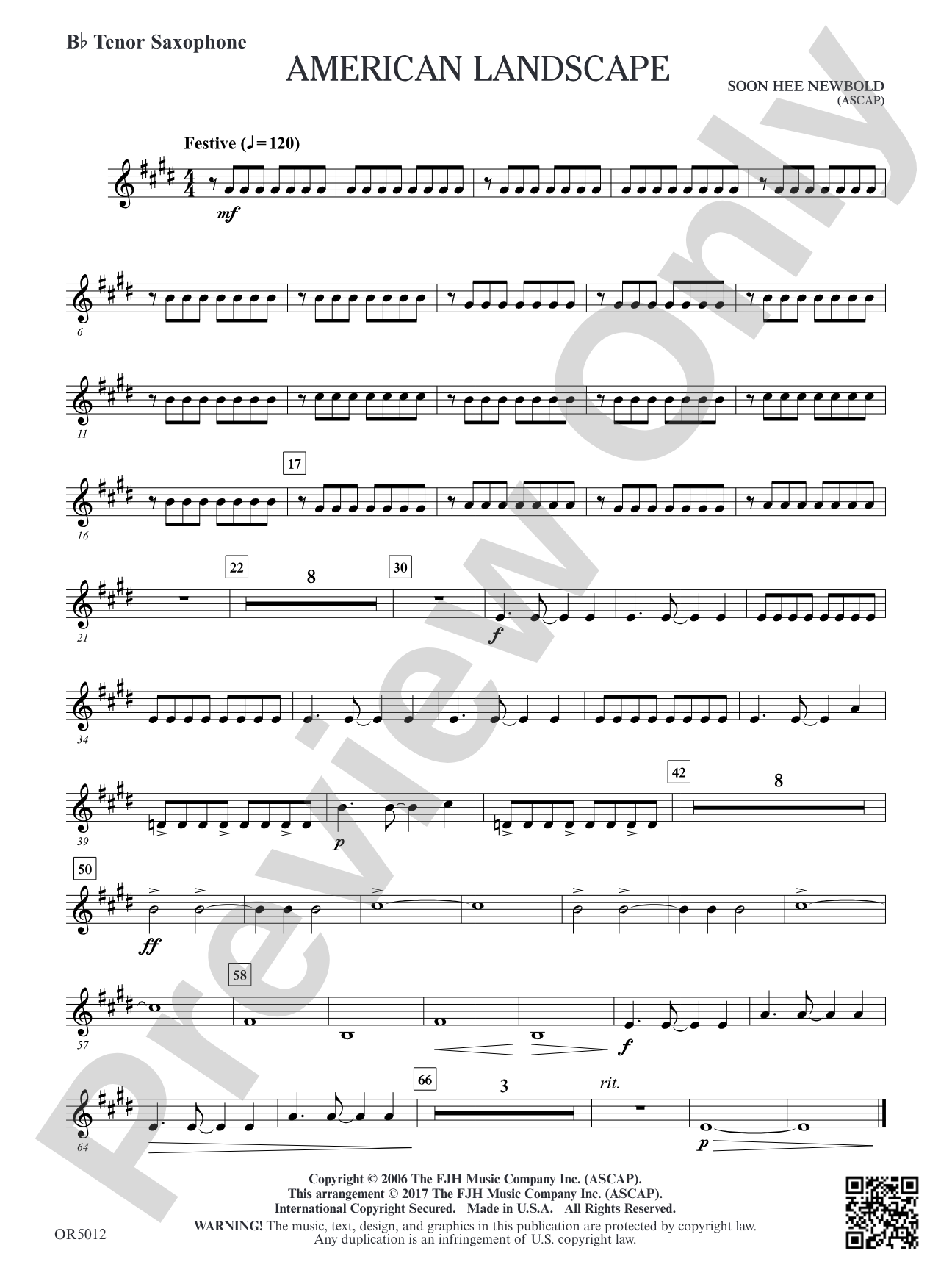

American Landscape: Optional B-flat Tenor Saxophone
By Soon Hee Newbold
Grade: 3.5
Item: 98-PC-DOR5012_OTX
$7.00
Pickup currently not available
Description
Inspired by train rides through the countryside, this full orchestra work depicts our diverse landscape from vast plains to majestic mountains; from forests and streams to large cities. Rich in history and many cultures, the land tells many stories as varied as the backdrop. The style and spirit of the piece has influences from film and other contemporary American composers. Enjoy the soaring melodies and many colors of a cross-country train ride through the diverse scenes of America.


Don't just read it, hear it, play along with it, and watch your students grow with it. In MakeMusic Cloud, American Landscape: Optional B-flat Tenor Saxophone comes alive with professional accompaniment, adjustable tempo, and built-in practice tools that turn solo practice into real progress.
Open in the Player
Jump straight in and assign it today.
Start Your Free Trial
Open this title and explore the full library in minutes.
Sample Audio
1
Audio File
--:--
0:00
0:00
Sample Video
No sample videos found.
Additional Details
Series:
FJH Symphony Orchestra
Publisher:
The FJH Music Company, Inc.
SKU:
98-PC-DOR5012_OTX
More about this title
About the Composer: Soon Hee Newbold

Soon Hee Newbold brings a global perspective to orchestral writing, shaped by her background as both a concert performer and seasoned composer. Beginning her musical training at five on piano and seven on violin, she performed professionally around the world before establishing herself as a major voice in contemporary composition. Her works span from professional symphony orchestras to elementary ensembles and have been heard at Carnegie Hall, the Kennedy Center, Lincoln Center, Disney Hall, Wolf Trap, and the Midwest Band and Orchestra Clinic.
As a guest clinician and keynote speaker, Newbold regularly conducts ensembles across the United States and internationally, including in the Netherlands, Belgium, Australia, Indonesia, Singapore, and China. She has also composed for film and recording projects in Hollywood, lending her distinctive cross-cultural voice to multiple media. Her compositions consistently reflect the diverse musical traditions and ethnic styles she has encountered throughout her career.
Why we love this
This score captures the sweep and drama of American geography while remaining genuinely accessible for Grade 3.5 ensembles. Newbold writes with orchestral sophistication without losing sight of what young musicians can execute, making it an ideal festival or contest selection that sounds ambitious without being punitive. The narrative structure of a cross-country journey provides natural pacing and visual interest that keeps student musicians engaged throughout the work.
What to expect
The piece unfolds like watching landscape roll past a train window: moments of quiet, expansive beauty give way to energetic passage through bustling cities, then ease into the serenity of forests and streams. Newbold's score layers instruments to create depth and movement, honoring both the grandeur of the American terrain and the diverse cultures that inhabit it.
Who it's for
Conductors seeking repertoire that combines patriotic spirit with contemporary compositional language, suitable for concert programs, festivals, and contest environments. Young orchestras at the Grade 3.5 level can handle the technical demands while experiencing genuinely artistic orchestration rather than simplified scoring.
How to get the most out of it
- Balance the soaring melodic passages across different sections; resist the urge to let upper strings or woodwinds dominate, as the varied landscapes demand equally varied textural priorities.
- Attend to the film-influenced compositional approach by conducting with a cinematic eye for transition between scenes. Let tempo and dynamic shifts feel organic rather than mechanical.
- Shape phrases according to the geographic imagery. Mountains demand different musical weight than plains; use bow pressure, articulation, and breath support to help students visualize and express these contrasts.
How to use it
Program this as an opener or centerpiece for a concert celebrating American music and identity. Its Grade 3.5 difficulty makes it an excellent vehicle for festival or competition entries while adding substantive repertoire to patriotic programming. The narrative arc also works well alongside other Americana-inspired works or as a standalone feature piece that gives young orchestras a chance to demonstrate musical maturity.
Skills your students will build
- Managing dynamic contrast across sustained melodic lines
- Sectional independence while maintaining ensemble unity
- Responding to cinematic pacing and transitional shifts
- Balancing multiple simultaneous colors in thick orchestration
- Connecting musical gesture to programmatic imagery