
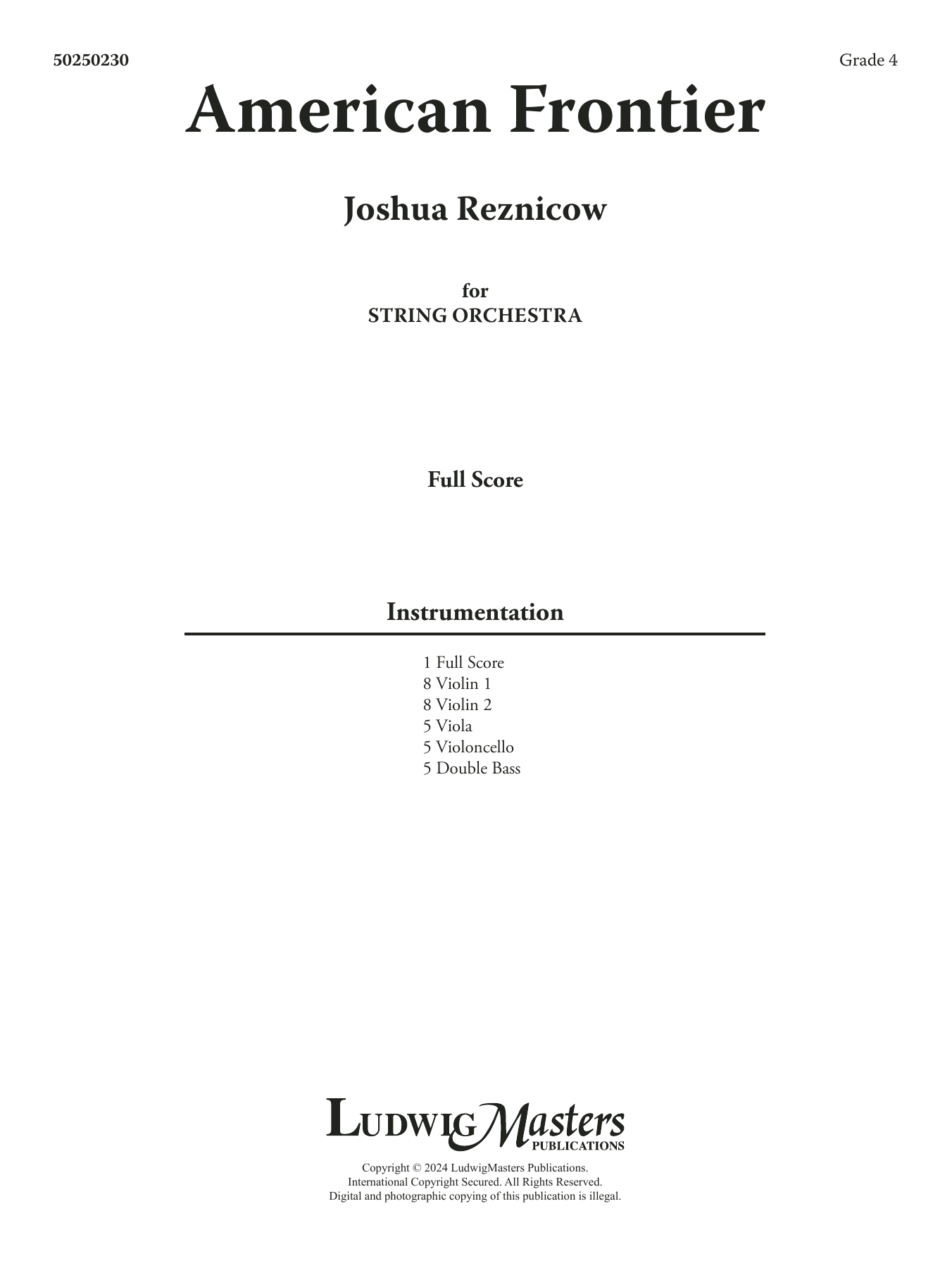

American Frontier: String Orchestra Conductor Score & Parts
By Joshua Reznicow
Grade: 4
Item: 35-PK01513606
$70.00
Pickup currently not available
Buy Extra Parts (Digital PDF Download)
| Product | Price | Quantity |
|---|---|---|
| American Frontier - Full Score | $8.00 | |
| American Frontier - Violin 1 | $5.00 | |
| American Frontier - Violin 2 | $5.00 | |
| American Frontier - Viola | $5.00 | |
| American Frontier - Cello | $5.00 | |
| American Frontier - Bass | $2.50 |
Parts Added to Cart!
Description
AMERICAN FRONTIER for string orchestra was written utilizing various ensemble configurations from within the string orchestra. Solo lines, quartet, quintet, and sectional soli all help to make up the overall design and orchestral colors of the piece. As a juxtaposition to this, large divisi string writing is utilized to help balance the smaller ensemble writing within the score. The work is inspired by images of a western frontierone filled with large fields, mountains and sunsets, as well as subtle character-filled details that would have a forward and fast-moving feel.


American Frontier: String Orchestra Conductor Score & Parts isn't in MakeMusic Cloud just yet...but it could be. Let us know you'd like to see it, and you'll help shape what comes next. In the meantime, start a free trial and dive into thousands of interactive titles your students can play along with today.
Request This Title
Tell us you want it.
Start Your Free Trial
Explore everything that's ready to play right now.
Sample Audio
No sample audio found.
Sample Video
No sample videos found.
Additional Details
Publisher:
Hal Leonard
SKU:
35-PK01513606
More about this title
Why we love this
Reznicow balances technical sophistication with genuine lyricism by threading solo and chamber textures through a larger orchestral canvas. The varied string configurations prevent monotony while remaining performable by Grade 4 ensembles, and the programmatic inspiration gives students a clear emotional anchor for their interpretive choices.
What to expect
Wide open spaces and sweeping vistas unfold across the ensemble, with intimate character moments catching light like details in a landscape. The piece moves with purposeful energy, balancing grand orchestral gestures against moments where just a few voices speak, creating a cinematic quality that feels both epic and personal.
Who it's for
Conductors seeking a mid-level string orchestra work that challenges players through varied textures and ensemble roles without overwhelming them technically. This fits programs that want to program something narrative and evocative while developing sectional awareness and independence.
How to get the most out of it
- Balance the solo and small ensemble passages by bringing forward players who are rhythmically secure; this isn't about volume but clarity and presence.
- Shape the divisi sections with attention to inner voice independence. Even when strings split into many parts, each line should breathe as if it's being sung.
- Establish a steady forward momentum throughout. The piece's inherent energy comes from its directional quality, so avoid dragging even the more lyrical moments.
- Coordinate transitions between ensemble configurations carefully in rehearsal. Mark exactly where players are "on" and "off," and be explicit about who leads during smaller groupings.
How to use it
Pair this with lighter contemporary works or classical repertoire to showcase range in a concert program. Its programmatic nature makes it particularly effective as a centerpiece when framed alongside other American works or used to anchor a thematic concert exploring landscape and place in music.
Skills your students will build
- Playing in small ensemble configurations (solos, quartets, quintets) within a larger orchestral context
- Managing rhythmic precision when divided across multiple parts
- Executing divisi string writing with voice independence
- Responding to conductor cues when transitioning between solo, sectional, and full ensemble textures
- Sustaining phrasing and forward motion across longer lyrical lines