
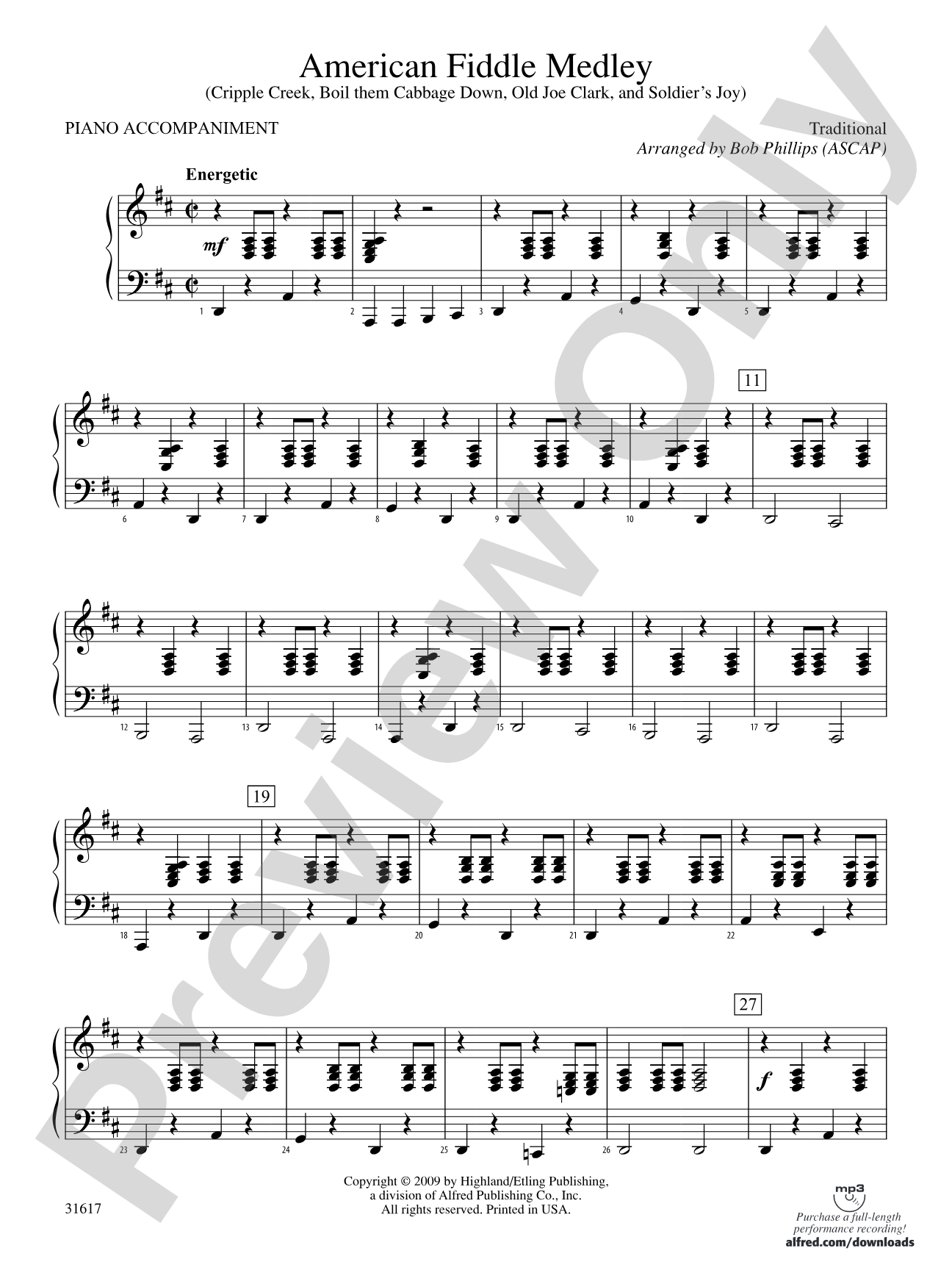

American Fiddle Medley: Piano Accompaniment
Featuring: Cripple Creek / Boil Them Cabbage Down / Old Joe Clark / Soldier's Joy
Traditional / arr. Bob Phillips
Grade: 2
Item: 00-PC-0001779_K
$5.99
Pickup currently not available
Description
Bring out the cowboy hats and bandanas for this fantastic arrangement of everyone's favorite fiddle tunes! Perfect for young players or as a quick play-down finale for older players, this medley will soon become a favorite that you hear them playing before class begins. All sections play the melodies, providing interest and a chance to work on dynamics. Performance recommendations to help make the tunes sound "fiddley" are provided in the score. This title is available in MakeMusic Cloud.


Don't just read it, hear it, play along with it, and watch your students grow with it. In MakeMusic Cloud, American Fiddle Medley: Piano Accompaniment comes alive with professional accompaniment, adjustable tempo, and built-in practice tools that turn solo practice into real progress.
Open in the Player
Jump straight in and assign it today.
Start Your Free Trial
Open this title and explore the full library in minutes.
Sample Audio
1
Audio File
--:--
0:00
0:00
Sample Video
Additional Details
Series:
Highland/Etling String Alternatives
Publisher:
Alfred Music
Page Count:
66
SKU:
00-PC-0001779_K
More about this title
About the Arranger: Bob Phillips

Bob Phillips has spent more than five decades developing innovative approaches to string education, earning recognition as a composer and arranger whose work shapes how young musicians learn ensemble playing. His career reflects deep expertise in pedagogical writing; he authored all six levels of the Sound Innovations series and pioneered eclectic styles publications including Fiddlers Philharmonic, Jazz Philharmonic, Rock Philharmonic, and Mariachi Philharmonic. Over 200 of his compositions and arrangements have been published for orchestras and bands, and his work regularly appears at the Midwest Clinic.
For 27 years, Phillips built the string program in Saline, Michigan into a national model serving over 700 students across classical and eclectic repertoire. He founded the Saline Fiddlers Philharmonic, an ensemble that performed internationally and made multiple appearances at the White House. His instructional work extends to conducting roles at prestigious venues: he served as resident conductor and arranger for the Wintergrass Festival in Seattle for 12 years and has led state and all-state orchestras across the country. Phillips is an award-winning ASCAP composer whose instructional DVDs, String Clinics to Go, have become teaching tools in thousands of classrooms.
Why we love this
This medley captures what makes fiddle tunes so infectious while honoring the acoustic reality of young string players. Phillips builds in doubling across sections so every player carries melody at some point, creating visibility and ownership that students remember and want to repeat. The included performance recommendations in the score guide you toward authentic fiddle character without requiring specialized technique knowledge.
What to expect
These fiddle tunes arrive with an energy that feels lived-in and celebratory, evoking barn dances and front porch gatherings rather than concert hall formality. The arrangement invites players into a style where rhythm breathes, dynamics sing, and ensemble playing becomes joyful rather than precise.
Who it's for
String orchestras in grades 2 and above will find this medley accessible and rewarding. It works equally well for younger ensembles seeking melodic engagement and older groups looking for a high-energy closer that connects with audiences instantly.
How to get the most out of it
- Study the performance recommendations in the score before rehearsal; they address specific articulation and bowing choices that distinguish these tunes from standard classical repertoire.
- Shape the dynamics generously within each tune rather than playing at one volume throughout; fiddle music thrives on rhythmic lift and accent contrast.
- Balance the melody across sections as it passes between violins, violas, and cellos so the tune remains clear even when players are accustomed to blending as accompaniment.
- Layer in the character gradually across rehearsals; begin with clean ensemble fundamentals and add the stylistic personality once intonation and rhythm lock together.
How to use it
Reserve this as a finale on concerts where you want the audience laughing and tapping along; it lands with immediate appeal after more formal repertoire. It also serves as an excellent rehearsal morale piece, the kind your students will request and play before class begins without prompting.
Skills your students will build
- Stylistic interpretation of folk idioms beyond classical articulation and phrasing
- Melodic awareness across multiple sections through shared thematic material
- Dynamic shaping within short phrases and tuneful passages
- Rhythmic vitality and stylistic accent distinct from standard orchestral technique
- Listening for ensemble balance when melody moves between instrument families