
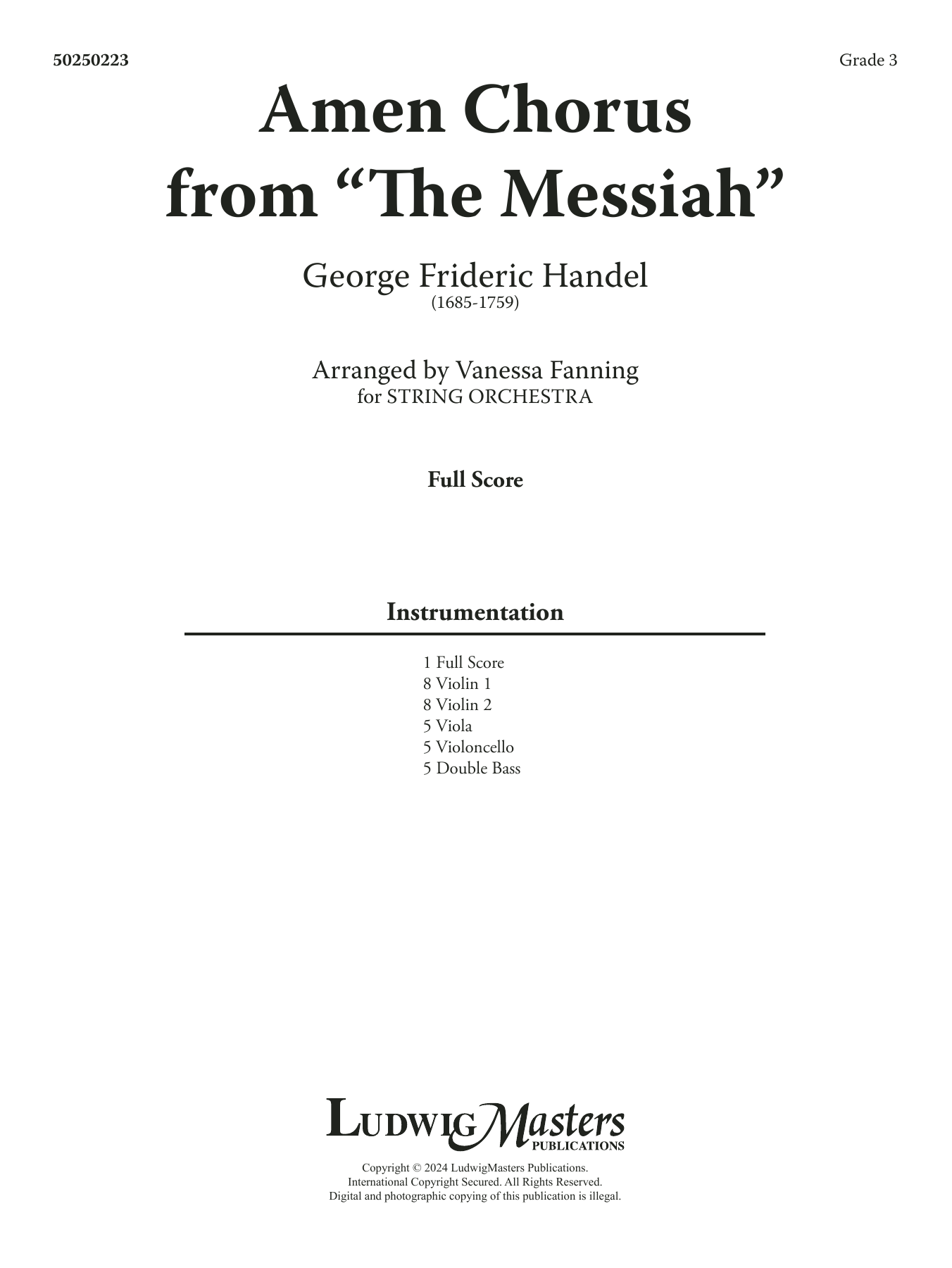

Amen Chorus (from The Messiah) (arr. Vanessa Fanning): String Orchestra Conductor Score & Parts
By George Frideric Handel / Arranged by Vanessa Fanning
Grade: 3
Item: 35-PK01513657
$50.00
Pickup currently not available
Buy Extra Parts (Digital PDF Download)
Parts Added to Cart!
Description
This arrangement of George Frideric Handels AMEN CHORUS is skillfully arranged for string orchestra. The fugue-like nature of the piece is the perfect setting for a chamber ensemble or orchestra. Each part is masterfully structured for the string musician with optimal use of bowings and phrasing. This classic is sure to be a classic for your ensemble as well.


Amen Chorus (from The Messiah) (arr. Vanessa Fanning): String Orchestra Conductor Score & Parts isn't in MakeMusic Cloud just yet...but it could be. Let us know you'd like to see it, and you'll help shape what comes next. In the meantime, start a free trial and dive into thousands of interactive titles your students can play along with today.
Request This Title
Tell us you want it.
Start Your Free Trial
Explore everything that's ready to play right now.
Sample Audio
No sample audio found.
Sample Video
No sample videos found.
Additional Details
Publisher:
Hal Leonard
SKU:
35-PK01513657
More about this title
About the Composer: George Frideric Handel
George Frideric Handel (1685-1759) was a master of dramatic musical architecture, composing across opera, oratorio, and instrumental music with equal command. His works shaped the Baroque sound world and remain central to music education because of their clarity, structural brilliance, and emotional directness. The Messiah stands as one of his most performed works, celebrated for its memorable melodies and accessible harmonic language that makes it ideal for students learning large-scale choral and orchestral writing.
Why we love this
Fanning's arrangement captures the architectural integrity of Handel's fugal writing while making it genuinely playable for a chamber or full string section. The piece sits at that sweet spot where students encounter real contrapuntal thinking without drowning in complexity, and the writing respects how strings actually function rather than forcing them into awkward compromises.
What to expect
Stately, purposeful, and architecturally satisfying. The subject unfolds with quiet authority as it passes from voice to voice, creating a sense of orderly inevitability rather than drama. There's a meditative quality to the counterpoint, grounded in the affirmation the text itself carries.
Who it's for
String orchestras and chamber ensembles working at the intermediate level who want to tackle genuine contrapuntal literature without getting lost in four-part complexity. Directors seeking a recognizable, substantial piece that deepens students' grasp of fugal writing and baroque style.
How to get the most out of it
- Shape the subject entries across your ensemble with consistent articulation; the fugal architecture only reads clearly if each entry stands out as a distinct voice rather than blending into texture.
- Balance inner voices carefully during stacked entries so the listener hears the independent lines weaving together rather than perceiving a thick, undifferentiated chord.
- Trust the bowings indicated in the parts. Fanning's slurring and detaching choices are designed to clarify the counterpoint, not arbitrary.
- Take time in rehearsal to have different sections switch parts so players understand how the theme migrates through the texture.
How to use it
This works beautifully on a holiday concert where you want something substantial beyond typical seasonal fare, or as part of a baroque survey that includes other Handel or Bach selections. It also serves well in the classroom as a teaching piece for students studying fugue and voice leading, since they can follow the score while hearing real musicians execute the lines.
Skills your students will build
- Following fugal subjects through multiple voice entries
- Maintaining independence of line while balancing ensemble sound
- Reading baroque articulation and phrasing conventions
- Understanding counterpoint through performance rather than analysis alone
- Sustaining intonation across long, lyrical string passages