
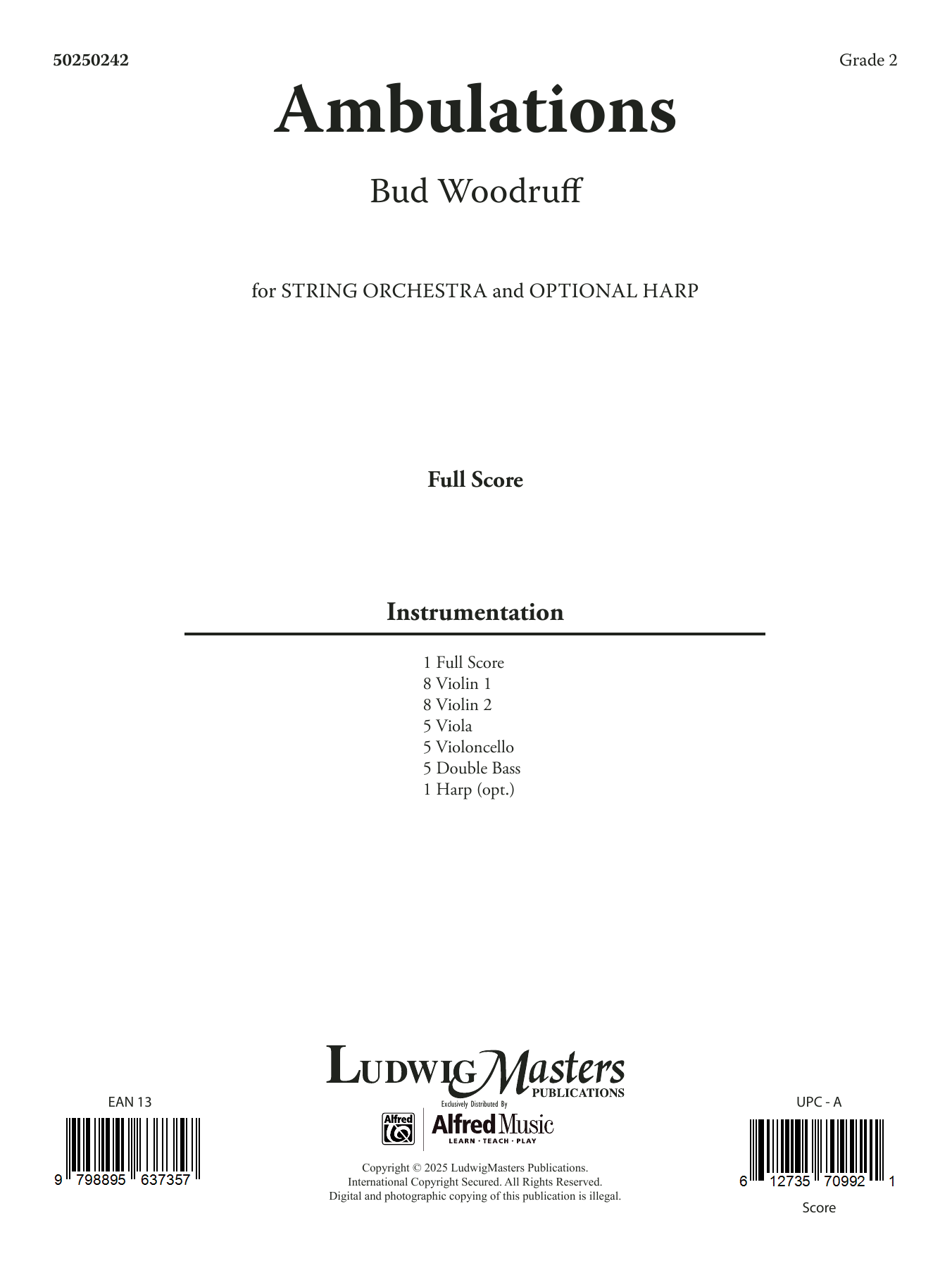

Ambulations: String Orchestra Conductor Score & Parts
By Bud Woodruff
Grade: 2
Item: 35-PK01699900
$55.00
Pickup currently not available
Buy Extra Parts (Digital PDF Download)
| Product | Price | Quantity |
|---|---|---|
| Ambulations - Full Score | $7.00 | |
| Ambulations - Violin 1 | $2.50 | |
| Ambulations - Violin 2 | $2.50 | |
| Ambulations - Viola | $2.50 | |
| Ambulations - Cello | $2.50 | |
| Ambulations - Bass | $2.50 | |
| Ambulations - Harp | $2.50 |
Parts Added to Cart!
Description
"Ambulations" means "Walkings." This piece brings to mind at least three different things that could occur when one is out walking with a friend. First, you could be walking and the sun is shining, the air pleasing, and you would be in complete agreement with your friend. Second, you could be in conversation with a companion while walking, and the conversation would flow back and forth, both of you shedding colorful details and good information. The third occurrence could be when one is out walking and something interferes with what you are doing. It could be the beginnings of rain, some pesky bugs, an argument, or puddles in your path. Everyone may imagine their own, completely different, scenario of what this piece may mean to them. Have your students write their thoughts and send them to me, along with a recording of them performing the piece. I would love to hear their performance and read their thoughts.


Ambulations: String Orchestra Conductor Score & Parts isn't in MakeMusic Cloud just yet...but it could be. Let us know you'd like to see it, and you'll help shape what comes next. In the meantime, start a free trial and dive into thousands of interactive titles your students can play along with today.
Request This Title
Tell us you want it.
Start Your Free Trial
Explore everything that's ready to play right now.
Sample Audio
No sample audio found.
Sample Video
No sample videos found.
Additional Details
Publisher:
Hal Leonard
SKU:
35-PK01699900
More about this title
Why we love this
Woodruff's narrative approach invites student musicians to become storytellers rather than passive readers of notes. The open-ended imagery sparks genuine musical interpretation and personal connection, making this far more engaging than a generic Grade 2 piece. Best of all, the composer actively welcomes student responses, turning a single performance into an ongoing dialogue about what music can express.
What to expect
Three distinct moments unfolding like a walk through changing terrain. Sunshine, conversation, and disruption each carry their own character, inviting listeners into the composer's world while leaving space for their own interpretations.
Who it's for
Grade 2 string orchestras ready to move beyond technical exercises into expressive storytelling. This works beautifully for programs where student input and imagination matter as much as note accuracy.
How to get the most out of it
- Spend time with your students discussing which 'walking' scenario they imagine during each section. Let their chosen imagery guide how they shape phrases and dynamics.
- Balance the conversational back-and-forth moments between sections. Think of it as dialogue where each part listens before responding, not simply alternating.
- Pay attention to transitions between contrasting moods. Mark where the weather shifts or the argument begins so players understand the dramatic arc.
How to use it
Program this at a spring or fall concert where students can reflect on their own neighborhood walks. The approachable technical level makes it ideal for a younger group to close a concert or bridge into more ambitious repertoire later in the season.
Skills your students will build
- Phrasing and shaping for expressive effect
- Identifying and executing contrasting musical moods
- Listening for balance in ensemble texture
- Translating narrative and imagery into musical choices