
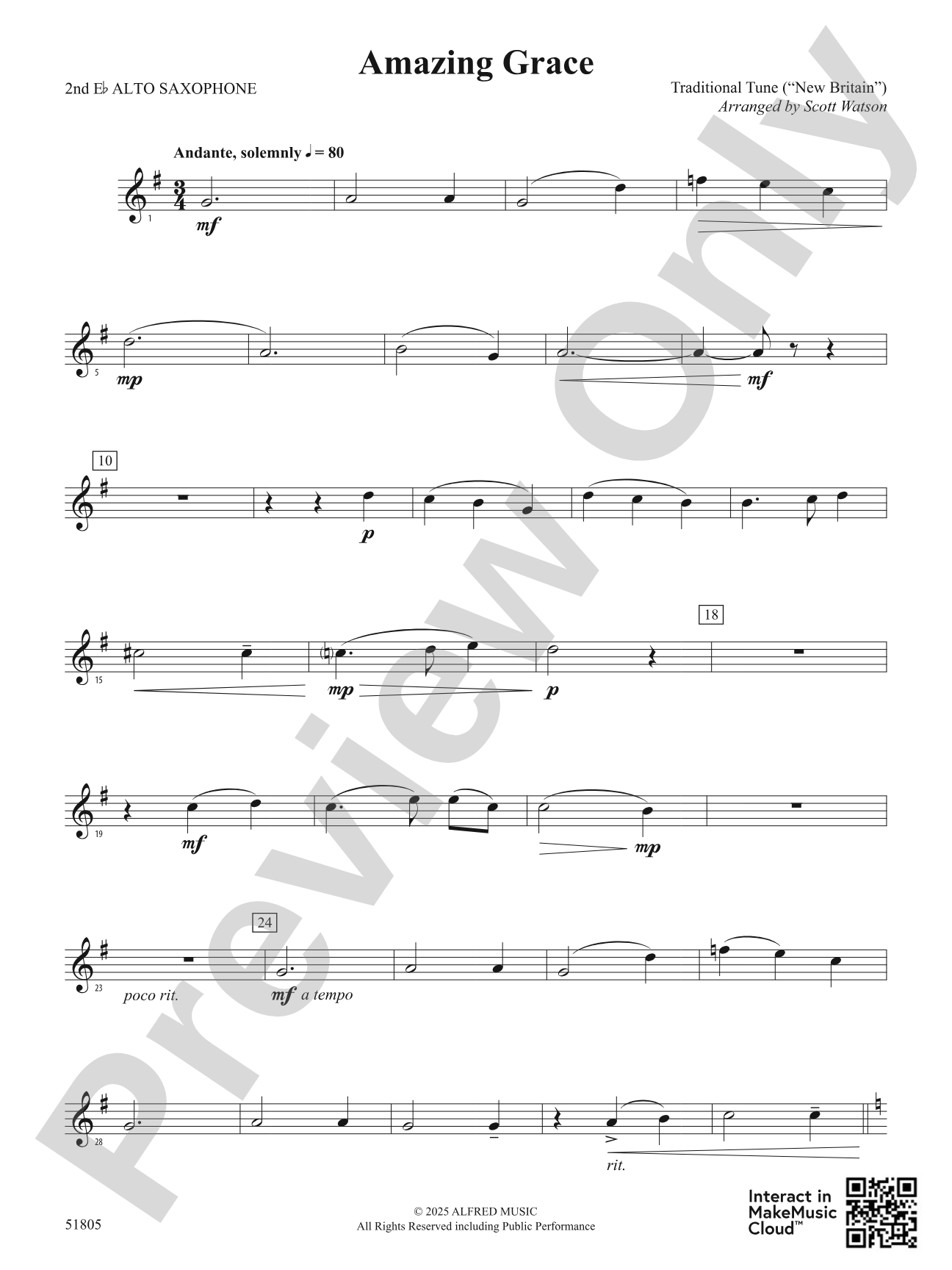

Amazing Grace: 2nd E-flat Alto Saxophone
Traditional Tune ("New Britain") / arr. Scott Watson
Grade: 2
Item: 00-PC-0019505_AX2
$5.99
Pickup currently not available
Description
Amazing Grace, one of the most enduring and beloved songs known the world over, means many things to many people. The tune, a pentatonic folk song known as "New Britain," existed separately from the famous 18th-century hymn text by John Newton with which it eventually became associated. For some, hearing or singing the song gives strength during trials; for others, it is a promise of hope and a balm of comfort at a funeral. For yet others, it is a reminder of their humanness, but with the possibility of forgiveness and mercy.
Watson's heartfelt new setting---employing fresh contemporary harmonies, a rapturous modulation, and reflective closing moments---was created for our time to cast new light on the centuries-old melody. Amazing Grace is the perfect lyrical ballad for your intermediate band. (2:50)


Watson's heartfelt new setting---employing fresh contemporary harmonies, a rapturous modulation, and reflective closing moments---was created for our time to cast new light on the centuries-old melody. Amazing Grace is the perfect lyrical ballad for your intermediate band. (2:50)
Discover MakeMusic Cloud: thousands of interactive titles your students can play along with today.
Sample Audio
1
Audio File
--:--
0:00
0:00
Sample Video
Additional Details
Series:
Young Symphonic Series
Publisher:
Alfred Music
SKU:
00-PC-0019505_AX2
More about this title
About the Arranger: Scott Watson

Scott Watson brings three decades of classroom experience into his work as a composer and arranger. After leading the band program at Parkland High School in Allentown, Pennsylvania, and building an elementary strings initiative across the district, he joined the faculty at Cairn University where he now teaches as Associate Professor of Music. His more than 120 published works reflect a composer who thinks deeply about both contemporary concert music and the practical needs of student ensembles.
Watson's voice carries weight beyond the page. His pieces have been performed at the Academy of Music in Philadelphia, the Midwest Clinic in Chicago, and the White House, and he serves as exclusive composer and clinician for Alfred Publications. He has authored texts on music technology and creativity and remains active as a guest conductor and clinician for honor bands and festivals across the country.
Why we love this
Watson honors the spiritual gravity of this melody without ornament or sentimentality. His contemporary harmonic language gives the familiar tune fresh resonance, while the rapturous modulation and reflective closing create genuine emotional architecture that intermediate bands can inhabit meaningfully. This is a concert piece that respects both the centuries-old hymn and the young musicians performing it.
What to expect
Reverent without heaviness. The contemporary harmonies prevent this from feeling antiquated, while the pentatonic melody retains its timeless, folk-like quality. Moments of luminous brightness give way to introspection, creating an arc that feels honest and earned rather than manufactured.
Who it's for
Grade 2 concert bands ready to invest in genuine musical storytelling. Your students have the technical foundation to focus on phrasing, balance, and ensemble sound rather than wrestling with range or rhythmic complexity. This arrangement rewards careful listening and collaborative musicianship.
How to get the most out of it
- Shape the phrasing across the full phrase length rather than breaking at obvious cadences. The lyrical ballad character depends on a sense of inevitable motion, especially through the modulation.
- Balance the inner harmonies carefully during the fuller sections. Contemporary harmonic color only lands if the band hears all four voices clearly.
- Allow the closing moments to breathe. The reflective passage at the end requires patience and dynamic restraint to achieve its intended contemplative quality.
- Build toward the modulation gradually. Treat it as a turning point emotionally, not just a harmonic event.
How to use it
Program this as a centerpiece ballad in a concert that might otherwise lean toward faster or more technical fare. It also works exceptionally well at festivals and contests where a musically mature but technically accessible piece makes a strong impression. Consider pairing it with an uptempo selection to showcase your band's full range of musical capabilities.
Skills your students will build
- Sustaining long lyrical phrases with consistent tone quality and intonation
- Balancing ensemble voices to hear contemporary harmonic color
- Responding to subtle dynamic shaping and control within a slow tempo
- Understanding and executing a key modulation as a musical turning point
- Maintaining musical independence within a reflective, ballad-style texture