Amazing Grace: 1st B-flat Trumpet Sheet Music Preview

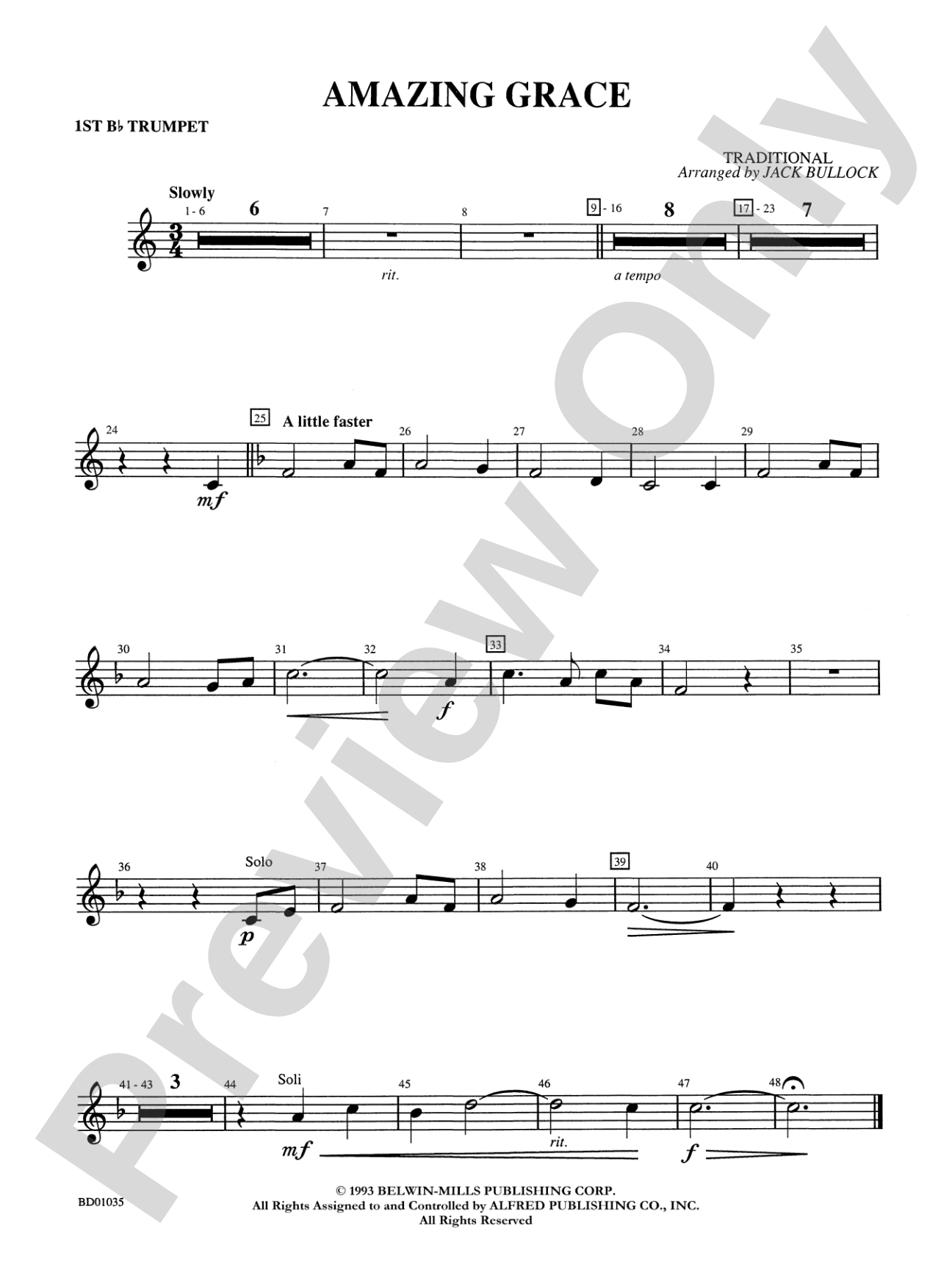
Amazing Grace: 1st B-flat Trumpet

Traditional / arr. Jack Bullock

Grade: 1 (Very Easy)

Item: 00-PC-0001997_T1

Digital Download
$3.00
Description
Classic beauty is so often enhanced by simplicity. This arrangement is written for the beginning band level, but we suspect that this stunning setting will be used by band directors at all educational levels. This is a hymn scoring with universal appeal.

Don't just read it, hear it, play along with it, and watch your students grow with it. In MakeMusic Cloud, Amazing Grace: 1st B-flat Trumpet comes alive with professional accompaniment, adjustable tempo, and built-in practice tools that turn solo practice into real progress.

Sample Audio
No sample audio found.
Sample Video
Additional Details
Series: Belwin Beginning Band
Publisher: Alfred Music
Page Count: 130
SKU: 00-PC-0001997_T1

More about this title

About the Arranger: Jack Bullock

Jack Bullock

Jack Bullock brings decades of practical experience to his arranging work. A accomplished trumpet performer who has played with ensembles ranging from the Miami Philharmonic Orchestra to touring dance bands, he understands instrumental writing from the inside. He holds degrees at the undergraduate, graduate, and doctoral levels in music education and spent 20 years teaching instrumental music in public school settings, including seven years as an assistant band director at Ithaca College's School of Music.

Bullock's prolific output includes more than 600 published compositions and arrangements across concert band, orchestra, jazz ensemble, and marching band repertoire. His work shaped music education curricula as co-author of the Belwin 21st Century Band Method and as a contributing arranger for Alfred Music's Music Expressions program. An ASCAP member since 1980, he has conducted clinics and workshops throughout the United States, Canada, and England.

Why we love this

This arrangement strips away unnecessary complexity while preserving the hymn's spiritual depth, making it equally rewarding for a developing ensemble and a mature one. Bullock's years in the classroom shaped his ability to write music that sounds richer than its technical demands, which means your band will experience real musical success from day one. The universal familiarity of the melody frees students to focus on ensemble blend, intonation, and phrasing rather than note-reading anxiety.

What to expect

This arrangement carries the quiet power of a familiar hymn sung by an entire community. There is no flash here, only honest musical expression: sustained chords that ring with clarity, straightforward melodic lines, and the kind of direct emotional communication that comes from removing everything unnecessary.

Who it's for

Beginning band students will find this arrangement accessible and immediately gratifying to perform. Directors at any level can program this piece; the elegant simplicity means it works beautifully in contests, festivals, and concert programs where it speaks to mixed audiences of all ages.

How to get the most out of it

  • Allow the melody to breathe with gentle phrase shaping; resist the urge to rush through sustained passages. The simplicity of the scoring means every dynamic choice becomes audible.
  • Balance the part-writing so inner voices support rather than compete with the melodic line. Younger players often underplay harmonic parts, leaving the texture thin.
  • Establish a consistent, unhurried tempo that honors the hymn's reverent character. Younger bands frequently default to faster tempos out of nervousness; ground them in a tempo that feels settled.

How to use it

Slot this into spring concert programs as a moment of reflection between more energetic selections, or open a holiday concert with it to center the audience's attention. It works especially well in sacred or patriotic programming and travels well to contests where adjudicators consistently respond to tasteful, age-appropriate literature performed with genuine musicality.

Skills your students will build

  • Sustaining tone quality across longer note values
  • Balancing ensemble blend within a hymn setting
  • Shaping phrases using dynamics and breath placement
  • Reading four-part concert band voicing
  • Responding to expressive, non-technical musical demands

You May Also Like