
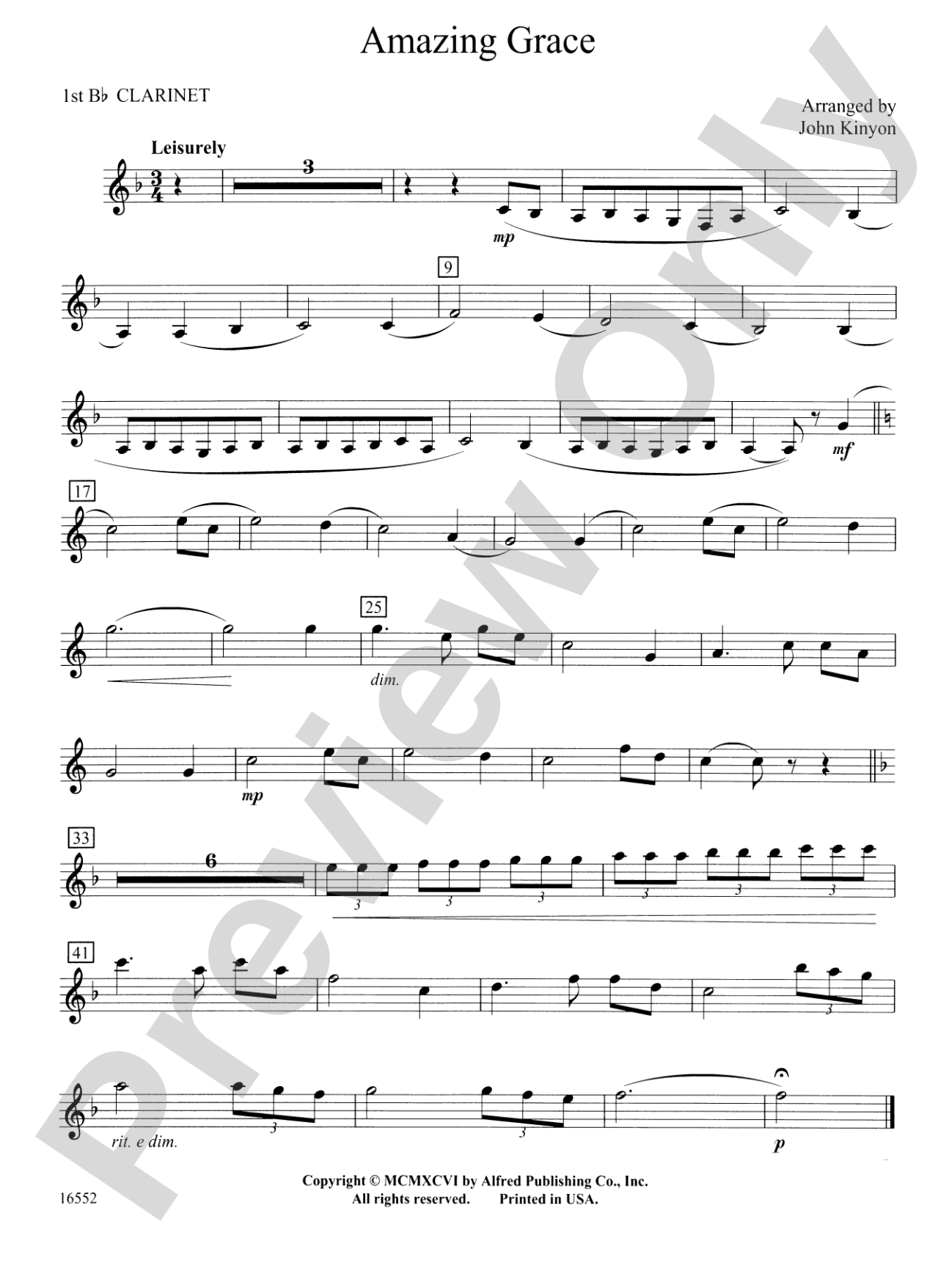

Amazing Grace: 1st B-flat Clarinet
Arr. John Kinyon
Grade: 2 (Medium Easy)
Item: 00-PC-0000188_C1
$3.00
Pickup currently not available
Description
The gospel roots of Amazing Grace are explored in this relaxed and inspiring arrangement by John Kinyon. A solo trumpet is spotlighted at the beginning, then is gradually joined by the entire ensemble. Through a number of modulations, this version builds to a touching climax, then ends calmly. Sure to be an all-time favorite arrangement!


Don't just read it, hear it, play along with it, and watch your students grow with it. In MakeMusic Cloud, Amazing Grace: 1st B-flat Clarinet comes alive with professional accompaniment, adjustable tempo, and built-in practice tools that turn solo practice into real progress.
Open in the Player
Jump straight in and assign it today.
Start Your Free Trial
Open this title and explore the full library in minutes.
Sample Audio
1
Audio File
--:--
0:00
0:00
Sample Video
No sample videos found.
Additional Details
Series:
Young Symphonic
Publisher:
Alfred Music
Page Count:
65
SKU:
00-PC-0000188_C1
More about this title
About the Arranger: John Kinyon

John Kinyon studied at Ithaca College and the Eastman School of Music, later earning an honorary doctorate from Limestone College. His career spans instrumental music direction, music department leadership in multiple school districts, educational work with Warner Brothers Music in New York, and faculty positions in music education, including a professorship at the University of Miami, Florida.
Kinyon has composed and arranged over 250 works for Alfred Music since 1982, establishing himself as a defining voice in educational wind band literature. His catalog spans Grades 1 through 3 and embraces diverse styles, from marches to ballads to overtures. Now semi-retired in Tuckasegee, North Carolina, his output remains a cornerstone resource for young ensembles seeking repertoire that is both musically substantial and pedagogically sound.
Why we love this
Kinyon's treatment respects the spiritual depth of Amazing Grace while keeping the orchestration accessible to a developing ensemble. The solo trumpet opening creates an immediate focal point and gives your lead player a featured moment without requiring virtuosity, and the gradual addition of voices builds naturally toward the emotional arc without overwhelming younger musicians.
What to expect
Kinyon's setting opens with quiet reverence, the lone trumpet voice carrying the melody like a prayer. As the band gradually swells around it, the music grows warmer and more embracing, moving through gentle key shifts that freshen the familiar tune. The climax feels inevitable rather than forced, and the calm resolution leaves audiences with a sense of peace and sincerity.
Who it's for
This arrangement serves concert bands at the Grade 2 level seeking a sacred standard that connects to genuine musical substance. Directors programming festivals, concerts, or seasonal services will find this particularly valuable because it requires neither advanced technique nor extended rehearsal time while delivering a finished, moving performance.
How to get the most out of it
- Allow the opening trumpet solo space to breathe; resist rushing through it. A thoughtful, almost hymn-like tempo here sets the meditative tone for what follows.
- Balance is critical as the ensemble enters. The trumpet should remain audible even as harmonic support grows, so light ensemble voicing in early sections prevents drowning out the soloist.
- Lean into the modulations as dramatic moments rather than harmonic pivots alone. Each key change offers a chance to refresh the listeners' attention and signal emotional progress toward the climax.
- The final resolution should feel earned and peaceful rather than abrupt. Shape the ending with enough space and diminuendo to let the arrangement's calm conclusion land with dignity.
How to use it
Program this in the second half of a concert to shift the emotional temperature after energetic opening numbers. It pairs well with other sacred or reflective works and works equally effectively as a season closer at winter or spring concerts, in memorial services, or as part of a festive concert pairing with lighter fare.
Skills your students will build
- Balancing solo and ensemble textures with dynamic control
- Following harmonic progressions through modulations
- Sustaining even tone and breath support across longer phrases
- Reading and responding to sectional cues as the texture grows
- Interpreting sacred music with emotional authenticity rather than technical display