Amavolovolo (arr. Rudolf de Beer) Sheet Music Preview

Amavolovolo (arr. Rudolf de Beer): SATB Choral Octavo

Arranged by Rudolf de Beer / Edited by Henry Leck

Item: 35-DS00474454

Digital Download
$2.99
Description

Amavolovolo (arr. Rudolf de Beer): SATB Choral Octavo isn't in MakeMusic Cloud just yet...but it could be. Let us know you'd like to see it, and you'll help shape what comes next. In the meantime, start a free trial and dive into thousands of interactive titles your students can play along with today.

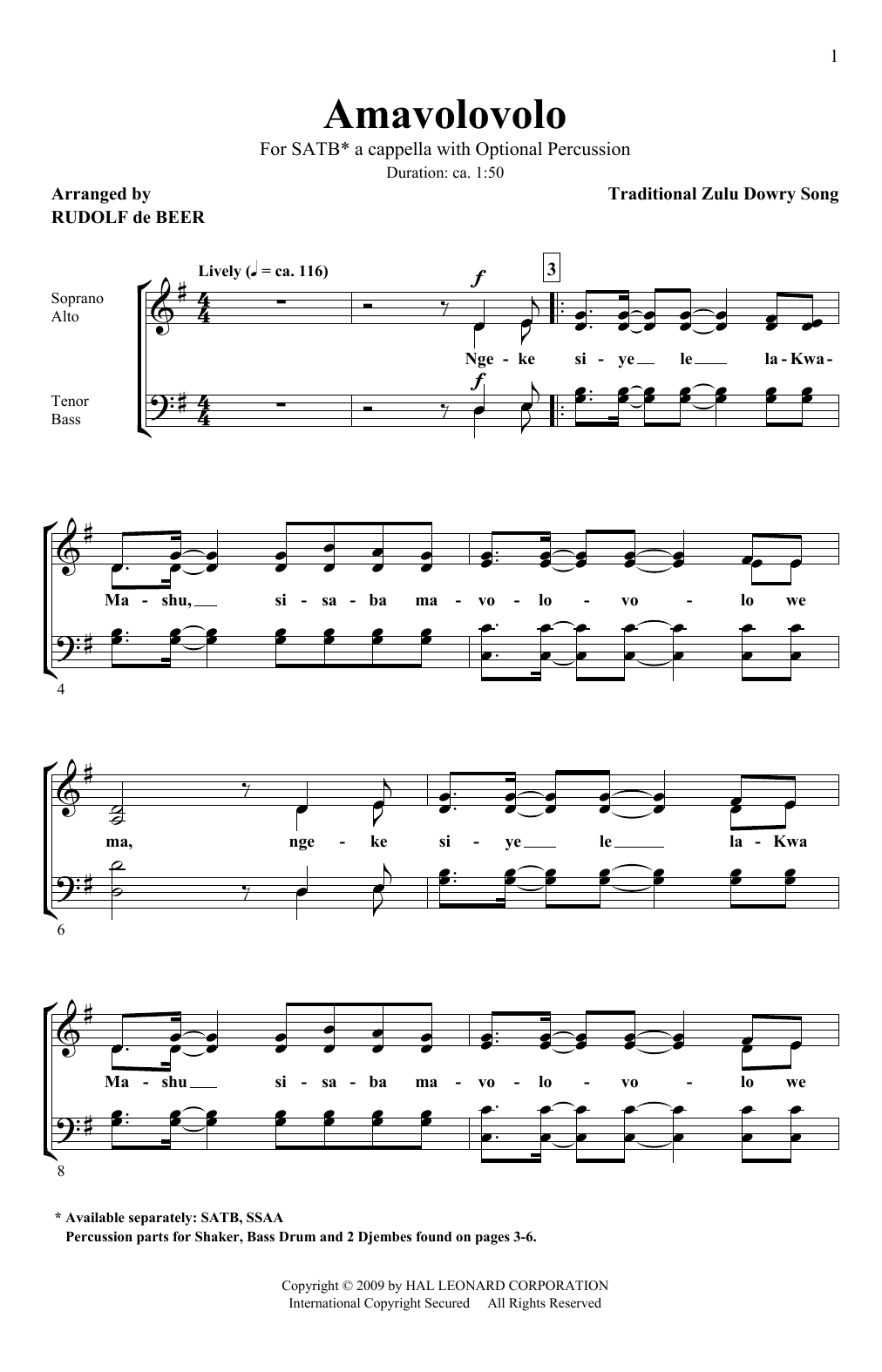
Sample Audio
No sample audio found.
Sample Video
Additional Details
Publisher: Hal Leonard
Page Count: 6
SKU: 35-DS00474454

More about this title

About the Arranger: Rudolf de Beer

Rudolf de Beer is a South African composer and arranger whose work centers on the rich musical traditions of Africa. His arrangements honor source material while making it accessible to choirs of varying abilities, demonstrating a deep understanding of both vocal writing and cultural authenticity.

Why we love this

De Beer's setting captures the infectious energy of this traditional song without oversimplifying it. The four-part writing balances accessibility with genuine harmonic interest, giving your singers real musical substance to sink their teeth into while keeping the arrangement singable for developing ensembles.

What to expect

Warm and communal, with a rhythmic vitality that invites participation. The piece carries an inherent joyfulness that engages both singers and listeners, unfolding with the kind of musical ease that feels spontaneous even after careful rehearsal.

Who it's for

Any SATB choir looking to expand their repertoire with genuine African material. This works equally well for high school singers building cultural literacy and college choirs seeking accessible concert pieces that don't sacrifice musical interest.

How to get the most out of it

  • Establish a clear pulse in rehearsal before worrying about pitch. The rhythmic vitality of the piece comes from the ensemble locking in together, not from metronomic precision.
  • Let the syllables breathe naturally. African languages have their own musical quality; avoid over-enunciating in a way that deadens the text.
  • Balance your voices so the melodic line emerges clearly without the harmony disappearing. This isn't about soprano dominance but about proportional blend.
  • Consider a light, buoyant tone rather than a heavy classical sound. The piece thrives on energy and movement.

How to use it

Place this alongside other world music selections to build a cohesive set, or use it as a lighter moment in a concert that includes more austere repertoire. Its accessibility makes it valuable as an early-year piece when you're building ensemble cohesion, or as a guaranteed audience favorite on spring concerts.

Skills your students will build

  • Reading and maintaining independent lines in non-traditional harmonic language
  • Rhythmic independence and ensemble cohesion across simultaneous rhythmic patterns
  • Culturally informed interpretation of African song material
  • Diction and resonance in a non-English text
  • Singing with lift and energy while maintaining vocal health

You May Also Like