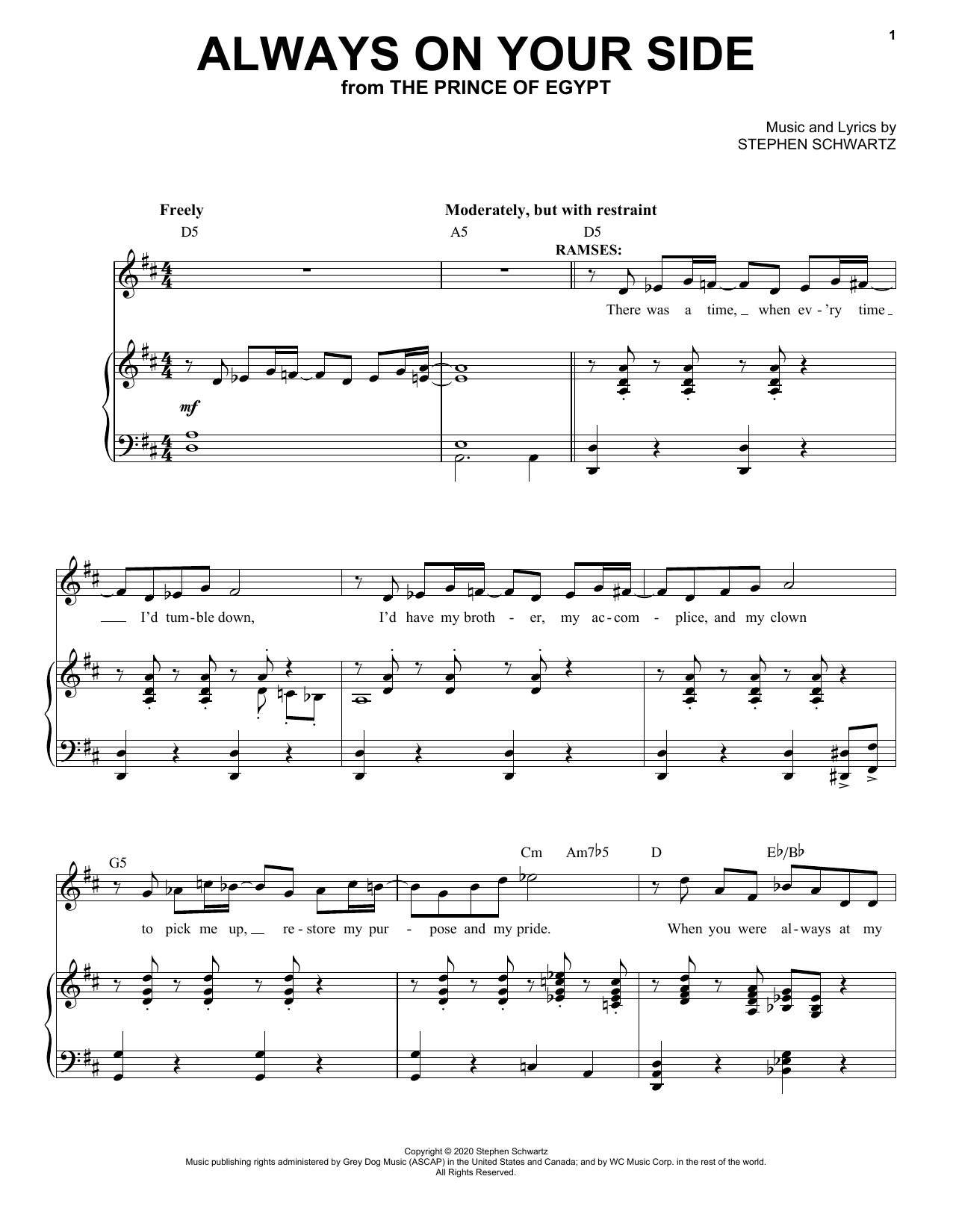
Always On Your Side (from The Prince Of Egypt: A New Musical) Sheet Music Preview

Always On Your Side (from The Prince Of Egypt: A New Musical): Piano Vocal

By Stephen Schwartz

Item: 35-DS00468059

Digital Download
$5.99
Description

Always On Your Side (from The Prince Of Egypt: A New Musical): Piano Vocal isn't in MakeMusic Cloud just yet...but it could be. Let us know you'd like to see it, and you'll help shape what comes next. In the meantime, start a free trial and dive into thousands of interactive titles your students can play along with today.

Sample Audio
No sample audio found.
Sample Video
Additional Details
Publisher: Hal Leonard
Page Count: 5
SKU: 35-DS00468059

More about this title

About the Composer: Stephen Schwartz

Stephen Schwartz has shaped musical theater for five decades, beginning with Godspell and Pippin in the 1970s before moving into film and larger theatrical works. His gift for writing character-driven songs that deepen emotional moments makes him one of Broadway's most performed composers in schools and community theaters alike.

Why we love this

Schwartz's melodies sit naturally in the voice while remaining emotionally sophisticated. This piece gives singers a moment of genuine vulnerability without requiring extreme vocal range, making it accessible for strong high school voices and rewarding for more advanced singers who can shape the subtler dynamics.

What to expect

A moment of quiet reassurance, the kind of intimate song that stops a scene to let a character speak directly to the heart. The music feels both tender and grounded, with warm harmonies that suggest support and presence.

Who it's for

Solo singers preparing audition material or concert repertoire, as well as music teachers building a contemporary musical theater library. The piece works well for high school and early college singers seeking emotionally mature material without extreme technical demands.

How to get the most out of it

  • Lean into the simplicity of the opening phrases; resist the urge to oversing before the music gives you permission to expand.
  • Balance the piano accompaniment so it supports rather than overwhelms the vocal line, especially in moments of sparse texture.
  • Shape the phrases by listening to where the melody wants to breathe, letting punctuation and harmonic movement guide your phrasing rather than lyrical stress alone.
  • Work the accompaniment separately first so you understand how Schwartz uses it to build emotional momentum beneath the vocal part.

How to use it

Include this as a solo feature in a musical theater concert or arts showcase where emotional authenticity matters more than spectacle. It pairs naturally with other Schwartz songs or works well alongside contemporary musical theater repertoire that values lyrical storytelling.

Skills your students will build

  • Sustaining emotional authenticity in intimate vocal passages
  • Coordinating with accompaniment that changes texture and harmonic function
  • Shaping long melodic lines without relying on dramatic range or volume
  • Interpreting contemporary musical theater text that uses conversational language

You May Also Like