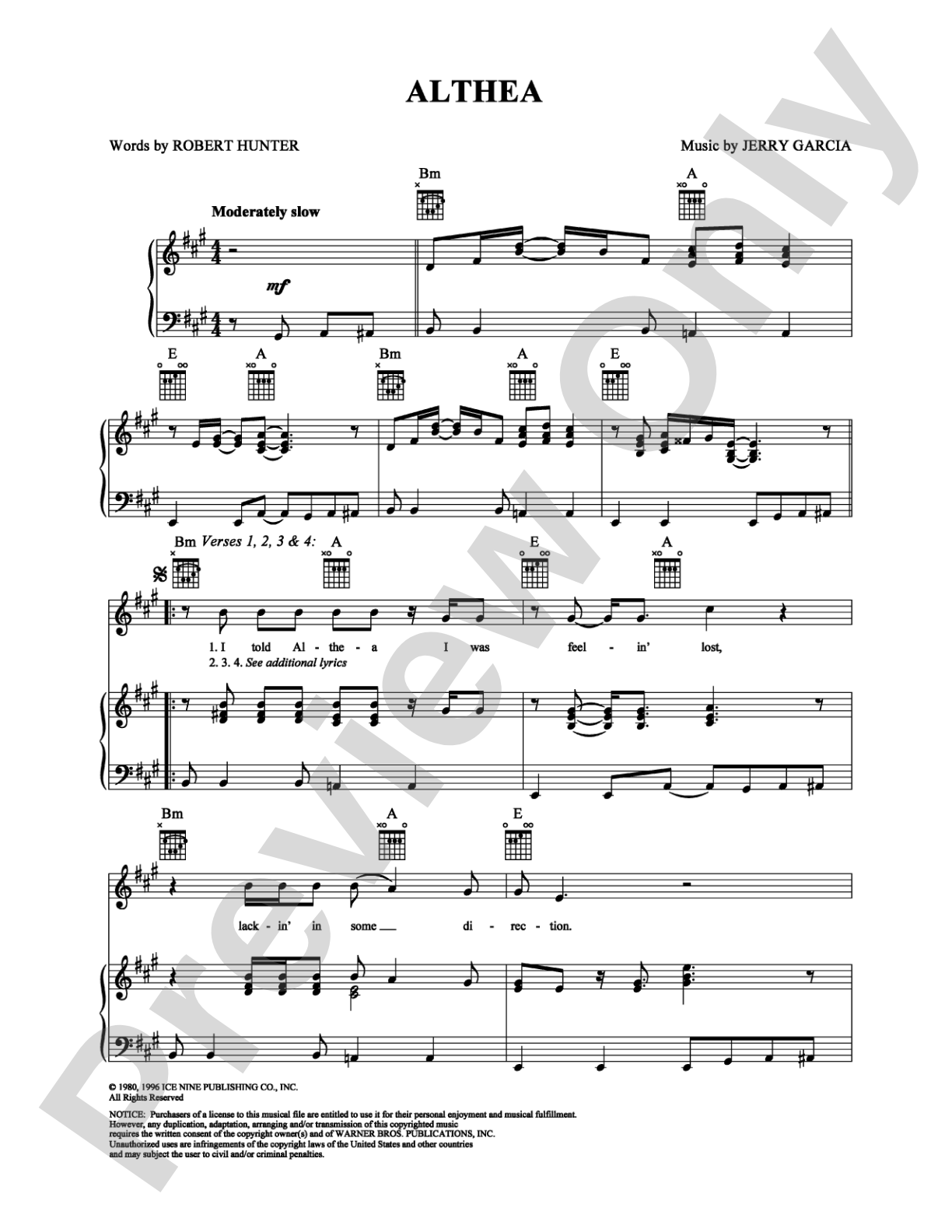
Althea: Piano/Vocal/Chords Digital Sheet Music

Althea: Piano/Vocal/Chords Digital Sheet Music

Jerry Garcia, Grateful Dead

Item: 00-PS-0005606

Digital Download
$2.95
Description

Althea: Piano/Vocal/Chords Digital Sheet Music isn't in MakeMusic Cloud just yet...but it could be. Let us know you'd like to see it, and you'll help shape what comes next. In the meantime, start a free trial and dive into thousands of interactive titles your students can play along with today.

Sample Audio
No sample audio found.
Sample Video
Additional Details
SKU: 00-PS-0005606

More about this title

About the Artist: Grateful Dead

The Grateful Dead emerged from the San Francisco Bay Area in the mid-1960s as architects of improvisational rock music and a counterculture phenomenon that shaped American music for decades. Led by guitarist Jerry Garcia and featuring the songwriting partnership of Garcia and Robert Hunter, the band became known for extended jam sessions, intricate harmonies, and a devoted following that documented and shared their live performances. Their influence extends well beyond rock music into folk, bluegrass, and jazz contexts, making their compositions enduring teaching tools for musicians learning about form, harmony, and ensemble communication.

Why we love this

Althea pairs sophisticated harmonic movement with a vocal melody that sits naturally for singers across experience levels, making it an ideal choice for introducing students to rock-influenced arrangements in a piano/vocal setting. The tune rewards close attention to chord voicings and offers pianists real interpretive choices in comping style and texture. Garcia and Hunter's songwriting clarity makes this accessible for young musicians while maintaining the harmonic depth that keeps returning musicians engaged.

What to expect

Althea unfolds with a reflective, contemplative quality that builds warmth through its harmonic progressions and the interplay between piano and voice. The tune invites intimate performance rather than bombastic display, creating space for both musicians to listen and respond to one another.

Who it's for

Pianists with intermediate to early advanced skills who sing or work with vocalists will find this arrangement accessible and musically rewarding. Teachers can use this for students crossing over from classical training into popular music contexts, or for pianists already comfortable with jazz voicings who want to deepen their work with contemporary repertoire.

How to get the most out of it

  • Establish a steady harmonic foundation on the piano before adding vocal interpretation; the chord changes are logical but require consistent rhythmic support to land clearly
  • Experiment with the dynamic range in the melody line; subtle dynamics in the vocal create lift without requiring dramatic changes
  • Layer the piano accompaniment gradually during rehearsal, starting with root position chords and adding inversions and voicings as the vocalist gains confidence
  • Negotiate the balance between guitar-style picking patterns (if translating from the original) and piano idiomatic playing; find the middle ground that serves the vocal line

How to use it

This works beautifully in recitals that blend classical and popular idioms, or in piano studio showcases highlighting contemporary songwriting. It also serves well as a bridge piece in educational concerts designed to show students how jazz harmony and popular song form intersect.

Skills your students will build

  • Reading and voicing seventh chords and extended harmonies typical of 1970s rock songwriting
  • Balancing accompaniment texture with vocal line priority
  • Interpreting chord symbols and making real-time voicing choices
  • Sustaining steady time while responding to slight rhythmic flexibility in vocal phrasing

You May Also Like