Alternate Time: Baritone T.C. Sheet Music Preview

Alternate Time: Baritone T.C.

By Mark D. Slater

Grade: 2.5 (Medium Easy)

Item: 00-PC-0016426_BTC1

Digital Download
$3.00
Description
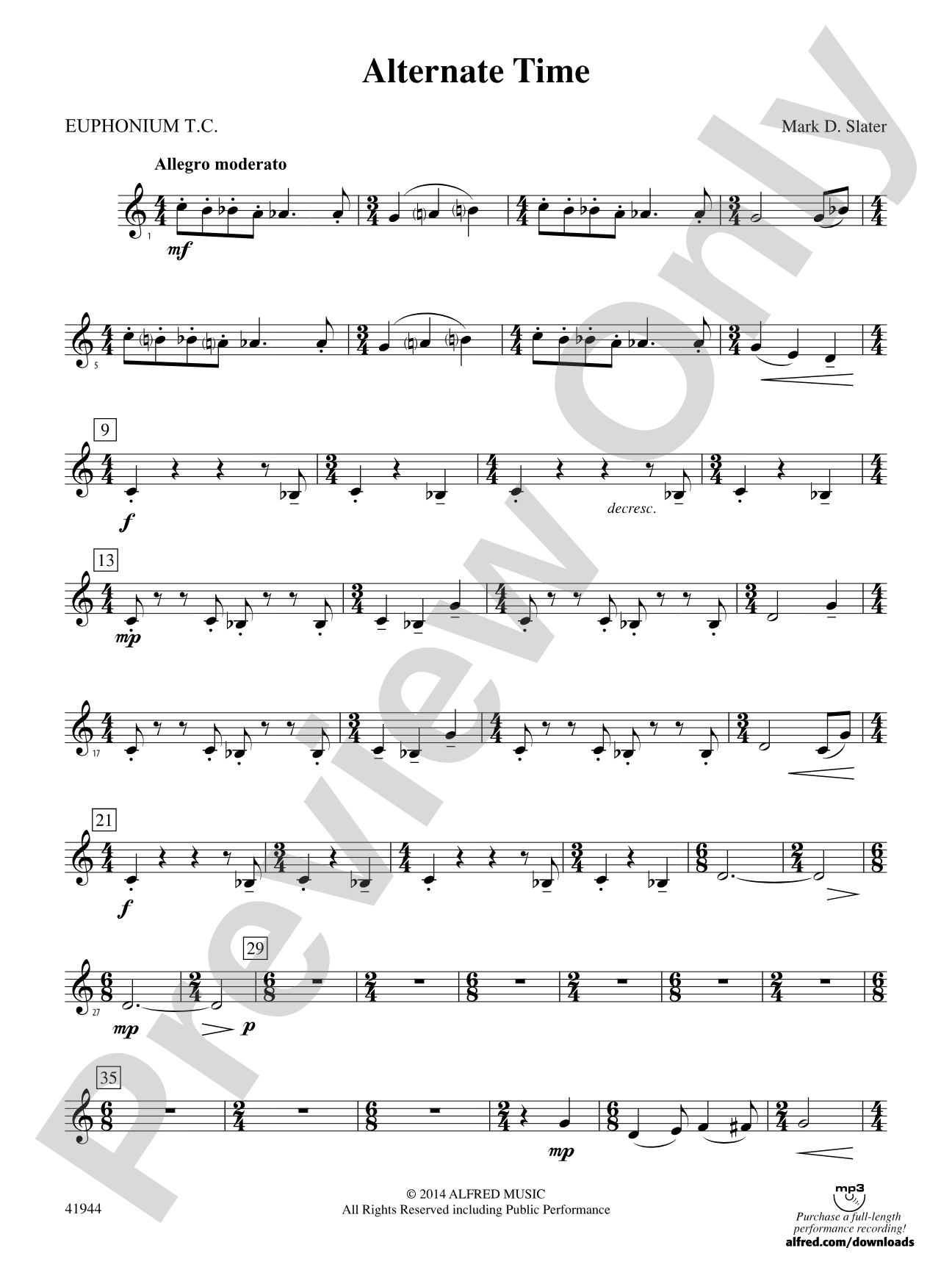
As indicated by the title, "Alternate Time" is an exciting and energetic way to explore constantly changing time signatures. Based on a bouncy theme, this composition also features chromatic passages, running scalar lines, and effective percussion scoring. A wonderful teaching piece, it is also great fun for the audience! (2:00)

Don't just read it, hear it, play along with it, and watch your students grow with it. In MakeMusic Cloud, Alternate Time: Baritone T.C. comes alive with professional accompaniment, adjustable tempo, and built-in practice tools that turn solo practice into real progress.

Sample Audio
0:00
0:00
Sample Video
Additional Details
Series: Young Symphonic
Publisher: Alfred Music
Page Count: 260
SKU: 00-PC-0016426_BTC1

More about this title

About the Composer: Mark D. Slater

Mark D. Slater has built a reputation as a composer who understands what works in the concert band classroom. His approach balances musical substance with accessibility, creating pieces that engage both students and audiences without sacrificing pedagogical value.

Why we love this

Slater nails the balance between pedagogical purpose and genuine musical interest. Too many meter-exploration pieces feel like exercises; this one swings with a real compositional voice, complete with scalar momentum and textured percussion writing that keeps audiences engaged while students tackle the rhythmic challenge.

What to expect

Rhythmically restless and playful. The bouncy theme gives the piece a forward momentum that propels through the meter shifts, while chromatic runs and scalar writing add color and sophistication. The percussion scoring adds sheen and buoyancy, making the whole thing feel intentional and deliberate rather than chaotic.

Who it's for

Concert bands at the Grade 2-3 level working on metric flexibility without sacrifice of musicality. This piece serves equally well as a teaching tool for musicians encountering constant meter changes and as a concert work audiences actually enjoy hearing.

How to get the most out of it

  • Map out the meter changes visually before rehearsal. Mark each time signature clearly in your score and parts so players see the pattern emerging rather than treating each bar as a surprise.
  • Use the bouncy character to anchor students through transitions. A consistent interpretive energy helps ensemble cohesion when the metrical ground shifts beneath them.
  • Balance transparency in the chromatic passages so listeners hear the harmonic logic, not just note-scrambling. These scalar lines sell the compositional sophistication of the piece.
  • Let the percussion scoring breathe. The effective writing in this section deserves space; don't bury it under heavy tutti passages.

How to use it

Slot this into a concert focused on contemporary technique or compositional innovation. Its two-minute length and accessible presentation make it ideal for the middle of a program where you want to show off student growth in reading and musicianship without demanding a major time investment from your concert runtime.

Skills your students will build

  • Reading constantly changing time signatures (including mixed meters)
  • Maintaining ensemble cohesion across metric shifts
  • Interpreting scalar and chromatic passages with clarity
  • Responding to precise percussion cues and rhythmic anchors
  • Sustaining musical phrase shape despite frequent meter changes

You May Also Like