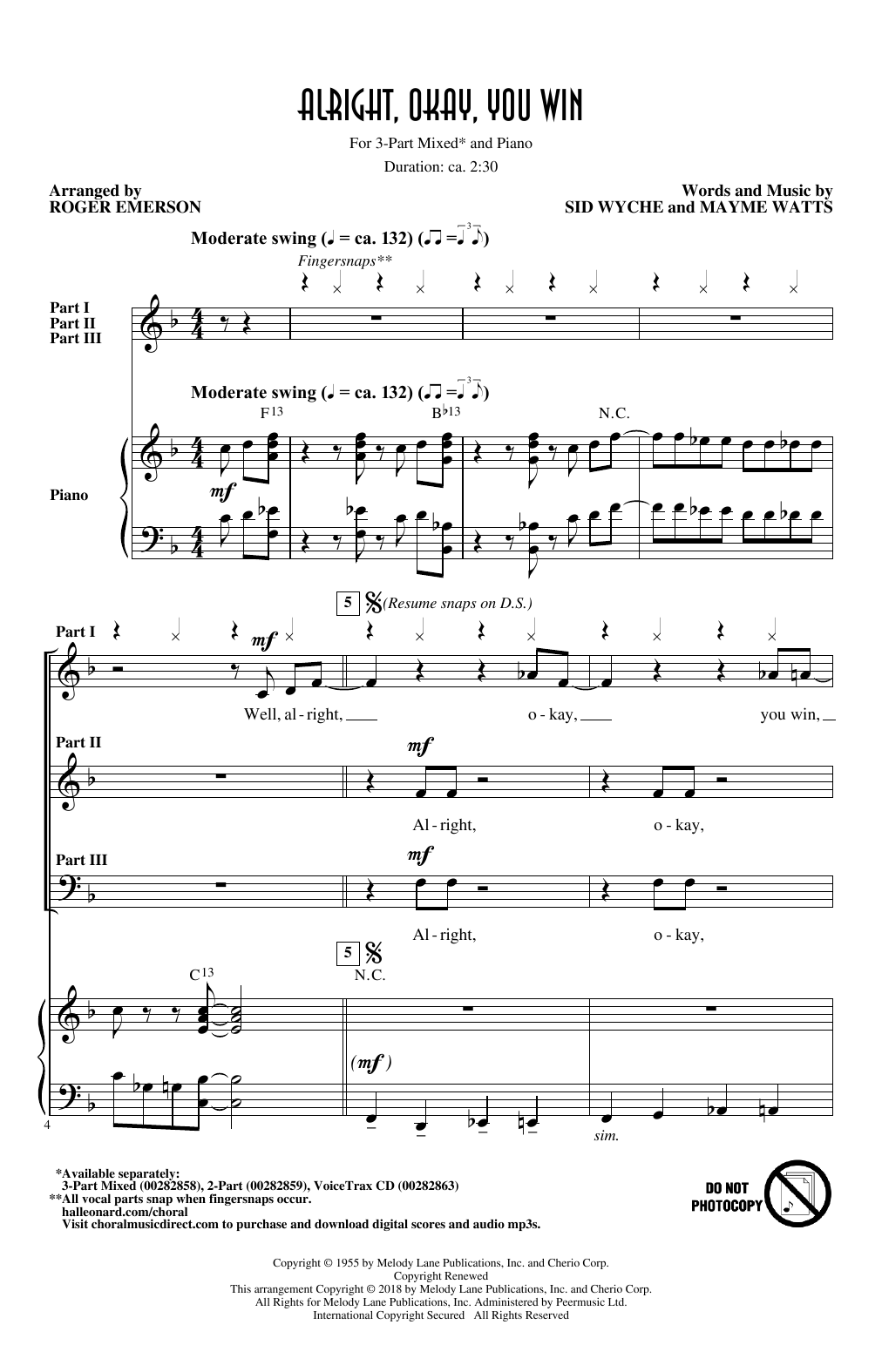
Alright, Okay, You Win (arr. Roger Emerson) Sheet Music Preview

Alright, Okay, You Win (arr. Roger Emerson): 3-Part Mixed Choral Octavo

As performed by Peggy Lee / Arranged by Roger Emerson

Item: 35-DS00427792

Digital Download
$2.99
Description

Alright, Okay, You Win (arr. Roger Emerson): 3-Part Mixed Choral Octavo isn't in MakeMusic Cloud just yet...but it could be. Let us know you'd like to see it, and you'll help shape what comes next. In the meantime, start a free trial and dive into thousands of interactive titles your students can play along with today.

Sample Audio
No sample audio found.
Sample Video
Additional Details
Publisher: Hal Leonard
Page Count: 14
SKU: 35-DS00427792

More about this title

About the Artist: Peggy Lee

Peggy Lee was a jazz and pop vocalist whose career spanned from the 1940s through the 1990s, making her one of the most recorded female artists of the 20th century. Her approach to phrasing and rhythmic flexibility influenced generations of singers, and her interpretations of standards remain touchstones for vocal expressivity and emotional restraint.

Why we love this

Roger Emerson's arrangement preserves the sophisticated swing of Lee's original recording while making it genuinely singable for three-part mixed ensembles. The writing respects the jazz idiom without demanding professional-level chops, and the text underlay keeps the conversational, flirtatious tone of the song intact.

What to expect

Playful and knowing, with that 1950s sophistication that Lee brought to every recording. The melody sits close to speech, conversational and intimate even when sung by a full section.

Who it's for

Choirs with singers comfortable with jazz vocabulary and a willingness to swing the rhythm. This works well for groups ready to move beyond classical phrasing but needing an arrangement that doesn't require advanced jazz chops.

How to get the most out of it

  • Shape the phrasing in short arcs rather than pushing through entire phrases in one breath. Jazz phrasing thrives on those strategic pauses where the lyric lands.
  • Treat the rhythm section parts (if using accompaniment) as dialogue partners, not as background. The interplay between voices and rhythm is what gives this tune its personality.
  • Balance clarity of the text with the smoothness of the vocal lines. Diction should pop without sacrificing the legit tone that keeps this from sliding into novelty territory.

How to use it

Pair this with other swing standards or use it as a strategic palate cleanser in a concert that otherwise leans classical. It's an excellent closer for a lighter program or a charming opener for a pops concert.

Skills your students will build

  • Swing rhythm notation and execution
  • Jazz interpretation and stylistic phrasing
  • Blending voices while maintaining clarity of text
  • Articulation appropriate to jazz idiom

You May Also Like