
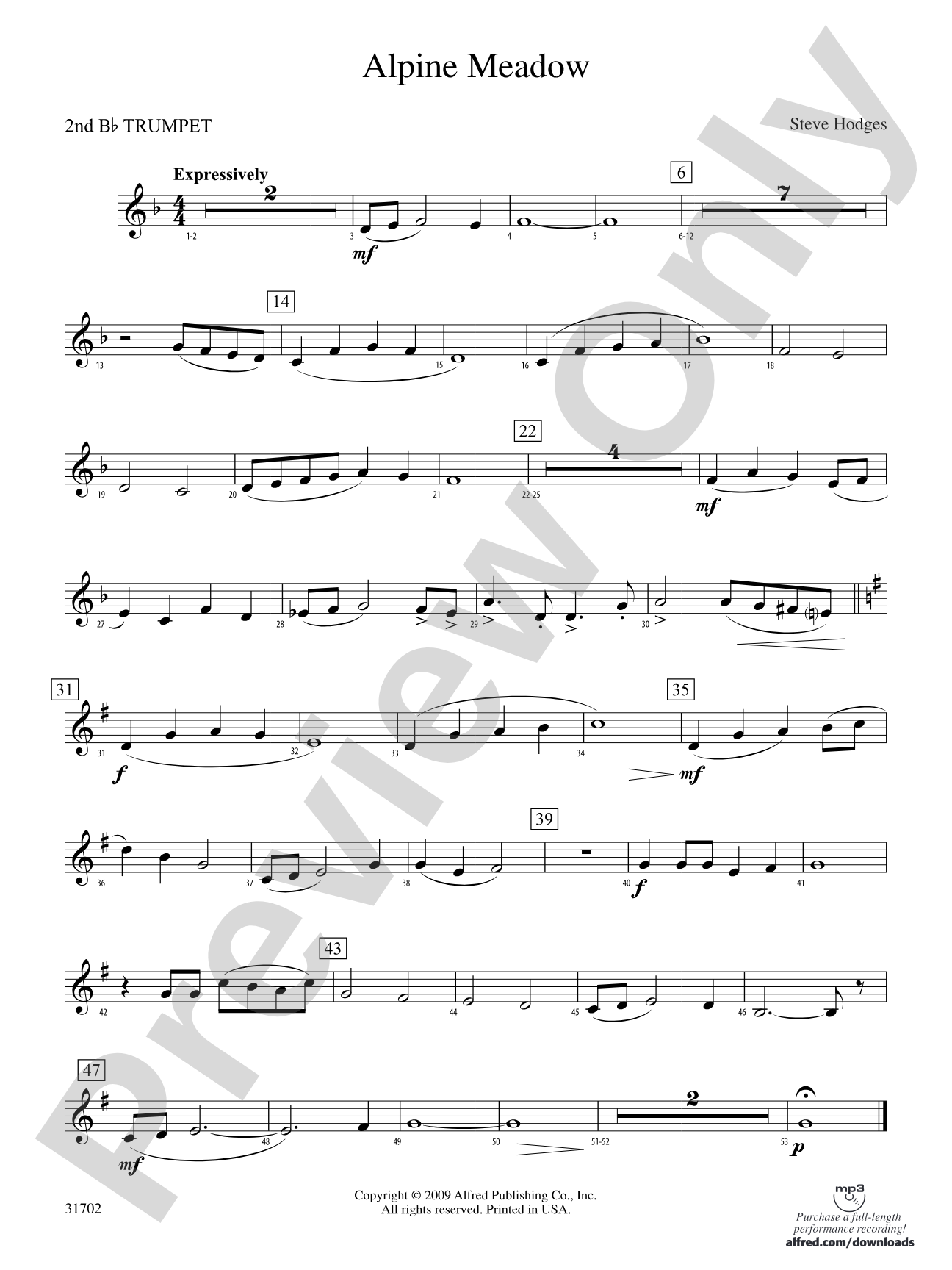

Alpine Meadow: 2nd B-flat Trumpet
By Steve Hodges
Grade: 1 (Very Easy)
Item: 00-PC-0014858_T2
$3.00
Pickup currently not available
Description
This lyrical piece provides the young band with many opportunities for expressive playing. A simple, memorable melody sets the stage for interesting harmonic and textural treatments by all sections of the ensemble. An effective transition builds to a seamless modulation which gradually diminishes to a quiet conclusion. Alpine Meadow is great teaching tool for phrasing, articulation and dynamics. (3:00)


Don't just read it, hear it, play along with it, and watch your students grow with it. In MakeMusic Cloud, Alpine Meadow: 2nd B-flat Trumpet comes alive with professional accompaniment, adjustable tempo, and built-in practice tools that turn solo practice into real progress.
Open in the Player
Jump straight in and assign it today.
Start Your Free Trial
Open this title and explore the full library in minutes.
Sample Audio
1
Audio File
--:--
0:00
0:00
Sample Video
Additional Details
Series:
Alfred Debut Series
Publisher:
Alfred Music
Page Count:
116
SKU:
00-PC-0014858_T2
More about this title
About the Composer: Steve Hodges

Steve Hodges holds degrees from Western Oregon University (Bachelor of Science) and Central Washington University (Master of Music Education). His forty-year career in public school music education shaped a prolific compositional practice; since 1986, he has published over 120 concert band works through Alfred Music, along with choral arrangements through Staff Music and Shawnee Press.
Hodges's compositions appear regularly at festivals and state conventions across North America, from Virginia to British Columbia. His commissioned works for honor bands and schools have earned him recognition as an ASCAP member with multiple standard awards. Based in The Dalles, Oregon, Hodges remains active in community music and finds particular joy in hearing his grandchildren perform his pieces in their own school bands.
Why we love this
Alpine Meadow rewards young players with a genuinely beautiful melody that feels rewarding to perform, not like a simplified substitute. The harmonic and textural variety throughout keeps the ensemble engaged across all sections, making this a rare Grade 1 piece that doesn't ask listeners to imagine its potential. The modulation and dynamic arc give you clear teaching moments without requiring your students to navigate unusual complexity.
What to expect
Peaceful and pastoral, with the expansive quality of open space and clear air. The melody invites listeners in immediately while the harmonic movement underneath keeps things from feeling static; the dramatic middle section offers contrast before settling into a graceful, contemplative close.
Who it's for
Beginning and developing concert bands (Grade 1) ready for material that respects their musicianship without simplifying the musical content. This works equally well for groups in their first year and those settling material into your early-season rehearsals.
How to get the most out of it
- Shape the melody with careful attention to the phrase arch; even at Grade 1, students respond well to thinking about where the line wants to breathe and peak.
- Balance the harmonic textures by having your wind sections listen across parts, not just within their own line. This builds ensemble awareness early.
- Let the transition build naturally without rushing; the climax lands harder when the approach feels inevitable rather than sudden.
- Reserve your full dynamic range for the final diminuendo. It's the emotional payoff and should feel like a deliberate choice, not a fade.
How to use it
Open a concert with this piece to establish an intimate, lyrical tone for your audience, or place it early in a set to showcase musicality before moving into more energetic works. Its three-minute length and clear emotional arc make it excellent for contest or festival programming where you want to highlight artistic maturity at an accessible level.
Skills your students will build
- Shaping sustained melodic lines with intentional phrasing
- Executing dynamic contrast across the full range (ppp to mf)
- Balancing inner parts to support textural clarity
- Recognizing and performing through modulation without pitch instability
- Responding to articulation as an expressive tool, not just technical requirement