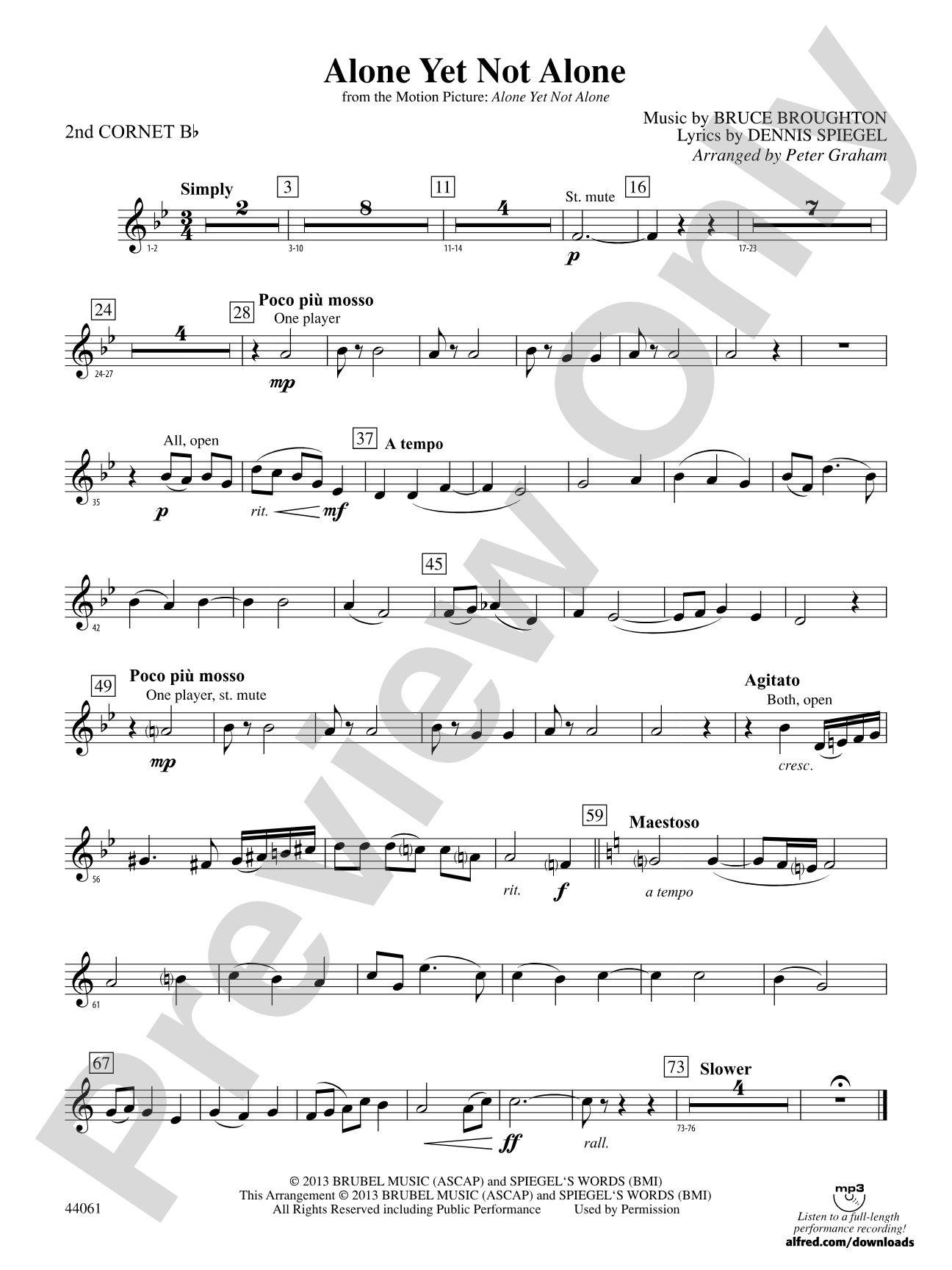
Alone Yet Not Alone (from the Motion Picture Alone Yet Not Alone): 2nd B-flat Cornet Sheet Music Preview

Alone Yet Not Alone (from the Motion Picture Alone Yet Not Alone): 2nd B-flat Cornet

For Brass Band

By Bruce Broughton and Dennis Spiegel / arr. Peter Graham

Item: 00-PC-0017297_CO2

Digital Download
$3.00
Description
Written by veteran Hollywood film composers Bruce Broughton and Dennis Spiegel, this lyrical, hymn-like euphony from the movie Alone Yet Not Alone, has been beautiful arranged for brass band by Peter Graham.

Don't just read it, hear it, play along with it, and watch your students grow with it. In MakeMusic Cloud, Alone Yet Not Alone (from the Motion Picture Alone Yet Not Alone): 2nd B-flat Cornet comes alive with professional accompaniment, adjustable tempo, and built-in practice tools that turn solo practice into real progress.

Sample Audio
No sample audio found.
Sample Video
Additional Details
Series: Brass Band
Publisher: Alfred Music
Page Count: 40
SKU: 00-PC-0017297_CO2

More about this title

About the Composer: Bruce Broughton

Bruce Broughton

Bruce Broughton has spent decades composing for Hollywood, creating scores for films including Silverado, Tombstone, The Rescuers Down Under, and Miracle on 34th Street. His work extends across television, from theme music for JAG and The Orville to scores for miniseries like Texas Rising and made-for-TV films such as Warm Springs. His accolades include an Oscar nomination, a Grammy nomination, and ten Emmy Awards from twenty-three nominations.

Beyond film and television, Broughton has written concert music performed by major orchestras including the Cleveland Orchestra and Chicago Symphony. He serves as a Board member of ASCAP and has held leadership roles in both the Academy of Television Arts and Sciences and the Academy of Motion Picture Arts and Sciences. His influence on contemporary American music spans multiple mediums, from theme park attractions worldwide to pioneering orchestral work in interactive media.

Why we love this

Peter Graham's brass band arrangement transforms a lyrical film theme into an accessible work that sits beautifully across the full ensemble without requiring advanced technical demands. The hymn-like quality gives conductors a chance to shape genuine musical expression through phrasing and balance rather than technical complexity, making it rewarding for players at intermediate to advanced levels who appreciate straightforward but emotionally compelling writing.

What to expect

This piece unfolds with quiet dignity, its melody moving like a hymn through gentle harmonic progressions. The arrangement creates moments of warmth and spaciousness, drawing listeners into reflection while the brass band's full sonority brings richness to what might otherwise feel intimate.

Who it's for

Brass bands seeking repertoire that pairs emotional depth with musical accessibility will find this arrangement ideal. It suits intermediate to advanced ensembles looking to expand beyond march-based programming and offers conductors a chance to develop musicianship through lyrical, sustained playing rather than technical display.

How to get the most out of it

  • Shape the melodic line with subtle dynamics and rubato to honor the hymn-like character; this is not a march, so allow breathing room between phrases.
  • Balance the euphonium solo line against the supporting harmony, bringing it forward just enough to sing without overpowering the ensemble's texture.
  • Attend to intonation in the sustained chords, as the piece's lyrical quality depends on clean, stable harmony throughout.
  • Bring the full band together dynamically during climactic moments to create emotional peaks, then pull back to let the original quieter sections breathe again.

How to use it

Program this as a centerpiece for a concert devoted to film music or contemporary works, where it can stand alongside other accessible but earnest compositions. Its contemplative nature makes it an effective contrast to more energetic brass band fare, or it can open a concert to set a reflective tone before moving into lighter material.

Skills your students will build

  • Sustaining warm, balanced tone across full chords
  • Shaping longer melodic lines with phrase awareness and breathing
  • Balancing solo and supporting voices in ensemble texture
  • Responding to subtle dynamic and tempo adjustments for musical expression

You May Also Like