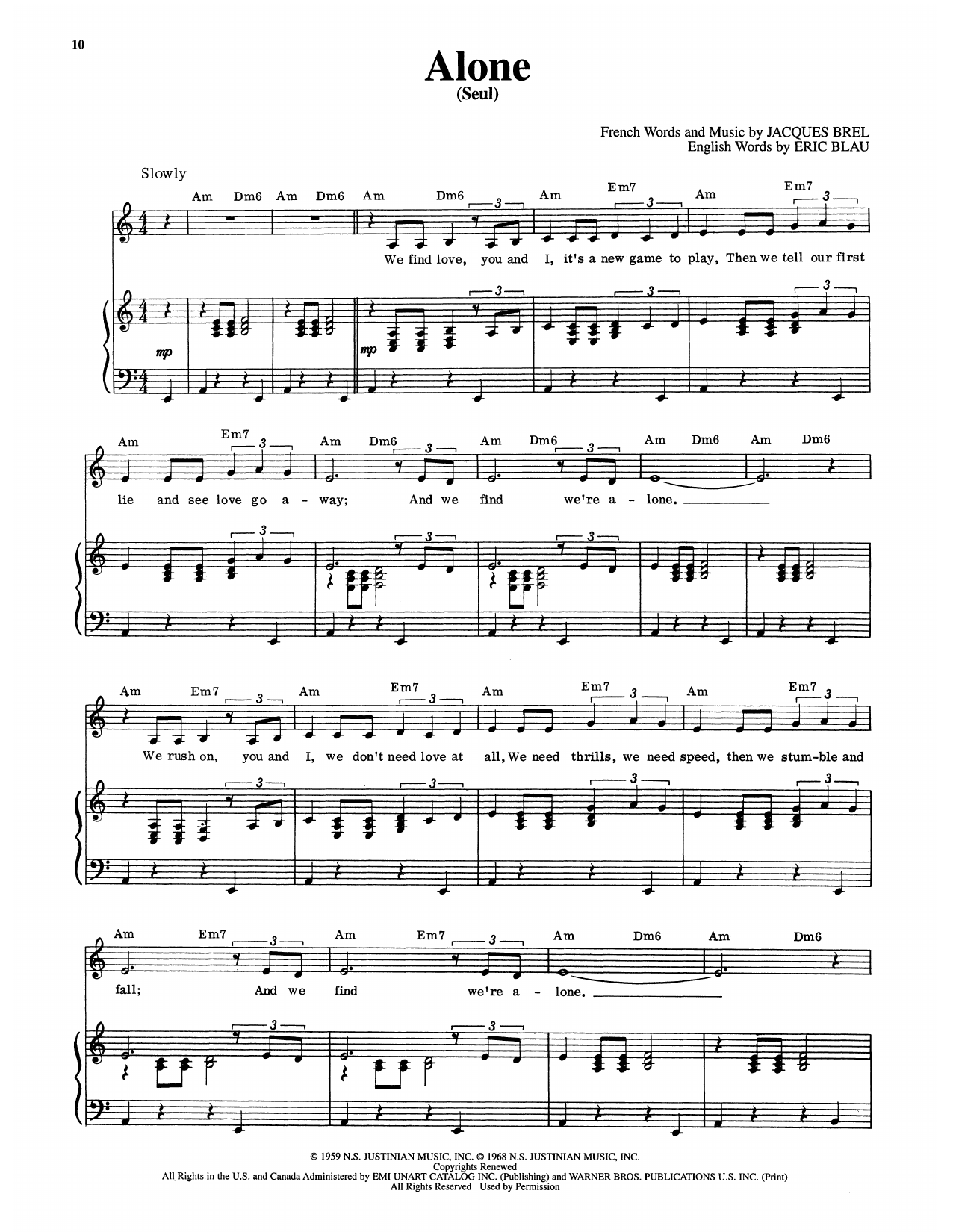
Alone (Seul) (from Jacques Brel Is Alive And Well And Living In Paris) Sheet Music Preview

Alone (Seul) (from Jacques Brel Is Alive And Well And Living In Paris): Piano Vocal

By Jacques Brel / As performed by Eric Blau

Item: 35-DS01740732

Digital Download
$5.99
Description

Alone (Seul) (from Jacques Brel Is Alive And Well And Living In Paris): Piano Vocal isn't in MakeMusic Cloud just yet...but it could be. Let us know you'd like to see it, and you'll help shape what comes next. In the meantime, start a free trial and dive into thousands of interactive titles your students can play along with today.

Sample Audio
No sample audio found.
Sample Video
Additional Details
Publisher: Hal Leonard
Page Count: 4
SKU: 35-DS01740732

More about this title

About the Composer: Jacques Brel

Jacques Brel was a Belgian singer-songwriter whose emotionally unflinching cabaret songs became touchstones of mid-twentieth-century vocal music. His work emphasized raw storytelling and psychological depth, rejecting sentimentality in favor of honest confrontation with loneliness, desire, and human fragility. Though he wrote in French, his influence on English-language musical theater was profound, particularly through the 1968 off-Broadway revue that introduced his catalog to American audiences.

Brel's compositional voice blended sophisticated harmonic language with conversational melody, creating songs that demand complete emotional commitment from performers. His pieces remain staples in voice studios and contemporary musical theater programs because they require singers to inhabit complex interior emotional states rather than simply display vocal technique.

Why we love this

This song offers singers a masterclass in restraint and intimacy. Unlike many Broadway selections that rely on vocal showmanship, Seul demands that performers communicate psychological vulnerability through subtle phrasing and genuine vocal simplicity. The piano part provides enough harmonic sophistication to keep accompanists engaged while maintaining space for the voice to breathe.

What to expect

The song sits in a quiet, introspective space where isolation becomes almost companionable. Harmonically, it moves with deliberate understatement, creating moments of harmonic color that feel like small revelations rather than grand statements. The overall effect is confessional: someone speaking directly to you about what it means to be alone.

Who it's for

Advanced high school singers and college-level vocalists seeking material that challenges emotional maturity rather than range. This piece also suits experienced amateur singers and professional performers building a contemporary cabaret or musical theater repertoire.

How to get the most out of it

  • Resist the urge to add vibrato or ornamentation. The melody's power comes from directness and stillness; embellishment masks the emotional content.
  • Approach the accompaniment as a conversation partner rather than background support. The piano should respond to vocal phrasing with slight flexibility in tempo.
  • Find the specific physical or emotional image that defines loneliness for your character. Brel's songs collapse the distance between singer and audience when performed with genuine presence.
  • Shape phrases toward moments of harmonic change rather than toward breath marks. This keeps the song moving through its emotional arc instead of fracturing it into sung phrases.

How to use it

This works powerfully in a concert exploring twentieth-century song or contemporary cabaret styles. It pairs well with other introspective vocal selections and provides excellent contrast if programmed alongside more extroverted Broadway numbers. In an educational setting, use it to teach singers the difference between vocal display and emotional communication.

Skills your students will build

  • Singing sustained phrases without excessive vibrato or ornamentation
  • Shaping melody around harmonic structure rather than lyrics alone
  • Collaborating with accompanist on tempo flexibility and musical phrasing
  • Inhabiting a character's emotional interiority and conveying it through simplicity
  • Reading piano-vocal scores and responding to accompaniment gestures

You May Also Like