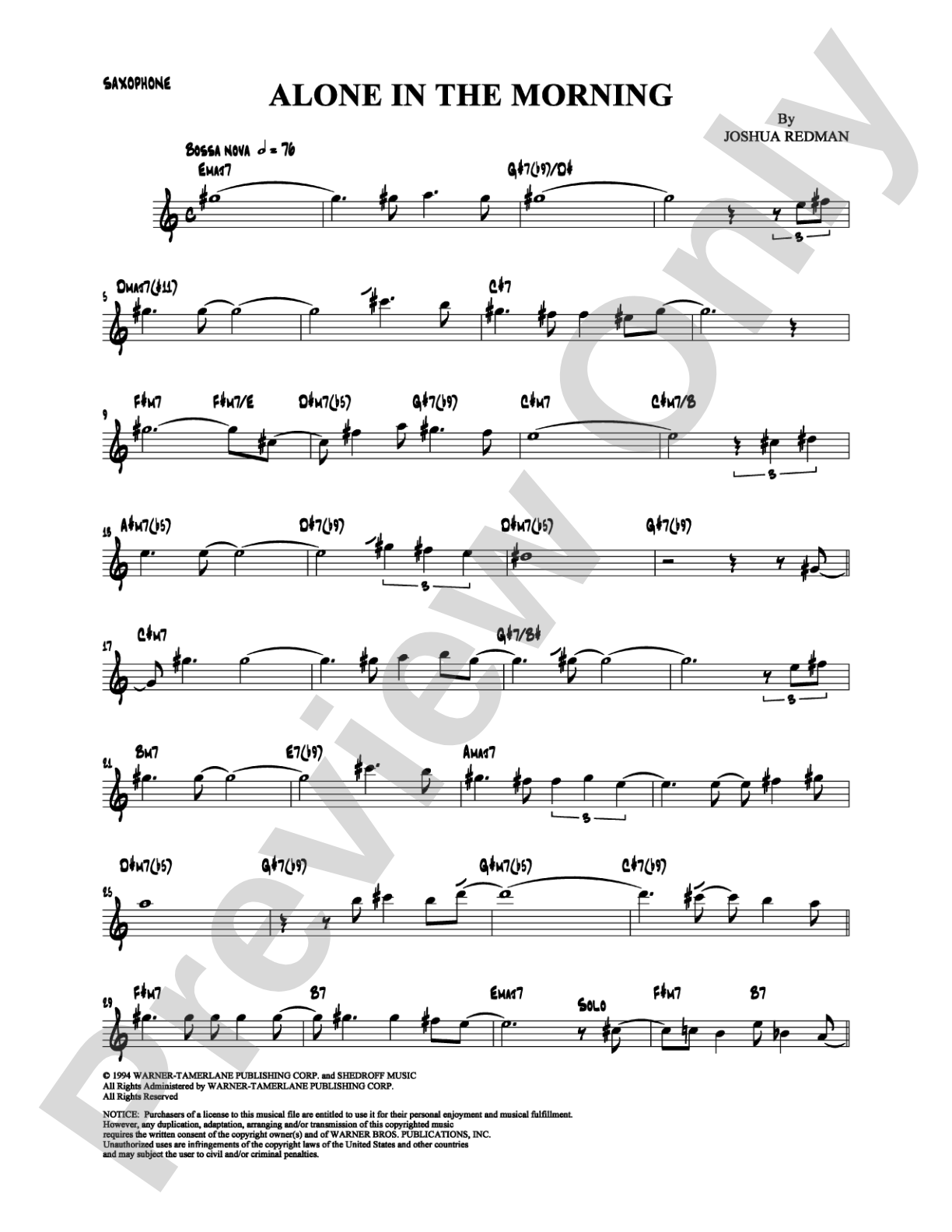
Alone in the Morning: Solo & Small Ensemble Digital Sheet Music

Alone in the Morning: Solo & Small Ensemble Digital Sheet Music

Joshua Redman

Item: 00-PS-0003160

Digital Download
$2.95
Description

Alone in the Morning: Solo & Small Ensemble Digital Sheet Music isn't in MakeMusic Cloud just yet...but it could be. Let us know you'd like to see it, and you'll help shape what comes next. In the meantime, start a free trial and dive into thousands of interactive titles your students can play along with today.

Sample Audio
No sample audio found.
Sample Video
Additional Details
SKU: 00-PS-0003160

More about this title

About the Artist: Joshua Redman

Joshua Redman stands among the most accomplished saxophonists of his generation, known for his restless creativity across jazz, classical, and experimental music. His work as a bandleader, sideman, and collaborator has earned him recognition as both a virtuoso improviser and a thoughtful composer who respects the traditions he builds upon.

Why we love this

Redman's blues writing gives players and ensembles authentic material rooted in real jazz practice rather than classroom approximations. The solo and small ensemble format makes this accessible for a range of skill levels while preserving the sophistication that makes his work worth studying.

What to expect

The piece carries the unhurried, introspective quality of early morning reflection. There's a conversational ease to the writing that invites players to breathe naturally, find their own voice within the form, and discover how much can be said through simplicity and listening.

Who it's for

This work serves saxophonists and small jazz ensembles seeking substantive blues material written by an artist with deep roots in the tradition. It's equally valuable for jazz students looking to understand how a master composer approaches blues form and for gigging musicians wanting arrangements that feel contemporary yet rooted in blues fundamentals.

How to get the most out of it

  • Ground yourself in the blues form before adding improvisation; understanding the harmonic architecture gives you freedom within the changes.
  • Listen to multiple interpretations of blues standards to internalize phrasing, space, and how different artists approach the same changes.
  • Balance technical clarity with the conversational quality blues demands; don't rush or over-articulate when the music calls for a relaxed feel.
  • If playing with accompaniment, establish the groove early and lock in dynamically with the rhythm section rather than layering volume on top of it.

How to use it

Feature this in a jazz or blues-focused concert alongside other contemporary jazz composers, or use it as a recital piece for advanced saxophonists exploring their improvisational voice. The flexible ensemble format makes it useful for studio classes or sectionals where you're developing small-group sophistication.

Skills your students will build

  • Blues form navigation and harmonic awareness
  • Jazz phrasing and space management
  • Improvisation within a structured harmonic context
  • Small ensemble balance and listening
  • Interpretation of stylistically informed notation

You May Also Like