Alman: Percussion 1 Sheet Music Preview

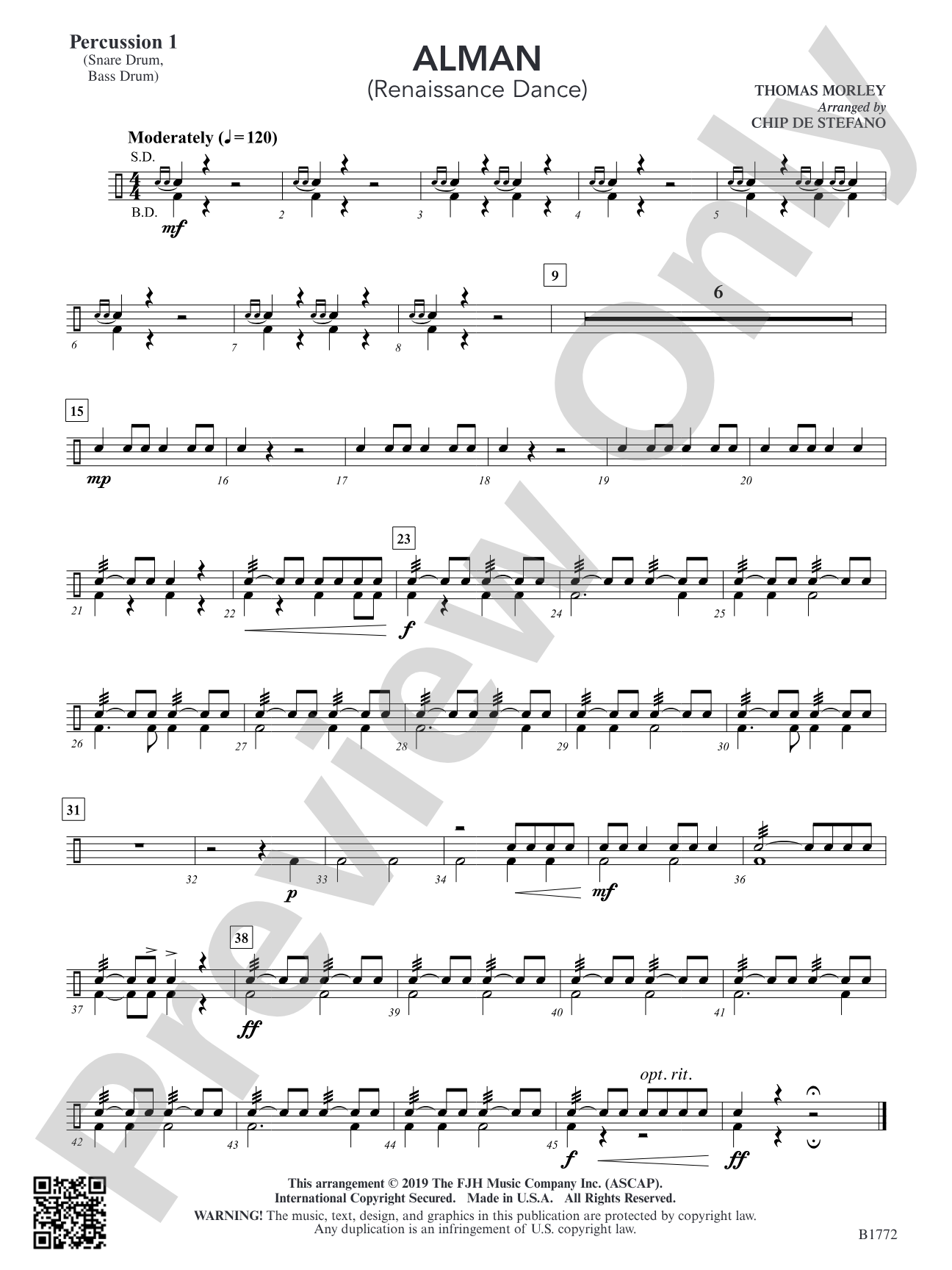
Alman: Percussion 1

By Thomas Morley / arr. Chip De Stefano

Grade: 1

Item: 98-PC-DB1772_PC1

Digital Download
$7.00
Description
This fantastic arrangement is the perfect way to introduce Renaissance music to young musicians. An excellent choice for providing contrast within your concert program, this lively dance has wonderful technical, musical, and stylistic teaching opportunities throughout.

Don't just read it, hear it, play along with it, and watch your students grow with it. In MakeMusic Cloud, Alman: Percussion 1 comes alive with professional accompaniment, adjustable tempo, and built-in practice tools that turn solo practice into real progress.

Sample Audio
0:00
0:00
Sample Video
Additional Details
Series: FJH Beginning Band
Publisher: The FJH Music Company, Inc.
SKU: 98-PC-DB1772_PC1

More about this title

About the Composer: Thomas Morley

Thomas Morley (1557–1602) was an English composer and music theorist whose output shaped the sound of late Renaissance England. He served as a member of the Chapel Royal and held the position of organist at St. Paul's Cathedral in London, giving him both the technical mastery and institutional platform to influence musical tastes across the country. Morley's instrumental dances, including almans, were widely performed in both court and domestic settings, and his theoretical writings remain foundational to our understanding of Renaissance music pedagogy.

Why we love this

De Stefano's arrangement opens a genuine window into Renaissance instrumental music without requiring students to navigate the period's original textures or notation. The Grade 1 voicing preserves the character and forward momentum of Morley's alman while building young musicians' comfort with dance forms and historical style, making it a teaching tool as much as a performance piece.

What to expect

An alman is a measured, orderly dance with stately bearing. This arrangement likely captures that courtly clarity: structured and elegant, with straightforward rhythms that invite ensemble precision and a melodic quality that feels conversational rather than virtuosic.

Who it's for

Beginning band directors seeking age-appropriate access to Renaissance repertoire will find this essential. Students at the Grade 1 level gain exposure to non-Baroque historical music and develop an ear for dance rhythms and period articulation without technical overload.

How to get the most out of it

  • Maintain a steady, dance-like pulse throughout; almans are in duple meter and should feel grounded and processional rather than rushed
  • Balance articulation across the ensemble to ensure clarity of melodic line; Renaissance style favors crispness without heaviness
  • Listen for opportunities to shape phrases with subtle dynamic swells that follow the melodic contour, keeping the texture transparent
  • Check that lower voices support the harmonic foundation without overwhelming; this arrangement likely relies on clear voice leading to teach functional harmony

How to use it

Program this early in a concert to establish stylistic range and give audiences a sense of period breadth. Its compact form and energetic character make it an ideal foil for a heavier Classical or Romantic work later on the program, and its contest/festival designation suggests it can stand alone in competitive settings as well.

Skills your students will build

  • Recognition of Renaissance dance forms and articulation style
  • Ensemble balance in transparent textures
  • Maintaining steady pulse in duple meter
  • Reading Grade 1 concert band parts with accuracy
  • Awareness of melodic phrasing across sustained harmonic accompaniment

You May Also Like