
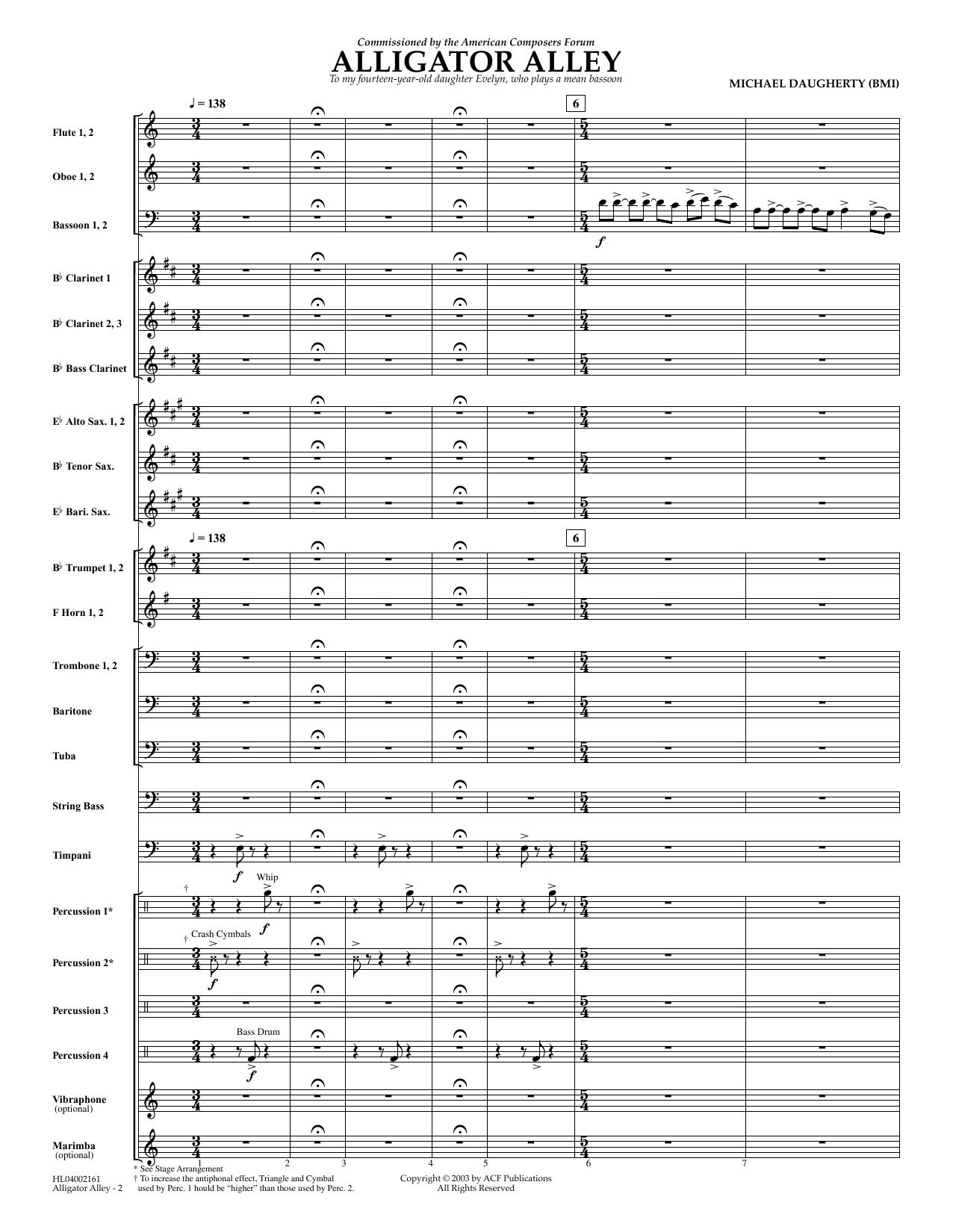

Alligator Alley: Concert Band Conductor Score & Parts
By Michael Daugherty
Grade: 3
Item: 35-PK00444388
$10.00
Pickup currently not available
Parts Added to Cart!
Description
Award-winning composer Michael Daugherty's first published work for young band describes a stretch of Interstate 75 that crosses through Florida's Everglades National Park. "Alligator Alley" celebrates this noble beast that has remained largely unchanged from prehistoric times. The first theme ("Alligator's Theme") features the woodwinds (predominantly bassoons) while the second theme ("Hunter's Theme") is performed by the brass. Program notes and staging suggestions are included in this marvelously descriptive work. A free downloadable interdisciplinary curriculum for teaching Alligator Alley is available at https://composersforum.org/bq-compositions/alligator-alley/. BandQuest, an exciting series of new music and accompanying curricula for band, is a program published by the American Composers Forum. The series was started as a response to feedback from music educators that there is a pressing need for new, fresh band music. The heart of this program is new works written by a diverse group of leading American composers who have created challenging pieces that are a true departure from standard middle school repertoire. Every BandQuest project includes a residency component in which the composer works collaboratively with a middle school as they create their new piece. Many BandQuest pieces are accompanied by an interdisciplinary curriculum designed to assist students as they learn the music and to integrate each piece with non-music studies. Visit www.bandquest.org to learn more about this innovative series, and email bandquest@composersforum.org to request a free downloadable audio catalog.


Discover MakeMusic Cloud: thousands of interactive titles your students can play along with today.
Sample Audio
No sample audio found.
Sample Video
No sample videos found.
Additional Details
Publisher:
Hal Leonard
SKU:
35-PK00444388
More about this title
About the Composer: Michael Daugherty
Michael Daugherty stands among America's most performed living composers, with works spanning orchestral, operatic, and chamber music genres. His gift for vivid orchestration and narrative storytelling makes his music particularly resonant in educational settings, where students engage not just with notes but with compelling musical imagery.
Daugherty's contributions to young band repertoire have significantly shaped what modern American wind music can be. His compositions balance accessibility with artistic substance, creating works that challenge ensemble musicians while remaining fully achievable for developing players.
Why we love this
Daugherty gives young musicians something rarely encountered in standard band fare: authentic contemporary voice combined with cinematic storytelling. The dual-theme structure (woodwind-driven 'Alligator's Theme' and brass-forward 'Hunter's Theme') provides natural contrast that holds attention while building orchestration awareness across your ensemble. The included staging suggestions and free interdisciplinary curriculum transform this from a concert piece into a teaching opportunity that extends far beyond the music itself.
What to expect
The music evokes the humid, primordial atmosphere of the Everglades without resorting to cheap pictorialism. Woodwinds weave together with earthy sophistication in the opening, establishing the alligator as a figure of quiet power. When the brass enter, energy shifts without becoming aggressive; instead, the textures overlay to create a more complex soundscape that captures both predator and environment.
Who it's for
Young band programs seeking repertoire that sounds fresh without sacrificing musical substance. Students benefit from learning how contemporary composers approach wind band writing, while directors gain a piece that teaches orchestration naturally through contrasting timbral ideas. This works equally well in concert settings, festival performances, or as the centerpiece of a program exploring American compositional voices.
How to get the most out of it
- Balance the bassoon-heavy opening by allowing those players room to project; this is their moment to establish character, not accompany.
- When the brass enter with 'Hunter's Theme,' resist the urge to let them overshadow the woodwinds' earlier material. Both themes deserve equal weight and clarity.
- Work the program notes and imagery into rehearsals from the start. Students who visualize the Everglades and its creatures bring more intentionality to dynamics and phrasing.
- Reference the provided staging suggestions during concert planning; visual presentation reinforces the narrative and amplifies audience engagement.
How to use it
Open a concert with this piece to immediately signal that your band is exploring contemporary music with serious intent. Its narrative clarity and manageable length (approximately 5-6 minutes) make it an ideal bridge between traditional standard repertoire and more adventurous programming. The accompanying curriculum also makes it a natural fit for schools integrating arts with science or environmental studies.
Skills your students will build
- Orchestration awareness through contrasting woodwind and brass textures
- Dynamic control and sustained tone in lyrical woodwind passages
- Ensemble balance when multiple themes occur simultaneously
- Interpretation of programmatic music and its connection to physical imagery
- Reading contemporary notation and compositional language