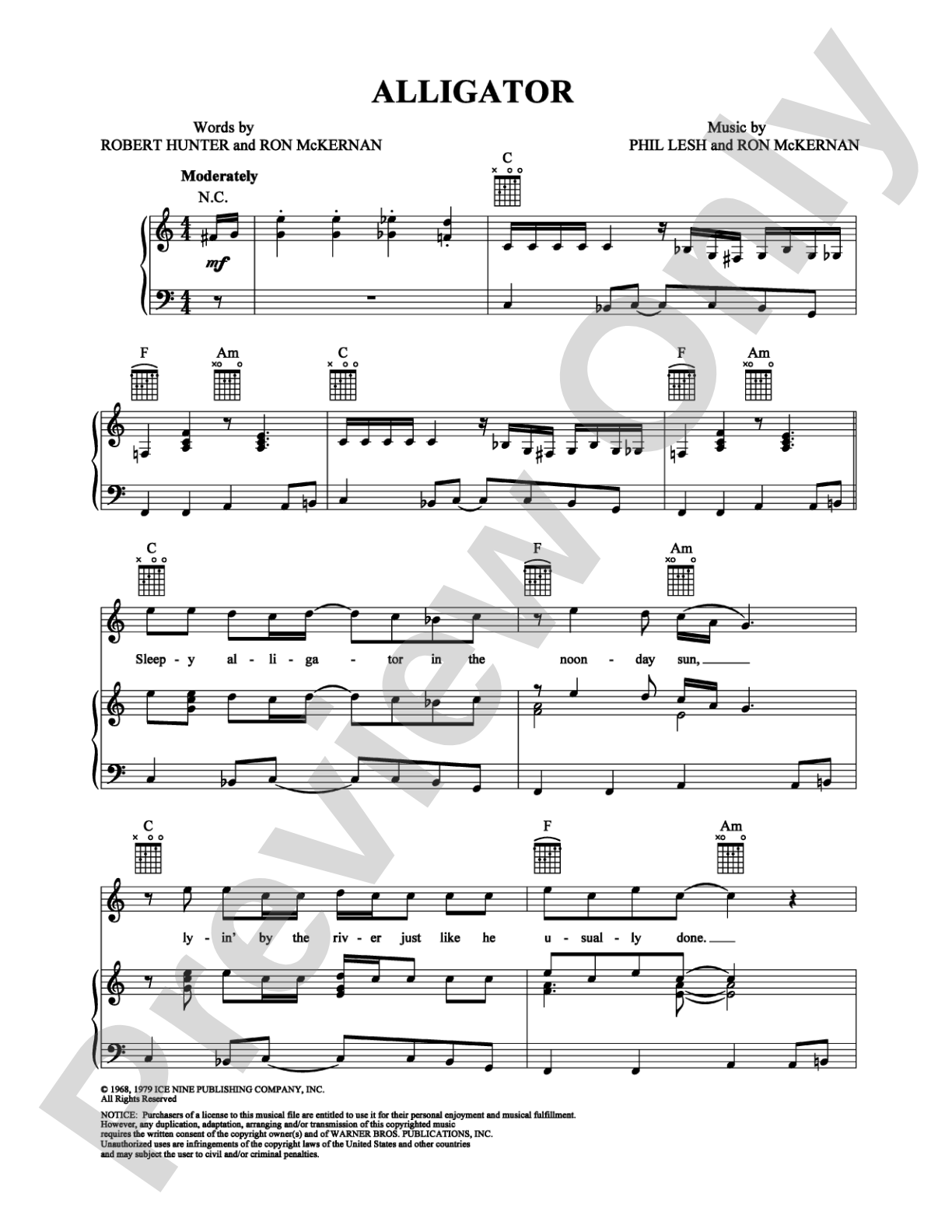
Alligator: Piano/Vocal/Chords Digital Sheet Music

Alligator: Piano/Vocal/Chords Digital Sheet Music

Grateful Dead, Phil Lesh, Ron McKernan

Item: 00-PS-0004139

Digital Download
$2.95
Description

Alligator: Piano/Vocal/Chords Digital Sheet Music isn't in MakeMusic Cloud just yet...but it could be. Let us know you'd like to see it, and you'll help shape what comes next. In the meantime, start a free trial and dive into thousands of interactive titles your students can play along with today.

Sample Audio
No sample audio found.
Sample Video
Additional Details
SKU: 00-PS-0004139

More about this title

About the Artist: Grateful Dead

The Grateful Dead emerged from the San Francisco Bay Area in the mid-1960s as pioneers of improvisational rock, blending folk, blues, country, and psychedelic influences into a sound that defined live performance for generations. Their decades-long career produced a catalog of deeply compositional songs that rewards close study, from intricate vocal harmonies to sophisticated harmonic progressions that challenge musicians well beyond surface-level familiarity.

Why we love this

This arrangement captures the playful, swinging character of a Grateful Dead staple while remaining accessible to singers and pianists working at a reasonable level. The chords are clearly notated, making this ideal for students exploring rock repertoire with harmonic depth and for ensemble programs seeking material that connects to popular music without sacrificing musicianship.

What to expect

Conversational and unhurried, with a gentle swing that invites interplay between voice and piano. The song has a storytelling quality that feels intimate despite its arena-rock origins, grounded in the band's gift for crafting memorable melodies over colorful harmonic movements.

Who it's for

This works well for intermediate to advanced pianists who can handle chord changes with fluency, singers developing interpretive skills in popular repertoire, and duet partners preparing recital material that bridges classical training with contemporary styles. It's also useful in contemporary music classes or jazz-adjacent curricula where students explore non-classical song forms.

How to get the most out of it

  • Study the original recording to absorb the rhythmic pocket and phrasing; the feel matters more than strict tempo adherence.
  • Balance the vocal melody against the piano accompaniment so both voices remain clear and conversational.
  • Experiment with the chord voicings; small adjustments in how you voice seventh chords and extensions will shift the groove significantly.
  • Let the rhythm breathe rather than locking rigidly to a metronome; Grateful Dead songs invite a relaxed, conversational swing.

How to use it

Pair this with other singer-songwriter or rock-influenced repertoire in a recital exploring how popular and classical idioms can coexist on the same program. It works equally well as a standalone teaching piece or as part of a unit on improvisation, harmonic analysis, or 20th-century American songwriting.

Skills your students will build

  • Reading and performing lead sheets with chord symbols
  • Voice leading and chord voicing choices on piano
  • Rhythmic flexibility and swing feel in popular music contexts
  • Interpreting melody over changes in a conversational, non-metronomic style
  • Coordination between vocal line and piano accompaniment

You May Also Like