

Alleluia Seven: 3-Part Mixed, a cappella Choral Octavo
Music by Jay Althouse
Item: 00-PO-0004061
$2.25
Minimum order quantity: 20 copies
Pickup currently not available
Related Items
Alleluia Seven: 3-Part Mixed, a cappella Choral Octavo |
$2.25
|
View |
Description
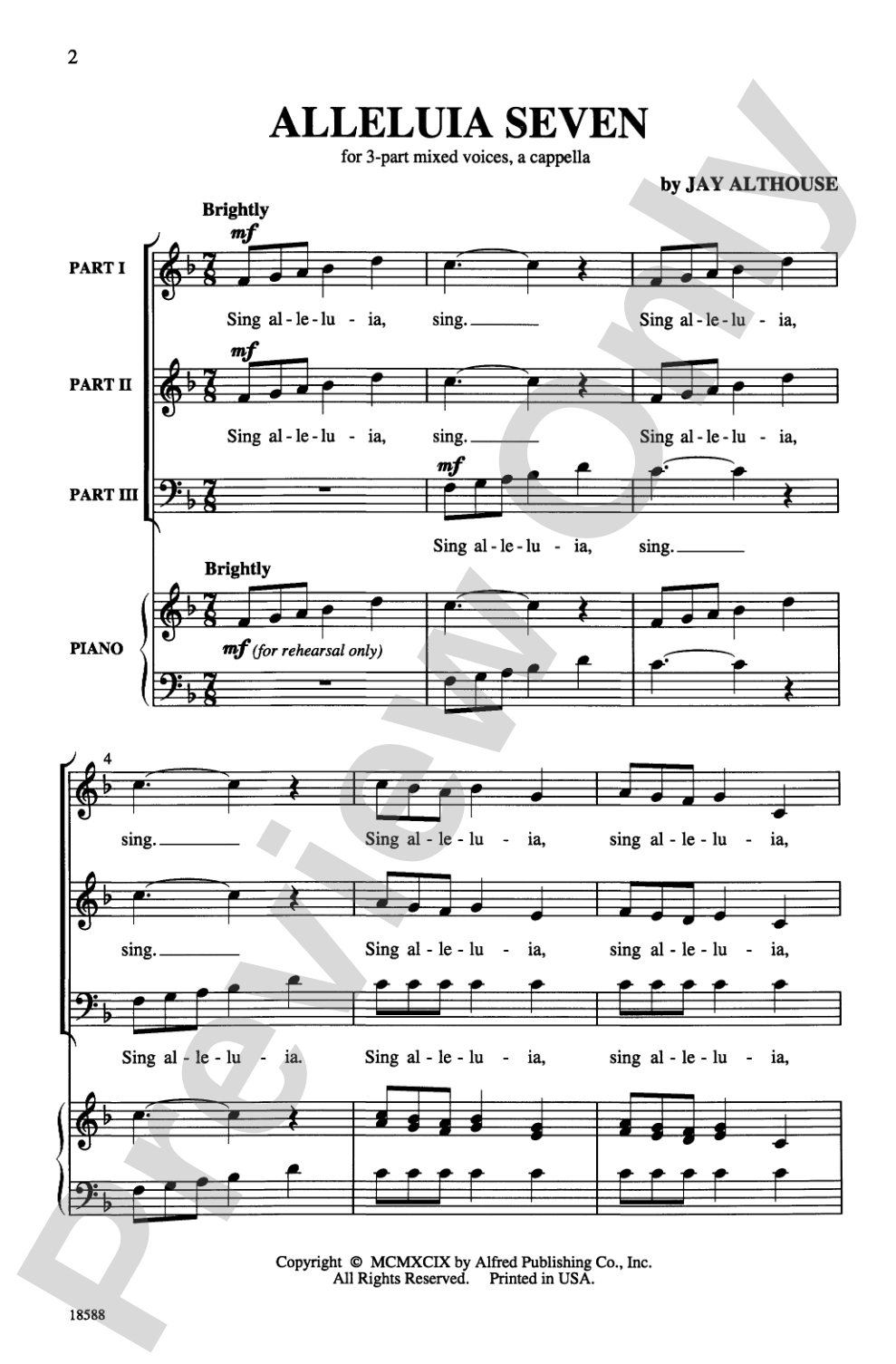
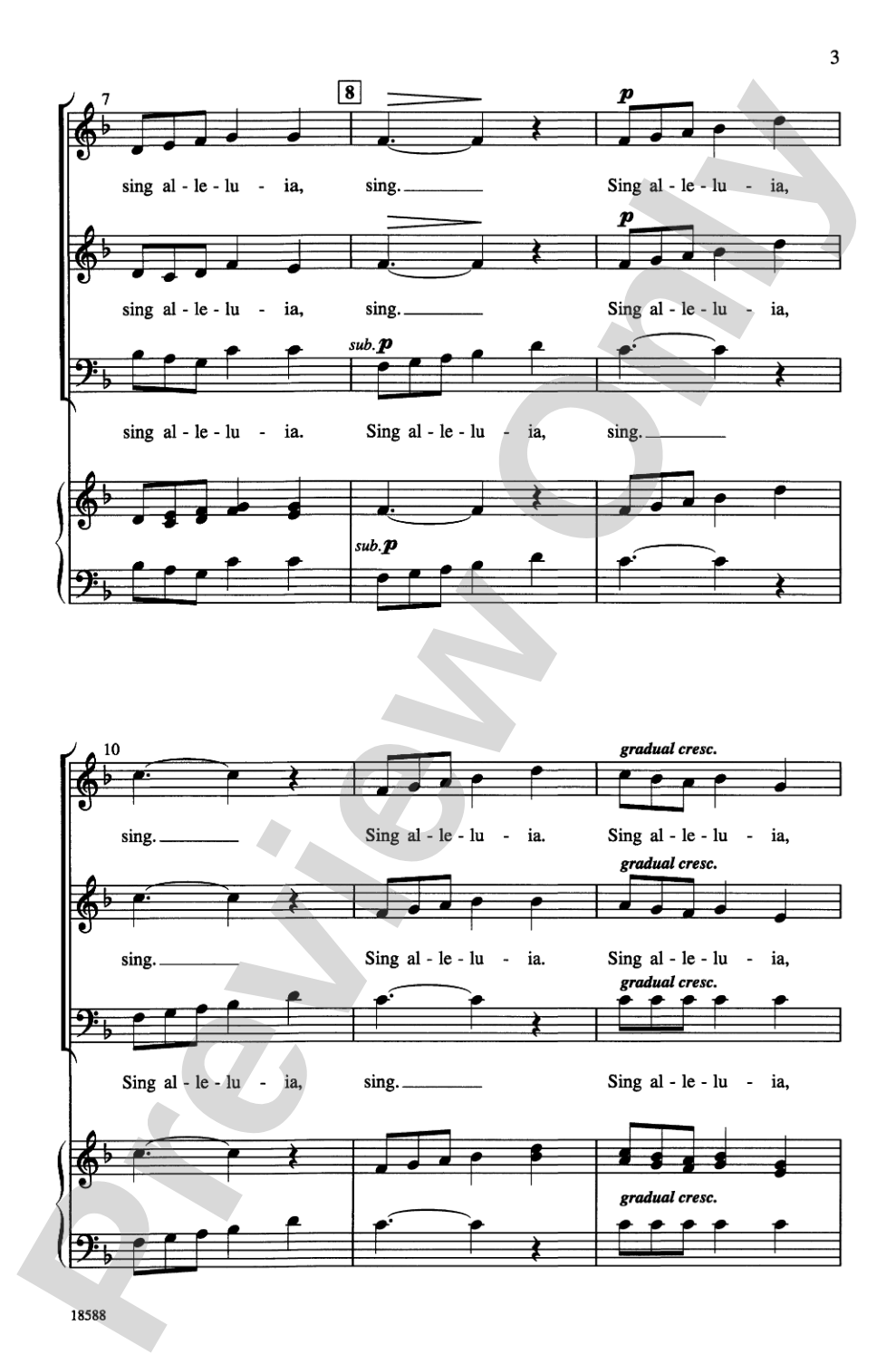
Much repetition and a catchy makes this 7/8 number deceptively easy to learn. Opens with eight measures in 7/8, then a smooth, homophonic andante section in 4/4, followed by a repeat of the opening 7/8 section. Great for competitions and festivals.


Alleluia Seven: 3-Part Mixed, a cappella Choral Octavo isn't in MakeMusic Cloud just yet...but it could be. Let us know you'd like to see it, and you'll help shape what comes next. In the meantime, start a free trial and dive into thousands of interactive titles your students can play along with today.
Request This Title
Tell us you want it.
Start Your Free Trial
Explore everything that's ready to play right now.
Sample Audio
1
Audio File
--:--
0:00
0:00
Sample Video
No sample videos found.
Additional Details
Series:
Alfred Archive Edition: Alfred Choral Designs
Publisher:
Alfred Music
Page Count:
8
SKU:
00-PO-0004061
More about this title
About the Composer: Jay Althouse

Jay Althouse holds degrees in Music Education and Music from Indiana University of Pennsylvania, where he was honored with the Distinguished Alumni Award. Early in his career, he worked for eight years as a rights and licenses administrator at a major educational music publisher and served on the Executive Board of the Music Publishers Association of America.
As a composer, Althouse has more than 800 choral works in print, performed widely across English-speaking countries. He is a writer member of ASCAP and a regular recipient of the ASCAP Special Award. Beyond composition, he has co-authored children's musicals with Sally K. Albrecht, compiled vocal solo collections including Folk Songs for Solo Singers, and co-written instructional books such as The Complete Choral Warm-up Book and Accent on Composers. His educational publications for the classroom include Ready to Read Music, Sixty Music Quizzes, and One-Page Composer Bios. Althouse served on the board of the North Carolina Master Chorale and currently serves on the National Advisory Board of the Folk Art Society of America.
Why we love this
The 7/8 meter opening has real rhythmic bite without requiring extensive rehearsal time on unfamiliar territory. Althouse's structural intelligence shines here: the contrast between the syncopated opening section and the grounded 4/4 andante gives your choir something genuinely musical to sink their teeth into, and the return to 7/8 lands with satisfying weight rather than confusion.
What to expect
Energetic and luminous. The opening pulse of 7/8 propels forward with a catchy, almost hypnotic quality, while the andante section offers a moment of serene homophonic warmth before the cycle restarts. The overall arc feels both contemporary and grounded in sacred tradition.
Who it's for
Mixed choirs at the high school and community levels who are comfortable with accessible modern sacred repertoire and want a piece that sounds far more sophisticated than the rehearsal time required. This works equally well for intermediate ensembles looking to build confidence with mixed meters and for advanced groups seeking a festival selection with quick payoff.
How to get the most out of it
- Lock the 7/8 pulse early by conducting it as 3+4 or 4+3; choose whichever subdivision your singers feel most naturally and stay consistent through both occurrences.
- Shape the andante section with real lyrical breath, since it's your moment to let the homophonic texture sing without the rhythmic complexity of the opening.
- Emphasize the catchy repeated figures in the 7/8 sections through clear articulation and dynamic intention; repetition builds power only when it's committed, not mechanical.
How to use it
This pairs beautifully in a concert that mixes meters and styles; program it alongside more traditional sacred work to showcase your choir's rhythmic sophistication. It's also ideal festival material: compact enough to prepare in a reasonable rehearsal window and striking enough to earn judges' attention.
Skills your students will build
- Reading and performing in 7/8 meter with confidence
- Shifting between mixed meter (7/8) and standard 4/4 time without losing pulse
- Sustaining rhythm in a cappella contexts through clear articulation and ensemble listening
- Shaping homophonic phrases with dynamic control and phrase direction