

Alleluia (On a Theme by William Billings): SAB, a cappella Choral Octavo
Music by William Billings / arr. Russell Robinson
Item: 00-PO-0002776
$2.25
Minimum order quantity: 20 copies
Pickup currently not available
Description
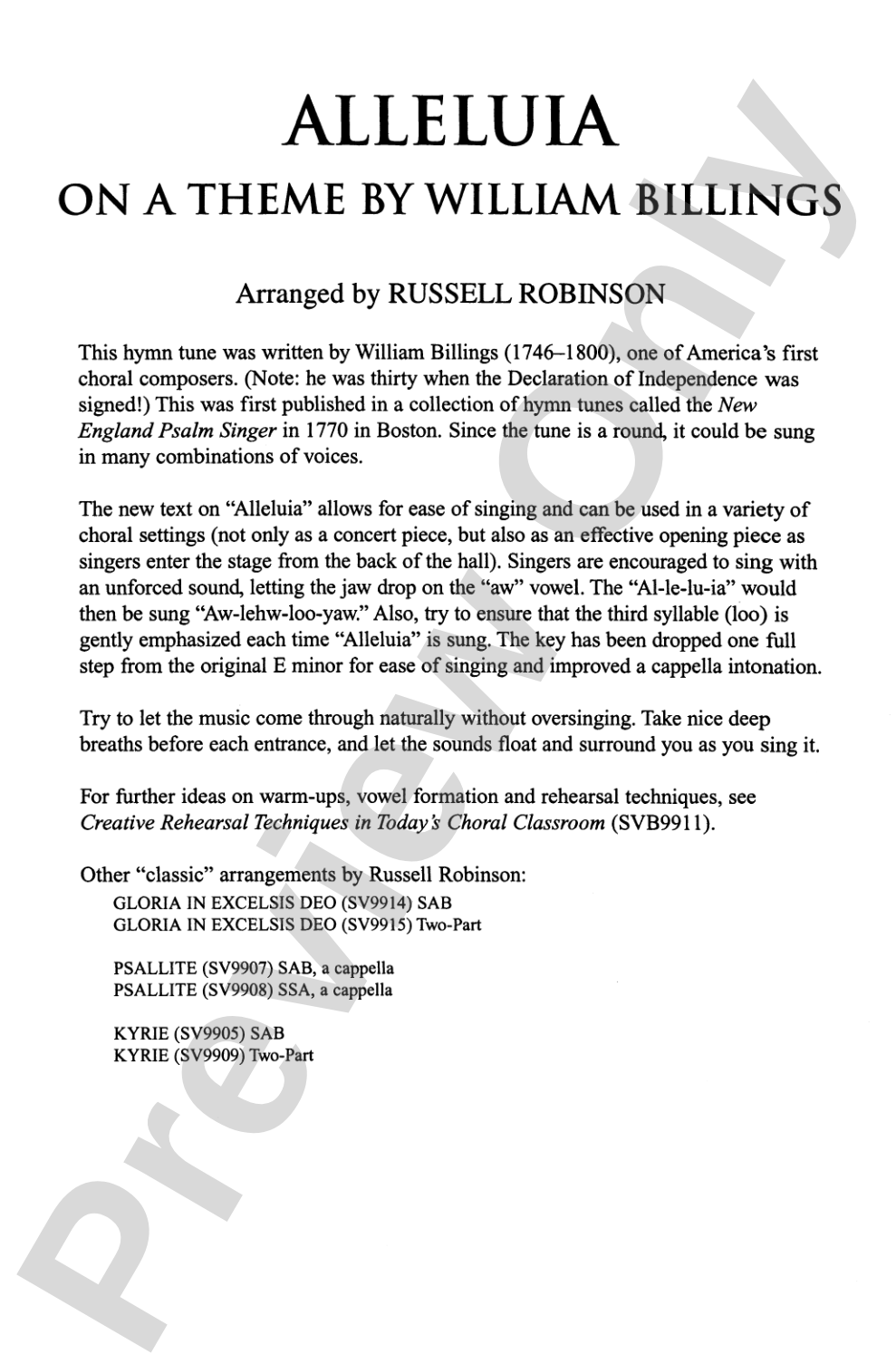
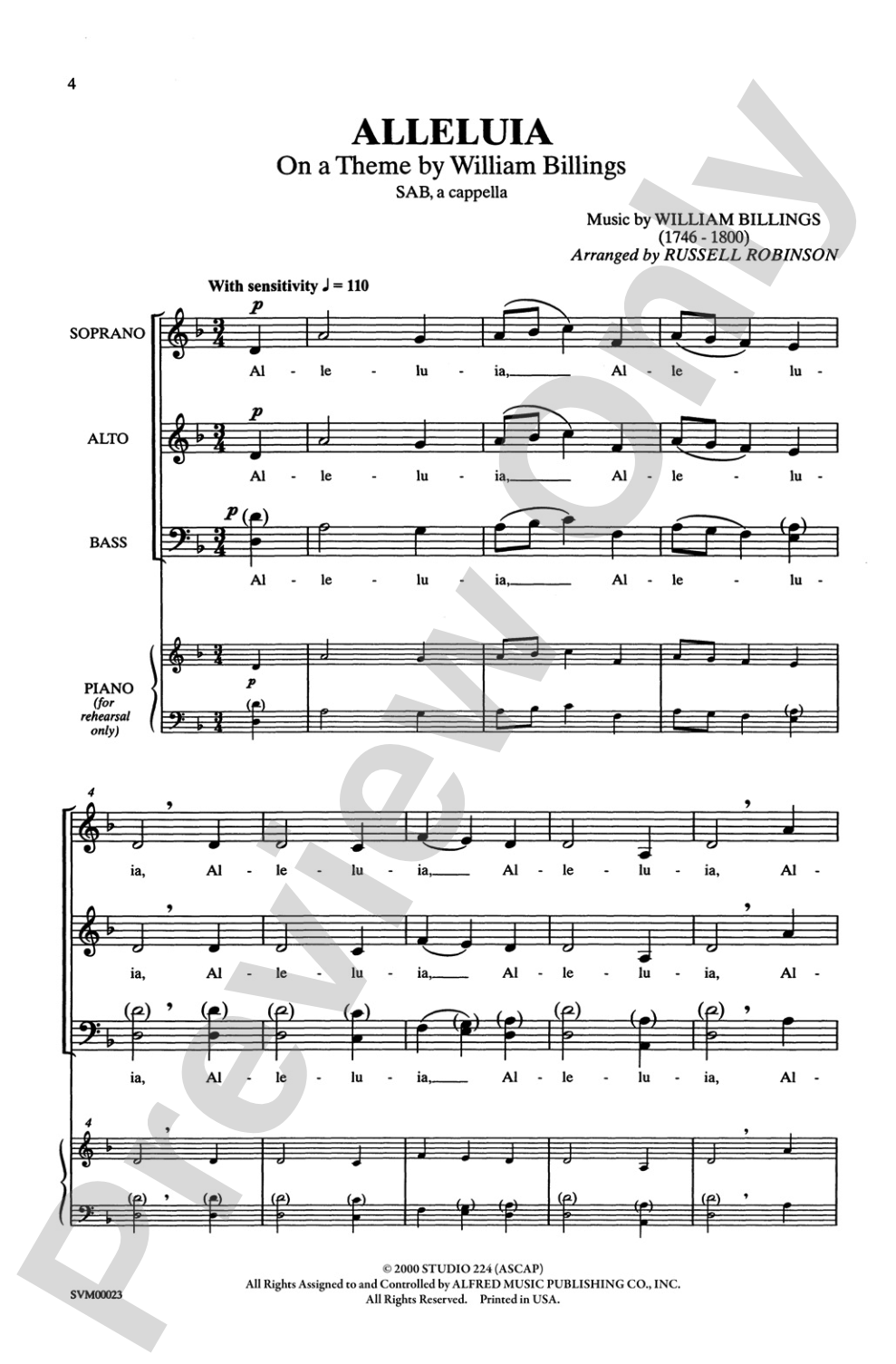
Russ Robinson has taken Billings' popular canon, "When Jesus Wept," and added an "Alleluia" text, making this Lenten work suitable any time during the church year. With its three available voicings, this work is perfect for any small ensemble and is a good introduction for younger voices to the early American composer.


Alleluia (On a Theme by William Billings): SAB, a cappella Choral Octavo isn't in MakeMusic Cloud just yet...but it could be. Let us know you'd like to see it, and you'll help shape what comes next. In the meantime, start a free trial and dive into thousands of interactive titles your students can play along with today.
Request This Title
Tell us you want it.
Start Your Free Trial
Explore everything that's ready to play right now.
Sample Audio
No sample audio found.
Sample Video
No sample videos found.
Additional Details
Series:
Alfred Archive Edition: Studio PR Catalog
Publisher:
Alfred Music
Page Count:
12
SKU:
00-PO-0002776
More about this title
About the Composer: William Billings
William Billings (1746-1800) was the first major American-born composer and a central figure in early American sacred music. A Boston tannery worker with no formal training, he taught himself music theory and composition, eventually leading singing schools and publishing tunebooks that shaped congregational singing across New England. His works, including the beloved canon "When Jesus Wept," combined practical accessibility with genuine harmonic invention, making them foundational to American choral tradition.
Billings' music remains essential in music education because it demonstrates how powerful compositional ideas need not depend on European conservatory training. His straightforward melodies, surprising harmonic progressions, and direct emotional expression continue to engage singers of all ages, and his prolific output provides teachers with authentic early American repertoire that students can actually learn and perform with joy.
Why we love this
Russ Robinson's arrangement breathes new life into Billings' canonical melody by adding "Alleluia" text, transforming a beloved secular work into something that fits the liturgical calendar without losing the original's character. The three available voicings mean you can use this same piece with multiple choir levels or rotate between versions as your singers' abilities grow. For directors seeking accessible early American repertoire that actually engages young singers, this is a natural choice.
What to expect
The piece carries a quiet reverence that builds without drama. Billings' simple harmonic language creates moments of unexpected richness, and the addition of "Alleluia" gives the music a gentle affirmation that feels earned rather than imposed. There's a sense of discovery when singers first hear how their individual lines weave together.
Who it's for
This arrangement serves small to mid-sized choirs, younger singers exploring part-singing, and ensembles seeking authentic early American sacred music. It works equally well in school choirs, church programs, and festival contexts where accessibility and historical substance matter equally.
How to get the most out of it
- Encourage singers to feel the natural phrase arcs in the melody rather than mechanically dividing at bar lines; Billings' periods often span across the visual measures.
- Balance the three parts carefully in rehearsal by running them independently first, then in pairs, so each voice hears its relationship to the others before singing full harmony.
- Let the text "Alleluia" shape the dynamic contour; this word often works best when singers treat it as a natural musical climax rather than holding it at one volume throughout.
- Since this is a cappella, spend time establishing a stable tonal center before performance; vocalize on a single pitch as a group for several measures before the entrance to anchor everyone's intonation.
How to use it
This fits naturally into Lenten services or concerts but works equally well in spring programs featuring American composers or historical choral literature. Pair it with other three-part works to showcase your choir's flexibility, or use it as a bridge between simple unison pieces and more complex four-part harmony.
Skills your students will build
- Reading three-part mixed voicing (SAB)
- Maintaining independent melodic lines in a cappella singing
- Understanding early American harmonic language and modal inflections
- Intonation control without instrumental support
- Phrase shaping in sacred music contexts